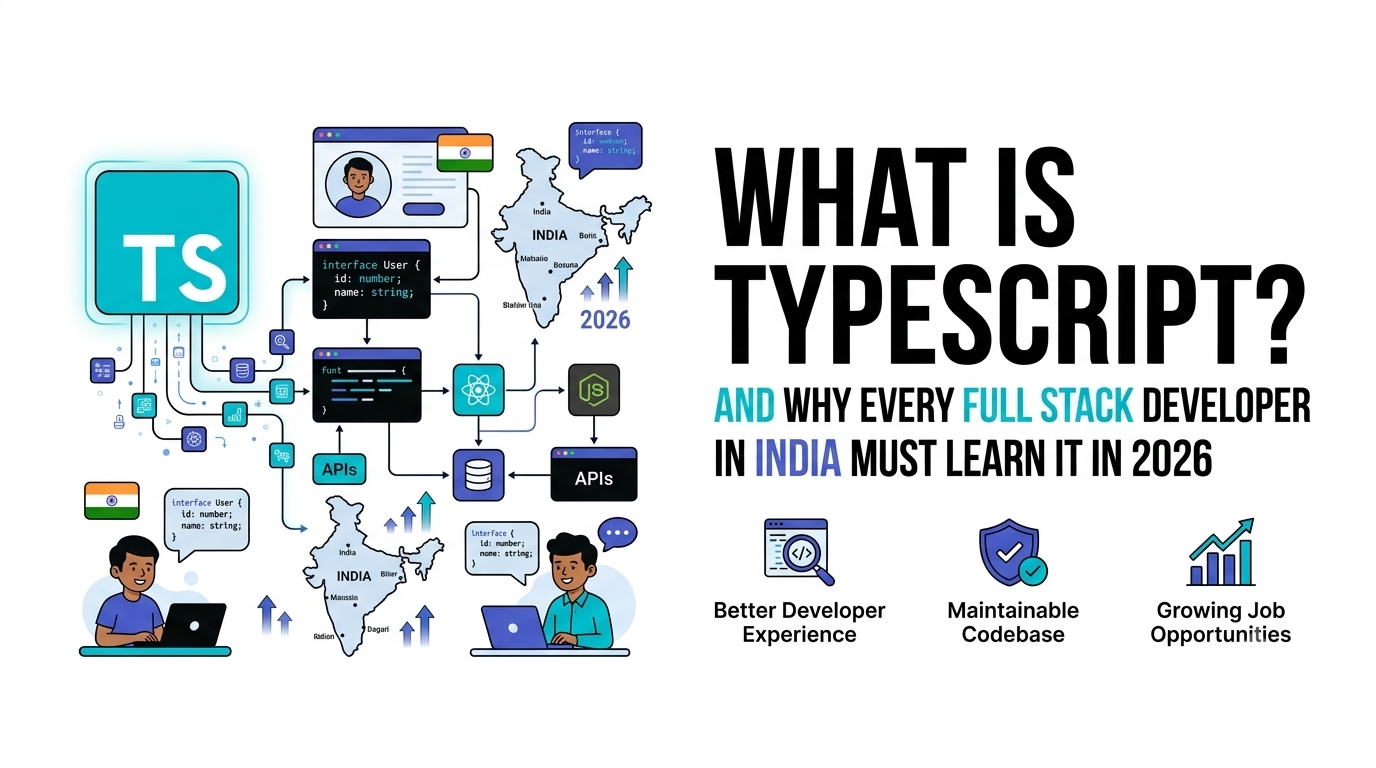
Picture this. You push your code on a Friday evening, everything looks fine, and then your phone buzzes at 11 PM. The production app crashed because a function expected a number and received a string. One tiny mistake, one ruined weekend.
If you've written JavaScript for more than a few weeks, you've probably lived some version of this story. That's exactly the problem TypeScript solves. And in 2026, it has moved from "nice to have" to "please list it on your resume." In this guide, we'll explain what TypeScript actually is, why it matters so much in the Indian job market, and how you can start learning it without feeling overwhelmed.
What Exactly Is TypeScript?
TypeScript is a programming language that Microsoft released in 2012, created by Anders Hejlsberg, the same engineer behind C#. Simply put, TypeScript is JavaScript with types. It's a superset of JavaScript, which means every valid JavaScript file already works as TypeScript. You just get extra powers on top.
Those extra powers come from static typing. You tell TypeScript what kind of data a variable, function, or object should hold, and it checks your code before it ever runs. Then, the TypeScript compiler converts your code into regular JavaScript that browsers and Node.js understand.
Here's a quick example:
typescript
function getTotal(price: number, quantity: number): number { return price * quantity;}getTotal("500", 2); // Error caught instantly in your editor
In plain JavaScript, that mistake slips through silently. In TypeScript, your editor underlines it in red before you even save the file.
How Is TypeScript Different From JavaScript?
JavaScript is dynamically typed, so it figures out data types while the program runs. That flexibility feels great on small scripts, but it becomes risky in large applications with many developers. TypeScript, on the other hand, catches type errors at compile time. As a result, you find bugs on your laptop instead of your users finding them in production.
Why Has TypeScript Become So Popular in 2026?
TypeScript didn't just grow. It took over. According to GitHub's Octoverse 2025 report, TypeScript became the most used language on the platform, overtaking both JavaScript and Python by contributor count. That shift tells you where the industry is heading.
Meanwhile, the ecosystem has fully embraced it. Angular uses TypeScript by default, Next.js creates TypeScript projects out of the box, and Vue 3 is written in TypeScript itself. Backend tools like NestJS, Prisma, tRPC, and Zod are designed around type safety. Even runtimes have caught up: Deno and Bun run TypeScript directly, and recent Node.js versions can now execute TypeScript files natively by stripping the types.
Is TypeScript Getting Faster Too?
Yes, and dramatically so. Microsoft is rewriting the TypeScript compiler in Go under a project codenamed Corsa, which promises roughly ten times faster build and type-checking speeds. For developers working on huge codebases, that means less waiting and more building.
Why Is TypeScript for Full Stack Developers Such a Big Deal?
Here's where things get really interesting. With TypeScript, you can use one language, with one type system, across your entire application. Your React frontend, your Node.js or NestJS backend, and your database layer with Prisma can all share the same type definitions.
So when your backend changes a field from userName to fullName, your frontend code immediately flags every place that breaks. No more guessing, no more hunting through files, no more silent bugs between the client and the server. That end-to-end type safety is the single biggest reason teams now choose TypeScript for full stack developers over plain JavaScript.
Better Autocomplete, Better Productivity
TypeScript also supercharges your code editor. In VS Code or Cursor, you get accurate autocomplete, instant documentation, and safe refactoring across hundreds of files. Consequently, you spend less time reading old code and more time shipping new features.
It Makes AI Coding Tools Smarter
In 2026, almost every developer works alongside AI assistants like Claude, ChatGPT, and GitHub Copilot. Interestingly, these tools produce far more accurate code when they have types to work with. Types act as clear instructions, so the AI understands what your functions expect and return. In addition, TypeScript catches the occasional mistake that AI-generated code introduces, which makes it a safety net for modern workflows.
Why Must Every Full Stack Developer in India Learn TypeScript in 2026?
India's tech industry has changed quickly. Product startups in Bengaluru, Hyderabad, and Pune, SaaS companies building for global customers, and IT service firms working on international projects all want developers who can write maintainable, scalable code. More and more of these job descriptions now list TypeScript as a core requirement rather than a bonus.
TypeScript Opens Better Job Opportunities
Open any job portal and search for React, Next.js, or Node.js roles. You'll notice a pattern: a large share of mid-level and senior listings mention TypeScript. Therefore, if you only know JavaScript, you're quietly filtering yourself out of many of the better-paying positions. Learning TypeScript for full stack developers roles puts you on the right side of that filter.
Remote and International Work Demands It
Many Indian developers now work remotely for companies in the US, Europe, and the Middle East. These teams usually run large, typed codebases, and they expect new hires to contribute from week one. Knowing TypeScript signals that you can handle production-grade code, which gives you a real edge in global hiring.
Kerala's Tech Scene Is Growing Too
It's not only the big metros. Tech parks like Technopark in Thiruvananthapuram, Infopark in Kochi, and Cyberpark in Kozhikode keep adding product and services companies. As these teams modernize their stacks, TypeScript for full stack developers becomes just as important in Kerala as it is in Bengaluru.
Is TypeScript Hard to Learn for Beginners?
Honestly, not at all, especially if you already know some JavaScript. Since TypeScript builds on JavaScript, you don't start from zero. You start with what you know and gradually add types.
Most beginners can learn the basics in two to three weeks. Start with simple types like string, number, and boolean. Next, move on to interfaces and type aliases for describing objects. After that, explore union types, generics, and utility types like Partial and Pick. Finally, turn on strict mode and practice in a real project.
What Should You Learn Before TypeScript?
You'll get the most out of TypeScript if you're comfortable with JavaScript fundamentals first: variables, functions, arrays, objects, promises, and async/await. Once those feel natural, TypeScript will feel like a helpful upgrade rather than a new language.
What Does a Full Stack TypeScript Roadmap Look Like in 2026?
A practical path looks something like this. First, master modern JavaScript and basic TypeScript. Then, build frontends with React and Next.js using TypeScript from day one. After that, create APIs with Node.js, Express, or NestJS, and connect them to PostgreSQL or MongoDB through Prisma. Finally, deploy your projects on Vercel or a cloud platform and add them to your GitHub portfolio.
The key is building real projects. A typed e-commerce store, a booking app, or an AI chat tool will teach you more than any number of tutorials. Moreover, recruiters love seeing TypeScript for full stack developers skills proven through live, deployed work.
Where Can You Learn Full Stack Development With TypeScript in Kerala?
If you prefer structured learning over piecing together random YouTube videos, Milaaj Digital Academy in Kozhikode offers a practical way forward. Our Full Stack Development course covers React, Next.js, Python, AI integration, and DevOps, all taught by active industry practitioners.
Affordable fees: Every student who passes our free 10-minute aptitude test earns a 50% merit scholarship, so cost doesn't stand between you and a tech career. You can take the aptitude test here.
Faster learning: Our intensive 3 to 6-month programs skip recycled theory and focus on the tools companies actually use in 2026, so you become job-ready sooner.
Real convenience: The modular course lets you pick only the blocks you need, which suits students, freshers, and working professionals alike.
Quality curriculum: With small cohorts of 30 seats, AI-integrated workflows from day one, portfolio reviews, and placement support, you learn the right way and get noticed by hiring partners.
Frequently Asked Questions
What is TypeScript in simple words?
TypeScript is JavaScript with added types. It lets you describe what kind of data your code uses, then catches mistakes before the code runs. In the end, it compiles into regular JavaScript.
Should I learn JavaScript or TypeScript first?
Learn JavaScript basics first. Once you understand functions, objects, and async code, move to TypeScript. The transition is smooth because TypeScript builds directly on JavaScript.
Is TypeScript required for full stack jobs in India?
It isn't mandatory for every role, but many modern React, Next.js, and Node.js jobs now list it as a requirement. Learning TypeScript for full stack developers positions significantly widens your options.
Does TypeScript make websites slower?
No. TypeScript compiles to plain JavaScript, so your users run the same fast code. The type checking only happens during development.
Can I use TypeScript with React and Node.js?
Absolutely. React, Next.js, Node.js, Express, and NestJS all offer excellent TypeScript support, which makes a fully typed full stack application easy to build.
How long does it take to learn TypeScript?
If you know JavaScript, you can learn the essentials in two to four weeks. Mastering advanced features like generics takes a few months of real project work.
Final Thoughts: Is It Time to Make the Switch?
TypeScript isn't a passing trend. It's the new standard for serious web development, powering everything from startup MVPs to massive enterprise apps. It catches bugs early, makes your editor smarter, works beautifully with AI tools, and opens doors to better jobs across India and abroad.
So if you're serious about your career, start today. Convert one small JavaScript project to TypeScript this week and feel the difference yourself. Once you experience the confidence that types give you, you'll understand why TypeScript for full stack developers has become the skill nobody can afford to skip in 2026.