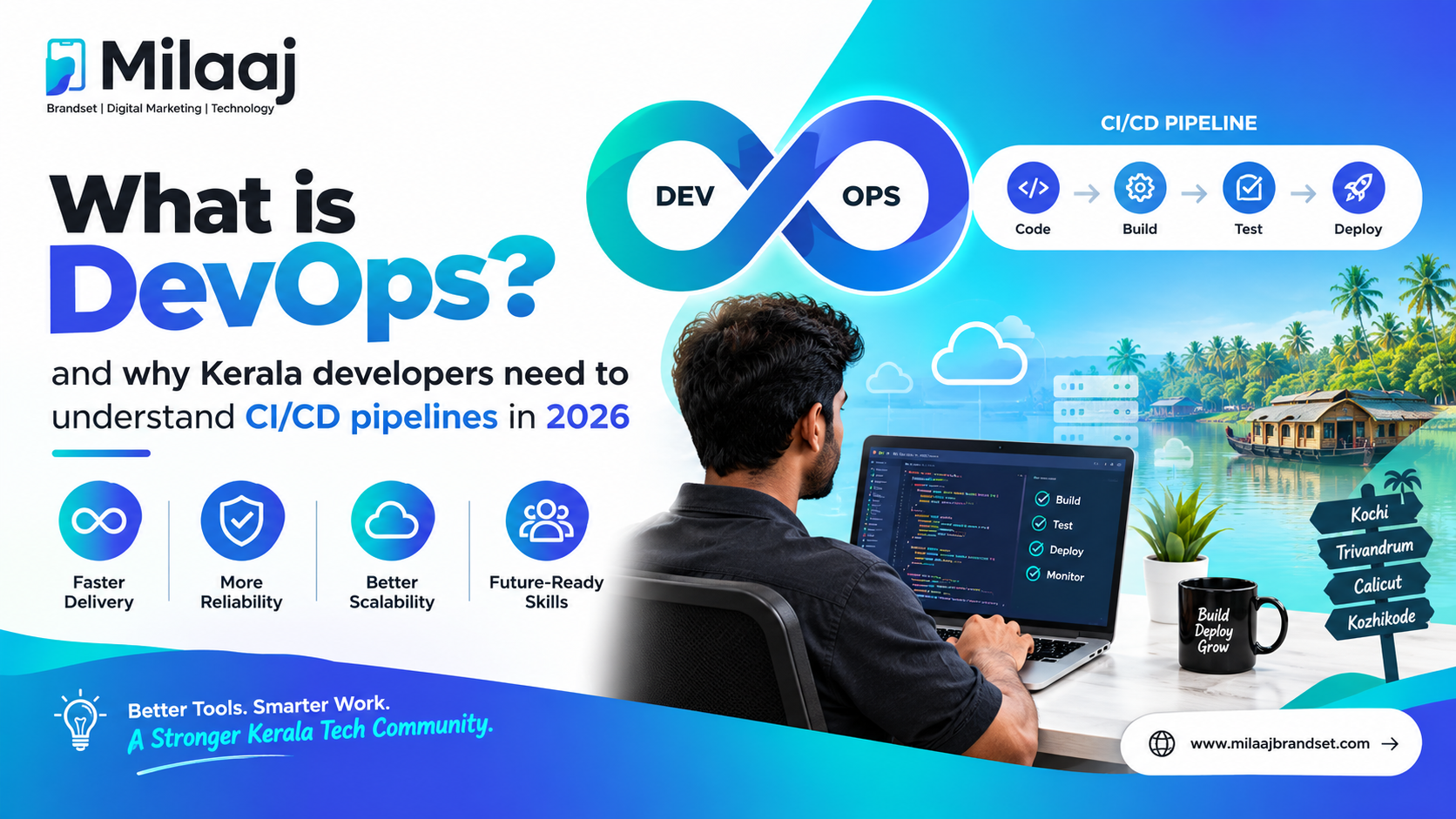
If you've been applying for developer roles lately and noticed "DevOps experience preferred" showing up in almost every listing, you're definitely not imagining it. This shift is real, and it's happening fast across Kerala's growing tech scene. So, let's break down exactly what is DevOps and why Kerala developers need to understand CI/CD pipelines in 2026, in a way that actually makes sense, even if you've never touched these tools before.
What Is DevOps, Really?
DevOps is a combination of practices, culture, and tools that bring development and operations teams together, rather than keeping them as separate, disconnected departments. Traditionally, developers wrote code and then "threw it over the wall" to operations teams, who handled deployment, infrastructure, and maintenance separately. However, this often led to miscommunication, delays, and bugs slipping through the cracks between teams.
DevOps changes this by encouraging collaboration throughout the entire software lifecycle, from writing code to deploying it live and monitoring its performance. Consequently, teams ship software faster, with fewer errors, and respond to issues far more quickly than traditional, siloed workflows ever allowed.
Breaking Down CI/CD: The Backbone of DevOps
What Does CI/CD Actually Mean?
CI/CD stands for Continuous Integration and Continuous Deployment (sometimes Continuous Delivery). Together, these practices automate how code moves from a developer's machine all the way into production, without requiring manual, error-prone steps along the way.
Continuous Integration Explained
Continuous Integration means developers frequently merge their code changes into a shared repository, often multiple times a day. Each time code is merged, automated tests run immediately to catch bugs early, rather than discovering problems weeks later during a massive, stressful release.
Continuous Deployment Explained
Continuous Deployment takes this a step further by automatically pushing tested, approved code changes directly into production. Therefore, instead of manually deploying updates during scheduled release windows, your application updates smoothly and consistently, often multiple times a day.
Why DevOps and CI/CD Matter So Much in 2026
Software Delivery Has Become Faster and More Competitive
Companies today can't afford slow, infrequent releases anymore. Since users expect constant improvements and quick bug fixes, businesses that rely on manual deployment processes simply fall behind competitors who've embraced automation.
Reduced Human Error
Manual deployments are genuinely risky, since a single missed step can break an entire application. CI/CD pipelines automate repetitive, error-prone tasks, significantly reducing the chances of costly mistakes during releases.
Faster Bug Detection and Resolution
Since automated testing runs with every code change, bugs get caught almost immediately, rather than accumulating unnoticed until a major release. Consequently, this saves development teams enormous amounts of time and stress.
Better Collaboration Between Teams
DevOps practices naturally encourage closer collaboration between developers, testers, and operations staff. Therefore, teams working within a DevOps culture typically communicate more effectively and resolve issues faster than traditionally siloed teams.
Why This Matters Specifically for Kerala Developers
Kerala's IT industry, particularly around Kochi, Thiruvananthapuram, and Kozhikode, has grown significantly, with more startups, IT parks, and remote-first companies hiring full stack and backend developers. Meanwhile, international clients working with Kerala-based agencies and freelancers increasingly expect modern development practices, including CI/CD pipelines, as a baseline requirement rather than a bonus skill.
Therefore, developers who understand DevOps concepts genuinely stand out during interviews and freelance negotiations, since this knowledge signals that you can contribute to modern, professional development workflows rather than just writing isolated code.
Core DevOps Tools You Should Know in 2026
Version Control: Git and GitHub
Before anything else, understanding Git and platforms like GitHub forms the foundation of any CI/CD workflow, since code changes need to be tracked, merged, and managed systematically.
CI/CD Platforms: GitHub Actions, Jenkins, and GitLab CI
These platforms automate the testing and deployment process. GitHub Actions has become particularly popular due to its tight integration with GitHub repositories, making it a great starting point for beginners.
Containerization: Docker
Docker allows developers to package applications along with all their dependencies into portable containers, ensuring consistent behavior across different environments, from a developer's laptop to production servers.
Orchestration: Kubernetes
For larger applications running multiple containers, Kubernetes helps manage, scale, and maintain these containers automatically, though this is typically a more advanced skill learned after mastering Docker basics.
Infrastructure as Code: Terraform
Rather than manually configuring servers, Infrastructure as Code tools like Terraform let developers define infrastructure through code, making environments easier to replicate and manage consistently.
How a Basic CI/CD Pipeline Actually Works
- Developer pushes code to a shared repository, like GitHub.
- Automated tests run immediately to check for bugs or broken functionality.
- If tests pass, the build process begins, compiling and packaging the application.
- The application deploys automatically to a staging or production environment.
- Monitoring tools track performance after deployment, alerting teams to any issues.
Therefore, this entire process happens automatically, often within minutes, compared to traditional manual deployments that could take hours or even days.
How to Start Learning DevOps as a Developer
Step 1: Strengthen Your Git Fundamentals
Since version control forms the foundation of every CI/CD pipeline, make sure you're genuinely comfortable with branching, merging, and resolving conflicts in Git before moving forward.
Step 2: Set Up a Simple CI/CD Pipeline
Start small. Create a basic project, push it to GitHub, and set up GitHub Actions to automatically run tests whenever you push new code. This hands-on practice builds real understanding far faster than theory alone.
Step 3: Learn Docker Basics
Next, practice containerizing a simple application using Docker. Understanding how containers work genuinely clarifies why consistency across environments matters so much in professional development.
Step 4: Explore Cloud Deployment
Platforms like AWS, Google Cloud, or Azure offer free tiers perfect for practicing real-world deployment scenarios without financial risk.
Step 5: Build a Complete Project With CI/CD Integrated
Finally, combine everything by building a small full stack project with an automated pipeline handling testing and deployment from start to finish.
Common Mistakes Beginners Make With DevOps
- Jumping straight into Kubernetes without understanding Docker fundamentals first.
- Ignoring automated testing, which defeats the entire purpose of CI/CD pipelines.
- Overcomplicating early projects instead of starting with simple, manageable pipelines.
- Skipping monitoring and logging, which are essential for catching issues after deployment.
- Not practicing hands-on, since DevOps concepts genuinely click faster through actual implementation rather than passive reading.
Why This Skill Set Boosts Your Career in Kerala's Tech Market
As more companies across Kerala adopt cloud-based, automated development workflows, developers who understand DevOps and CI/CD naturally become more valuable during hiring and freelance negotiations. Moreover, agencies and startups increasingly prioritize candidates who can contribute to the entire development lifecycle, not just write isolated code, making this genuinely one of the smartest skills to invest in right now.
If you're serious about building production-ready applications and understanding how real development teams operate, exploring a structured full stack development course can help you connect these DevOps concepts to actual, deployable projects rather than isolated tutorials.
Additionally, since faster, more reliable deployments directly affect site performance and user experience, understanding how backend practices tie into SEO and site performance gives you a broader perspective on how technical decisions impact real business outcomes.
Final Thoughts
At the end of the day, understanding what is DevOps and why Kerala developers need to understand CI/CD pipelines in 2026 isn't just about keeping up with industry trends, it's about becoming a genuinely more valuable, employable developer. Whether you're a student, freelancer, or experienced developer looking to expand your skill set, learning how automated pipelines work gives you a practical, future-proof advantage in Kerala's rapidly growing tech landscape.
Frequently Asked Questions (FAQs)
1. Do I need to be a senior developer to learn DevOps?No, many junior and mid-level developers successfully learn DevOps fundamentals alongside their regular development work, especially starting with Git and basic CI/CD pipelines.
2. Is DevOps a separate career path or a skill for all developers?Both. While dedicated DevOps engineer roles exist, understanding these concepts benefits every developer, since modern teams increasingly expect this knowledge as a baseline skill.
3. Which CI/CD tool should beginners start with?GitHub Actions is often recommended for beginners, since it integrates directly with GitHub repositories and requires minimal initial setup.
4. How long does it take to learn DevOps basics?With consistent practice, most developers become comfortable with fundamental DevOps concepts and basic CI/CD pipelines within four to six weeks.
5. Is Kubernetes necessary for beginners learning DevOps?Not immediately. It's generally better to master Docker fundamentals first before moving on to more advanced orchestration tools like Kubernetes.