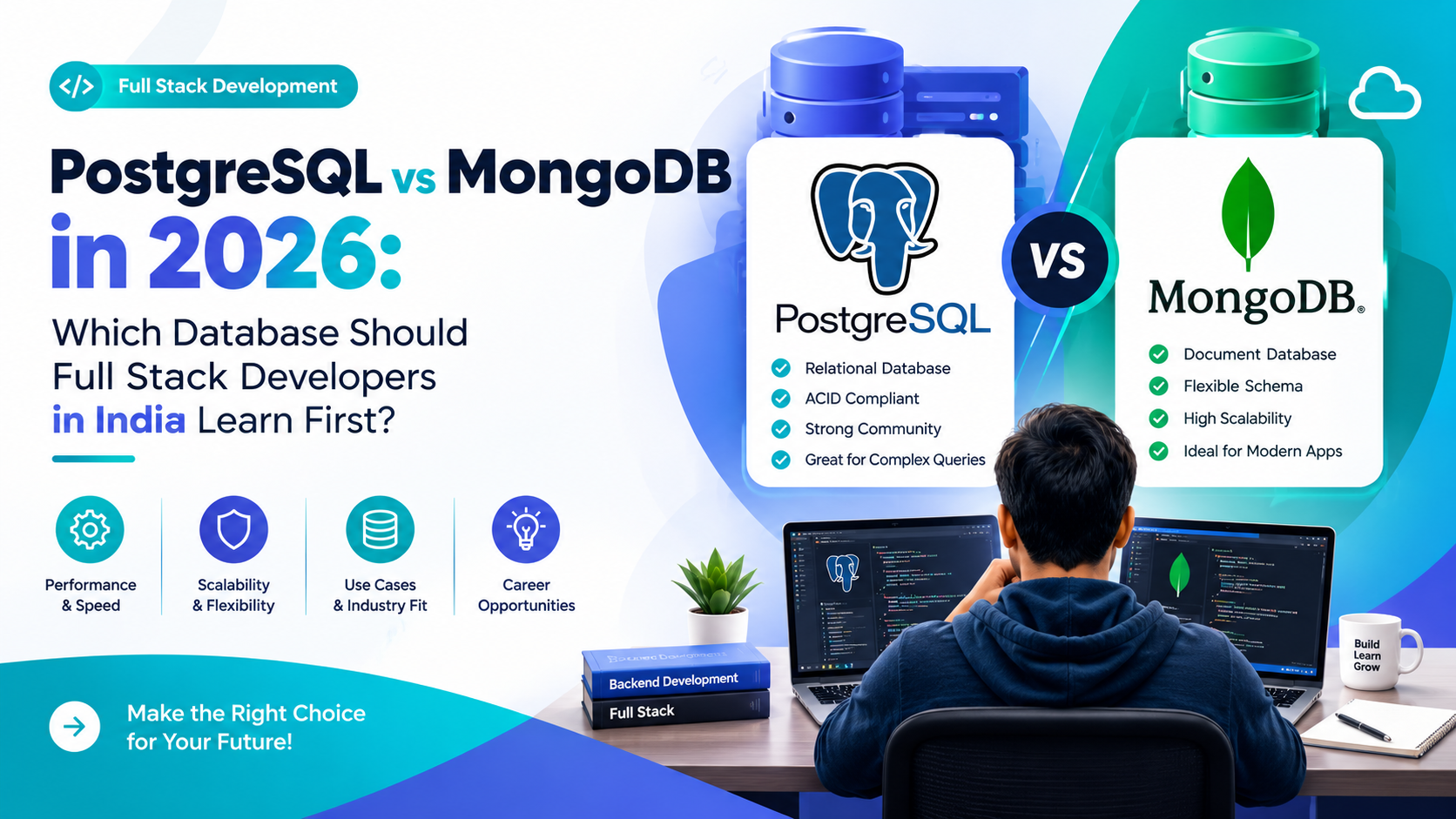
If you've just started learning full stack development, you've probably hit this exact fork in the road already. Every tutorial, course, and YouTube video seems to pick a side, and honestly, the conflicting advice can get overwhelming fast. So, let's settle this properly. In this guide, we'll break down PostgreSQL vs MongoDB in 2026 and which database should full stack developers in India learn first, based on real job market demand, technical differences, and practical learning paths.
Understanding the Core Difference First
Before comparing job prospects or ease of learning, it helps to understand what actually separates these two databases at a fundamental level.
What Is PostgreSQL?
PostgreSQL is a relational database, meaning it organizes data into structured tables with predefined columns and relationships between them. It follows SQL (Structured Query Language) and strictly enforces data consistency through ACID compliance, which ensures your data remains accurate and reliable even during complex transactions.
What Is MongoDB?
MongoDB, on the other hand, is a NoSQL document database. Instead of rigid tables, it stores data as flexible, JSON-like documents. Therefore, you don't need to define a strict schema upfront, which makes MongoDB feel more adaptable during rapid development, especially for applications where data structures evolve frequently.
Why This Decision Matters for Full Stack Developers
Since full stack developers handle both frontend and backend logic, choosing the right database early shapes how comfortably you build, scale, and maintain real-world applications. Moreover, your database choice directly affects how you structure APIs, handle relationships between data, and optimize performance as your application grows. Therefore, this isn't just a backend decision, it influences your entire development workflow.
PostgreSQL vs MongoDB: Key Technical Differences
Data Structure
PostgreSQL requires a defined schema with specific tables, columns, and data types. Consequently, this enforces consistency but requires more upfront planning. MongoDB, however, allows you to store data flexibly without worrying about rigid structure, which speeds up early-stage development significantly.
Relationships Between Data
If your application involves complex relationships, like users, orders, payments, and inventory all connected together, PostgreSQL handles this naturally through foreign keys and joins. MongoDB can handle relationships too, but it often requires embedding or referencing documents manually, which can get messy as complexity grows.
Scalability
MongoDB was built with horizontal scaling in mind, making it easier to distribute data across multiple servers for large-scale applications. PostgreSQL traditionally scales vertically, though modern tools and extensions have significantly improved its horizontal scaling capabilities in recent years.
Transaction Support
Since PostgreSQL strictly enforces ACID compliance, it's genuinely more reliable for applications involving financial transactions, bookings, or anything requiring strict data accuracy. MongoDB has improved transaction support over the years, but PostgreSQL still holds a stronger reputation in this area.
Which Database Should You Learn First as a Beginner?
The Case for Learning PostgreSQL First
Honestly, if you're completely new to databases, learning PostgreSQL first genuinely builds a stronger foundation. Since it forces you to understand relationships, normalization, and structured querying, these concepts transfer well even if you later switch to NoSQL databases. Therefore, many experienced developers recommend starting with relational database fundamentals before jumping into flexible, schema-less systems.
The Case for Learning MongoDB First
On the other hand, if you're building your first full stack project quickly, particularly using the MERN stack (MongoDB, Express, React, Node.js), starting with MongoDB might feel more intuitive. Since JavaScript developers already work with JSON-like objects daily, MongoDB's document structure feels naturally familiar, reducing the initial learning curve.
Job Market Demand in India: PostgreSQL vs MongoDB
This is where things get genuinely interesting for job seekers. Checking current listings on Naukri, LinkedIn, and Indeed India reveals that both databases remain heavily in demand, but for different types of roles.
PostgreSQL Job Demand
PostgreSQL skills are frequently required for enterprise applications, fintech platforms, SaaS products, and any system handling structured, relationship-heavy data. Consequently, companies building banking systems, e-commerce platforms, and large-scale business applications consistently list PostgreSQL as a core requirement.
MongoDB Job Demand
Meanwhile, MongoDB remains extremely popular among startups, particularly those using the MERN or MEAN stack. Since many Indian startups prioritize rapid development and flexible data structures during early growth stages, MongoDB experience is frequently requested for full stack and backend roles at these companies.
Therefore, rather than one being objectively "better" for your career, your ideal choice genuinely depends on whether you're targeting startup environments or more structured, enterprise-level companies.
Real-World Use Cases for Each Database
When PostgreSQL Makes More Sense
- E-commerce platforms with complex inventory and order relationships
- Banking and fintech applications requiring strict data accuracy
- SaaS products with structured, relational business logic
- Applications requiring complex reporting and analytics
When MongoDB Makes More Sense
- Rapid prototyping and MVP development
- Content management systems with flexible data structures
- Real-time applications like chat systems or activity feeds
- Applications handling large volumes of unstructured or semi-structured data
Can You Learn Both? Should You?
Absolutely, and honestly, most experienced full stack developers eventually learn both. Since different projects and companies require different database approaches, understanding both relational and NoSQL systems makes you significantly more versatile and employable. Therefore, rather than viewing this as an either-or decision, think of it as choosing which one to learn first, not which one to learn exclusively.
A Practical Learning Path for 2026
- Start with PostgreSQL fundamentals – Learn tables, relationships, joins, and basic SQL queries.
- Build a small relational project – Create something like a simple inventory or booking system.
- Transition to MongoDB basics – Understand documents, collections, and flexible schema design.
- Build a MongoDB-based project – Try creating a basic blog or social feed application.
- Compare both approaches hands-on – Rebuild the same simple project using both databases to genuinely understand the differences.
This approach genuinely gives you practical, comparative experience rather than theoretical knowledge alone.
Why This Skill Matters for Kerala and India's Growing Tech Market
As more companies across India, including growing tech hubs in Kerala, adopt diverse tech stacks, developers who understand both PostgreSQL and MongoDB naturally stand out during interviews and freelance opportunities. Moreover, agencies and startups increasingly prioritize versatility, making database fluency a genuine competitive advantage rather than just a technical checkbox.
If you're serious about building real, production-ready applications rather than just tutorial projects, exploring a structured full stack development course can help you learn both database approaches properly, alongside how they fit into complete, deployable applications.
Additionally, since database performance directly affects how fast your application loads and ranks, understanding how backend choices influence SEO and site performance gives you a broader perspective on how technical decisions impact real-world business outcomes.
Final Thoughts
At the end of the day, there's no universally "correct" answer to PostgreSQL vs MongoDB in 2026 and which database should full stack developers in India learn first. If you want a strong foundational understanding of data relationships and structured querying, start with PostgreSQL. However, if you're building your first JavaScript-based full stack project and want faster early momentum, MongoDB might feel more natural. Ultimately, the smartest long-term move is learning both, since real-world development rarely sticks to just one approach.
Frequently Asked Questions (FAQs)
1. Is PostgreSQL harder to learn than MongoDB for beginners?Not necessarily harder, just different. PostgreSQL requires understanding structured relationships upfront, while MongoDB feels more flexible initially but can become complex as applications scale.
2. Which database do Indian startups prefer in 2026?Many startups, especially those using the MERN stack, prefer MongoDB for its flexibility and faster development speed during early growth stages.
3. Can I switch from MongoDB to PostgreSQL later in my career?Yes, many developers transition between both databases throughout their careers, since understanding one often makes learning the other easier.
4. Do full stack developers need to know both databases?While not mandatory, knowing both significantly increases your versatility and makes you more attractive to a wider range of employers.
5. Which database is better for large-scale applications?It depends on the use case. PostgreSQL excels with structured, relationship-heavy data, while MongoDB often performs better with large volumes of flexible, unstructured data.