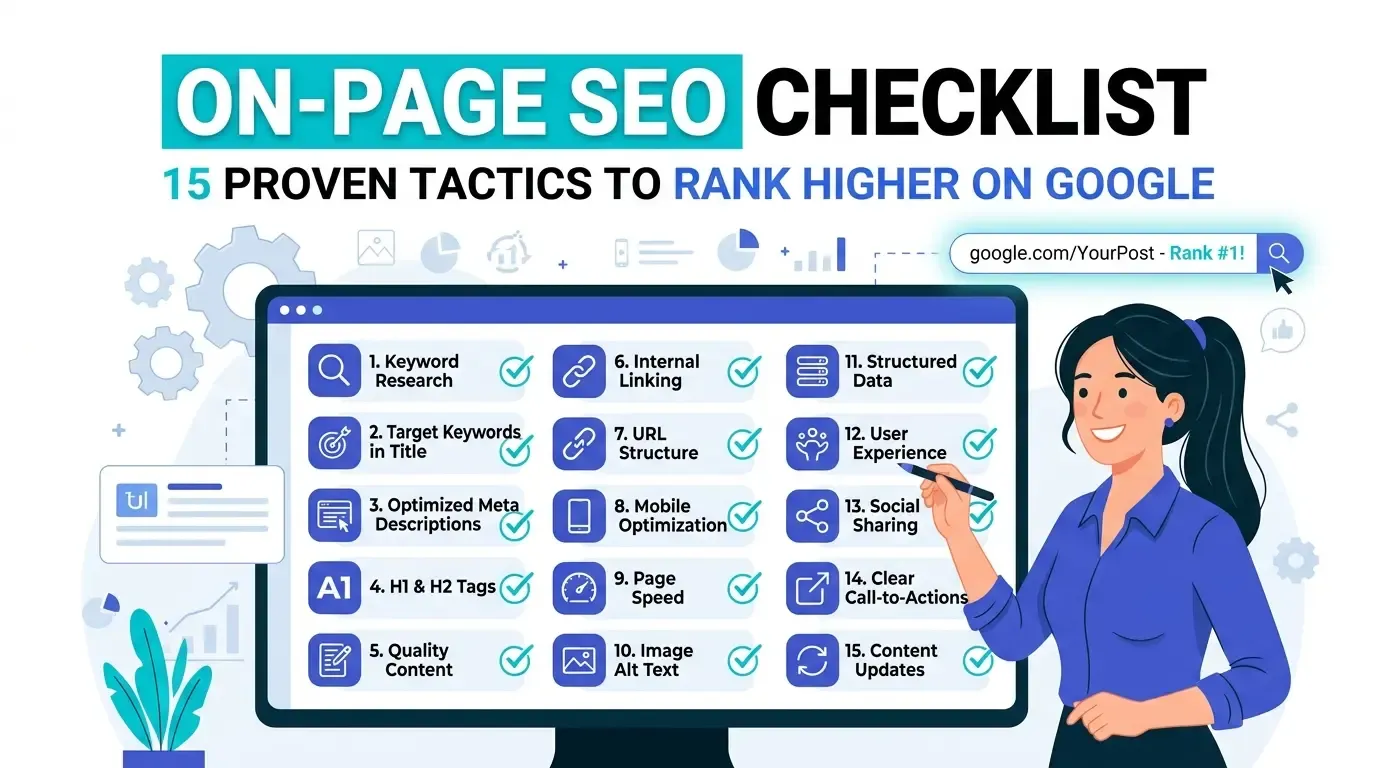
If your website is not ranking on Google, chances are your on-page SEO needs attention.
On-page SEO is one of the few things you can fully control. It is not about tricks or shortcuts. It is about making your content clear, useful, and easy for both users and search engines to understand.
In 2026, with AI-driven search and smarter algorithms, getting on-page SEO right is more important than ever.
This checklist walks you through 15 proven tactics you can apply right away to improve rankings, visibility, and organic traffic.
What is On-Page SEO?
On-page SEO refers to optimizing elements on your website to improve search engine rankings.
This includes:
- content quality and relevance
- keyword usage and placement
- page structure and HTML tags
- user experience and readability
In simple terms, it is about making each page as helpful and optimized as possible.
1. Start with Proper Keyword Research
Every optimized page begins with the right keyword.
Focus on:
- primary keyword (main topic)
- secondary keywords (variations)
- long-tail keywords (specific queries)
Use tools and search suggestions to understand what users are actually searching for.
2. Place Keywords Naturally in Key Areas
Where you place keywords matters just as much as which keywords you choose.
Include your primary keyword in:
- title (H1)
- first 50–100 words
- headings (H2, H3)
- meta description
- URL slug
Keep it natural. Avoid forcing keywords.
3. Write a Compelling SEO Title
Your title is the first thing users see in search results.
A strong title should:
- include the main keyword
- be clear and specific
- create curiosity or value
Example:On-Page SEO Checklist: 15 Proven Tactics to Rank Higher
4. Optimize Meta Descriptions for Clicks
Meta descriptions do not directly affect rankings, but they improve click-through rate.
A good meta description:
- summarizes the page clearly
- includes keywords naturally
- encourages users to click
Think of it as your page’s pitch.
5. Use Proper Heading Structure
Clear structure improves both readability and SEO.
Use:
- one H1 for the main topic
- H2 for sections
- H3 for subpoints
This helps search engines understand your content hierarchy.
6. Improve Content Quality and Depth
Thin content does not rank anymore.
Your content should:
- answer real user questions
- cover the topic in depth
- include examples and explanations
- provide practical value
Search engines prioritize helpful, comprehensive content.
7. Optimize for Search Intent
Matching search intent is critical.
Ask yourself:
- is the user looking to learn?
- compare options?
- take action?
Your content should align with that intent.
8. Use Internal Linking Strategically
Internal links help users navigate your site and improve SEO.
They:
- connect related content
- distribute page authority
- improve crawlability
Use natural anchor text and link to relevant pages.
9. Optimize URL Structure
Keep URLs simple and readable.
Good URL example:yourwebsite.com/on-page-seo-checklist
Avoid:
- long, messy URLs
- unnecessary numbers or symbols
Clean URLs improve both user experience and SEO.
10. Optimize Images and Alt Text
Images improve engagement, but they also need optimization.
Make sure to:
- compress images for faster loading
- use descriptive file names
- add keyword-rich alt text
This also helps with image search visibility.
11. Improve Page Speed
Page speed is a ranking factor.
Slow websites lead to:
- higher bounce rates
- lower user satisfaction
- reduced rankings
Optimize:
- images
- code
- hosting performance
A faster site improves both SEO and user experience.
12. Make Your Website Mobile-Friendly
Most users browse on mobile devices.
Search engines prioritize mobile-first indexing.
Ensure your website:
- adapts to different screen sizes
- loads quickly on mobile
- is easy to navigate
A poor mobile experience can hurt rankings significantly.
13. Add Schema Markup (Structured Data)
Structured data helps search engines understand your content better.
It can also improve your visibility with rich results.
Examples include:
- FAQ schema
- article schema
- review schema
This is especially important for AI-powered search.
14. Improve Readability and Engagement
Good SEO content is easy to read.
Improve readability by:
- using short paragraphs
- breaking content with headings
- using bullet points
- keeping sentences clear and simple
Better readability leads to longer time on page.
15. Keep Content Updated
SEO is not a one-time task.
Search engines prefer fresh and updated content.
You should:
- update outdated information
- refresh keywords
- improve existing sections
Regular updates keep your content competitive.
On-Page SEO in 2026: What Matters Most?
Search engines are becoming smarter with AI and natural language processing.
Technologies like Google RankBrain and BERT focus on:
- understanding context
- interpreting user intent
- ranking helpful content
This means optimization is no longer about keywords alone.
It is about delivering real value.
Final Thoughts
On-page SEO is the foundation of your website’s visibility. When done right, it improves rankings, drives organic traffic, and enhances user experience.
If you want to see how these strategies are applied in real-world learning environments, you can explore how Milaaj Digital Academy approaches practical digital education through its programs.
For those looking to build strong SEO fundamentals step by step, learning through a structured SEO-focused course can help connect concepts with real implementation.
And if you are still building your basics, this guide on what SEO really means can give you a clearer picture of how everything fits together.
FAQs
What is on-page SEO?
On-page SEO is the practice of optimizing content and page elements to improve search rankings.
Why is on-page SEO important?
It helps search engines understand your content and improves user experience.
How many keywords should I use on a page?
Focus on one main keyword and a few related terms used naturally.
Does on-page SEO affect rankings?
Yes. It directly impacts how your content is understood and ranked.
How often should I update SEO content?
Review and update content every few months to stay competitive.