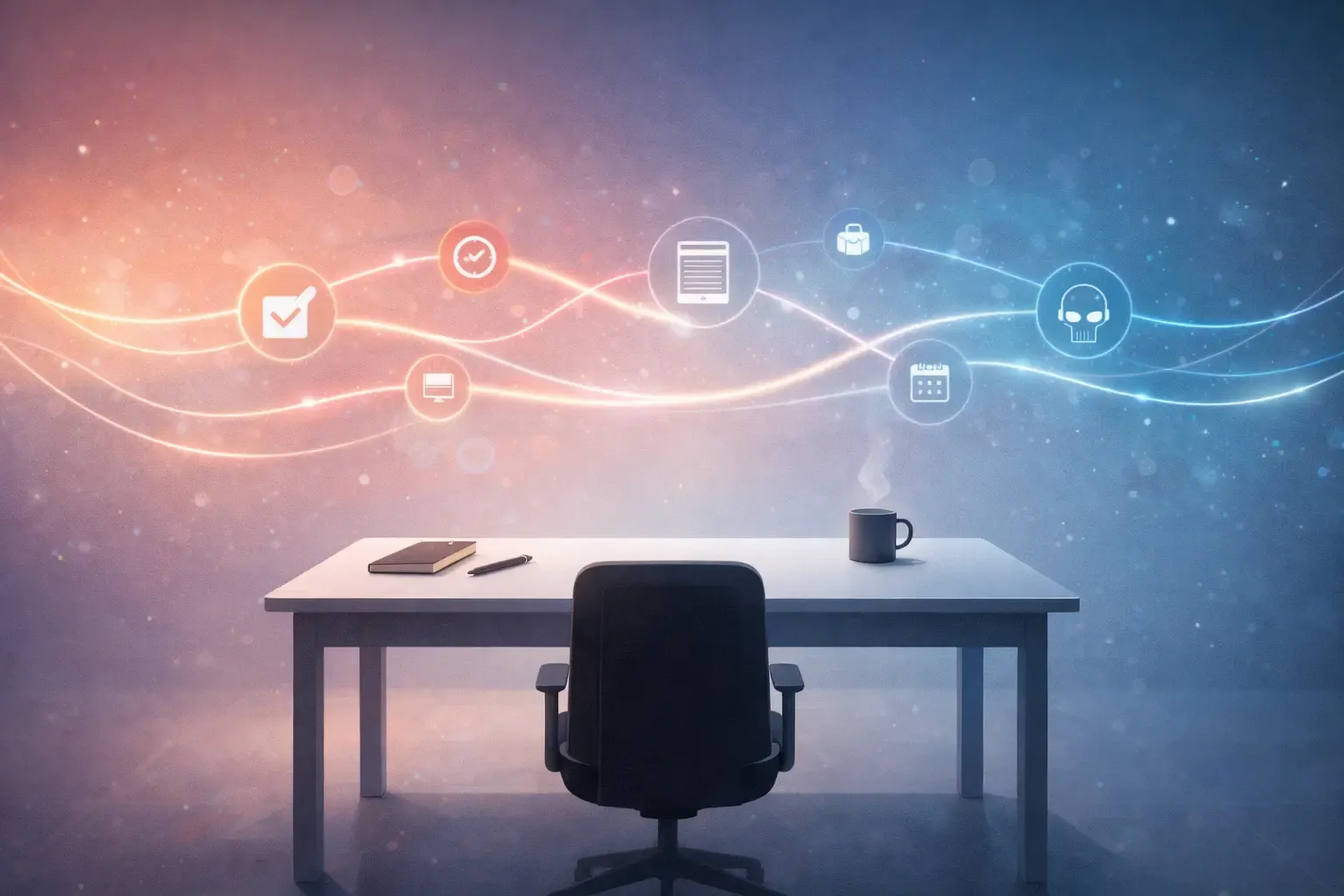
Modern workers are drowning in apps.Every task demands opening a platform, signing in, searching menus, and navigating tabs. Instead of saving time, tools steal it. Context switching kills focus. Notifications interrupt deep work. Productivity apps were meant to make work easier. Yet most of us feel buried under software.
Flow based productivity introduces a new direction.Instead of you going to the app, information comes to you.Work becomes continuous, natural, and distraction free.
The Problem With App Heavy Workflows
Today most workflows revolve around application hopping.Each task lives in a different tool.Files sit in drives.Chats sit in messaging apps.Tasks sit in project dashboards.
This scattered approach creates friction:
- Too many tabs open at the same time
- Searching for links, files, and messages
- Repeated logins and permissions
- Mental fatigue from switching tools
Even top performers struggle. Studies show workers lose hours every week simply switching between systems. The more apps you add, the slower you move.
Flow Based Productivity Explained Simply
Flow based work removes the need to chase information.It aligns tools behind the scenes, then pushes data into your workflow at the exact moment you need it.
Flow systems:
- Surface tasks from meetings automatically
- Show insights inside the document you are editing
- Suggest the next action based on intent
- Reduce search labor across tools
The goal is continuous focus.You stay in one environment.The software adapts to what you are doing.
Why Flow First Productivity Matters
Millions of professionals feel stuck in app chaos.Creativity disappears because the brain never reaches deep focus.Every interruption resets attention.
Flow based productivity changes this:
- Less clicking and navigation
- More thinking and creating
- Fewer errors caused by tool fatigue
- Faster work decisions
It protects energy and attention, two high value resources.
AI Makes App Free Work Possible
Artificial intelligence has matured enough to support dynamic workflows.Instead of hard coded rules, AI learns your patterns and adapts in real time.
AI can:
- Identify text that contains a task
- Track context from communication
- Predict what information you need next
- Sync decisions across platforms
- Generate summaries without opening a dashboard
This creates invisible assistance.Your workflow becomes smarter even if you never touch the software running it.
Common Examples Already Happening
Flow based productivity is not science fiction.Parts of it already exist in modern tools.
Examples include:
- Email writing suggested replies
- Meeting summaries with action lists
- Smart calendars that adjust automatically
- Operating systems showing recommended files
- AI models tagging data without manual work
Each example hints at a bigger shift:The interface disappears and the value stays.
How Teams Benefit From Going App Light
When teams rely less on app screens and more on context automation, collaboration changes.
Organizations gain:
- Better decision making from unified data
- Faster onboarding for new employees
- Fewer workflow errors
- Increased deep work hours
- Lower reliance on manual task tracking
IT departments win too.Fewer visible apps mean simpler adoption and easier monitoring.
Tools Will Not Disappear, They Will Hide
App free does not mean no software.It means software becomes infrastructure instead of a destination.
Apps will run quietly in the background:
- Syncing files
- Converting conversations into tasks
- Routing updates to the right person
- Reducing duplicate information
Interfaces will appear only when needed.Users will no longer hunt through apps to stay organized.
The Role of EEAT for Emerging Workflows
As work becomes more automated, trust matters.
Organizations must look for:
- Secure AI systems
- Clear data policies
- Traceable actions
- Verified source models
- Transparent workflow logic
Users will trust flow based platforms if:
- Content is accurate
- Recommendations are helpful
- Privacy is respected
- Errors are explainable
Strong governance builds confidence in automated systems.
How To Start Moving Toward Flow Based Work
Businesses do not need to delete every app.They should shift step by step.
Here is a simple path forward:
- Reduce tool duplication across departments
- Connect apps with shared hubs or API based platforms
- Train teams to rely on unified data streams
- Introduce AI assistants for simple workflows
- Replace manual reporting with automated summaries
- Encourage focus time and minimal tab switching
The result is a smoother transition with immediate gains.
The Future of Work Is Context Driven
Digital work once required humans to manage the tools.Next generation systems flip the model.
Content, tasks, and collaboration rise from context:
- A sentence spoke in a meeting becomes a task
- A note becomes a document draft
- A project milestone generates required actions
- A conversation reveals hidden planning needs
Flow replaces friction.Work becomes intuitive again.
Final Thought
Work without apps is not a fantasy. It is the next productivity evolution.Soon tools will be invisible, intelligent, and integrated.Users will shift back to thinking, solving, and creating rather than clicking, searching, and switching.
Flow based productivity restores focus.It puts humans back at the center of work.
When software becomes quiet, people become more powerful.