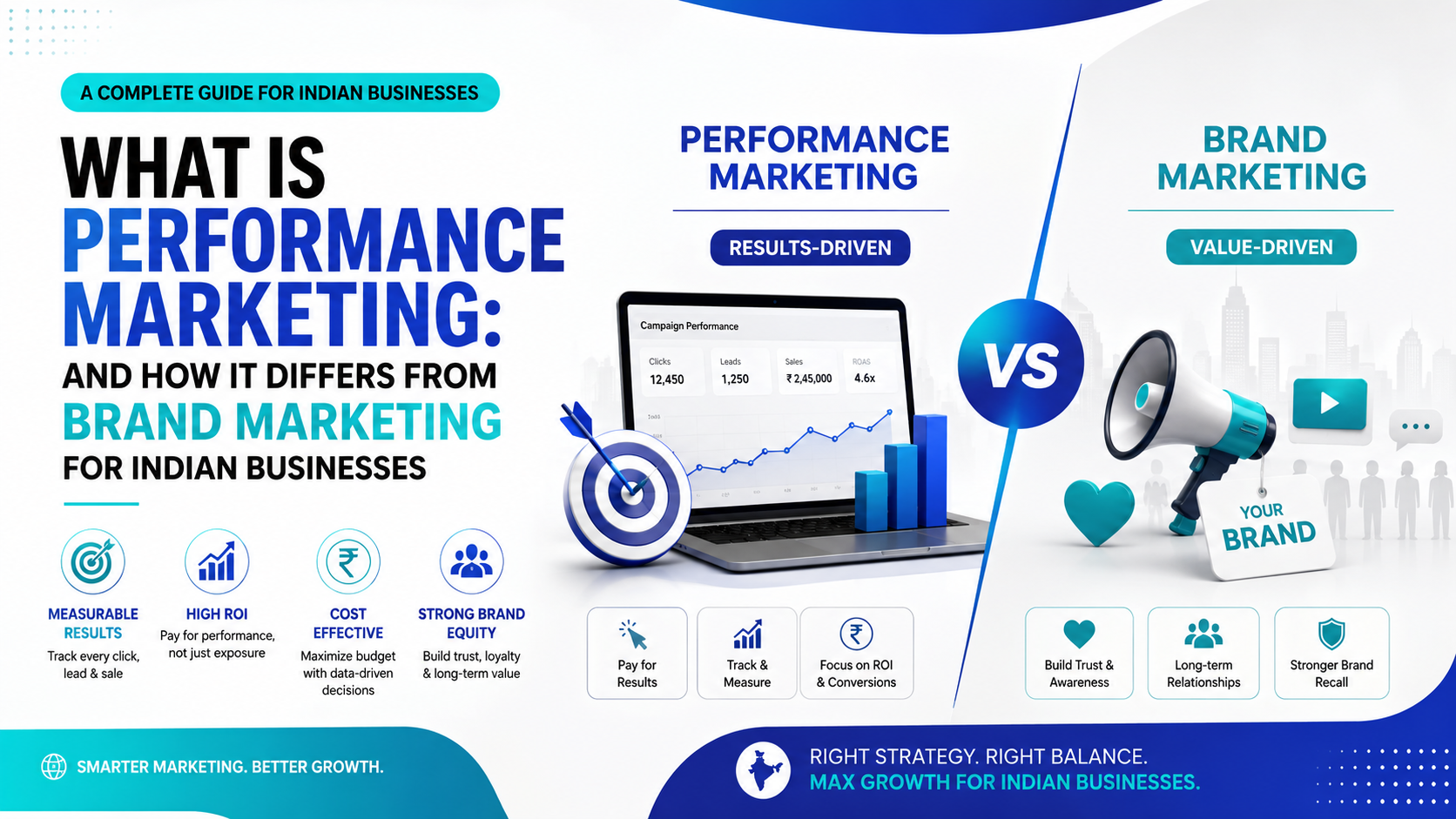
Every Indian business owner, founder, and media planner faces the same fundamental question when setting a digital budget: Should we spend money on immediate sales, or should we invest in building a brand people recognize?
In today's fast-moving Indian marketplace where customer acquisition costs on platforms like Meta and Google are steadily rising understanding what is performance marketing and how it differs from brand marketing for Indian businesses is critical to survival and profitable scale.
While brand marketing builds long-term recall and customer loyalty, performance marketing focuses squarely on measurable, trackable, and immediate return on investment (ROI). Choosing between the two isn't about picking a winner; it's about understanding how each strategy functions inside India’s unique consumer ecosystem.
This guide breaks down definitions, core mechanics, strategic differences, and real-world application frameworks so you can allocate your marketing budget with complete confidence.
What Is Performance Marketing?
Performance marketing is a data-driven digital strategy where advertisers pay only when a specific, measurable action occurs. Unlike traditional advertising, where you pay upfront for ad exposure regardless of outcomes, performance marketing ties your financial investment directly to tangible business results.
Core Characteristics of Performance Marketing:
- Pay-for-Results Model: You pay for completed leads, sales, link clicks, app downloads, or form submissions.
- Real-Time Trackability: Tools like Google Analytics (GA4), Meta Pixel, and server-side Conversion APIs track every stage of the user journey.
- Rapid A/B Testing: Media buyers can quickly test 20 ad creatives, kill underperforming angles within 48 hours, and double down on top performers.
- Channel Granularity: Campaigns run on channels with clear attribution, such as Google Search PPC, Instagram shopping ads, affiliate networks, and programmatic retargeting.
For an Indian Direct-to-Consumer (D2C) brand selling ayurvedic skincare or a local service firm in Kozhikode or Mumbai, performance marketing provides immediate proof of whether an ad campaign generates net-positive revenue.
What Is Brand Marketing?
Brand marketing is a long-term strategic approach focused on establishing brand identity, building emotional trust, increasing market perception, and cultivating customer loyalty.
Rather than asking the user to "Buy Now," brand marketing introduces the company’s core values, mission, and unique story. It lays the psychological groundwork so that when a customer eventually needs a product, your company is the first name they remember.
Core Characteristics of Brand Marketing:
- Top-of-Mind Awareness: Focuses on share of voice, brand recall, and market positioning.
- Long-Term Asset Building: Creates organic pull so customers seek out your brand directly instead of clicking on competitor ads.
- Storytelling Focus: Uses video ads, influencer collaborations, community initiatives, and public relations to create memorable brand associations.
- Higher Price Inelasticity: Strong brands can charge premium prices because customers trust their quality over unbranded alternatives.
Consider iconic Indian brands like Amul, Tata, or Zomato. Their brand marketing builds cultural resonance and emotional attachment that persists long after an ad campaign ends.
Key Differences: Performance Marketing vs Brand Marketing for Indian Businesses
To see how performance marketing differs from brand marketing for Indian businesses, let's examine their strategic pillars side by side:
Feature / Pillar | Performance Marketing | Brand Marketing |
Primary Goal | Immediate conversions, leads, & sales | Long-term brand equity & trust |
Target Audience | Warm, high-intent prospects | Broad demographic market |
Payment Structure | Pay per click, lead, or purchase (CPA/CPC) | Upfront investment for reach/impressions |
Key Metrics | ROAS, CPA, CAC, CTR, Conversion Rate | Brand recall, sentiment, reach, SOV |
Time Horizon | Immediate (Hours to days) | Long-term (Months to years) |
Primary Channels | Google Search, Meta Ads, Retargeting | TV, OOH billboards, Sponsorships, PR |
Flexibility | High (Can pause or adjust instantly) | Medium to Low (Planned campaigns) |
1. Measurement and Attribution
Performance marketing offers precise mathematical measurement. If you spend ₹50,000 on Google Ads and generate 100 orders worth ₹1,500,000, your Return on Ad Spend (ROAS) is 3x. You can track exact Customer Acquisition Costs (CAC).
Brand marketing, by contrast, relies on macro trends over time. Measuring how much a billboard in Bengaluru or a festive YouTube video campaign increased customer trust requires brand lift surveys, organic search volume tracking, and baseline sales comparisons.
2. Time Horizon and Cash Flow Dynamics
Performance marketing works like a light switch. Turn on Meta Ads or Google PPC, and targeted traffic hits your landing page within minutes. Turn off the ad spend, and traffic stops immediately.
Brand marketing acts more like planting an orchard. It takes time, consistency, and sustained capital investment before yielding fruits—but once established, it generates organic word-of-mouth growth and direct search traffic without requiring paid clicks for every single visit.
3. Customer Mindset and Funnel Position
Performance marketing targets bottom-of-the-funnel buyers who are already searching for solutions (e.g., searching "best accounting software for Indian SMBs" or clicking an Instagram offer for 20% off).
Brand marketing focuses on top-of-the-funnel awareness, educating cold audiences who may not even realize they have a problem yet.
Why Indian Businesses Need Both Strategies (The Full-Funnel Approach)
Relying exclusively on performance marketing or brand marketing creates structural vulnerabilities for growing Indian companies.
[ The Full-Funnel Growth Flywheel ] +--------------------------------------------+ | BRAND MARKETING | ──► Creates Demand & Trust | (Video, Influencers, Storytelling, PR) | (Lowers overall CPMs) +---------------------+----------------------+ │ ▼ +--------------------------------------------+ | PERFORMANCE MARKETING | ──► Captures Demand & Drives Sales | (Google Search, Meta Shopping, Retargeting)| (Generates immediate cash flow) +--------------------------------------------+
The "Performance Only" Trap
Many Indian startups and D2C brands spend 100% of their budget on performance marketing ads. In the beginning, this drives quick revenue. However, as ad platforms saturate and competition increases, ad fatigue sets in, Customer Acquisition Costs rise, and profit margins shrink.
Without brand awareness, customers view your product as a commodity and switch to cheaper alternatives the moment a competitor launches a discount.
The "Brand Only" Trap
Conversely, spending heavily on brand commercials and billboard ads without a performance engine to capture high-intent leads leads to wasted capital. Early-stage Indian businesses need cash flow to sustain operations, pay salaries, and fund product development.
The Solution: 70/30 Budget Allocation
Leading digital growth strategists recommend a balanced framework tailored to company stage:
- Early-Stage Startups / Local SMBs: 80% Performance Marketing (to generate immediate revenue) / 20% Brand Marketing.
- Scaling D2C & B2B Brands: 60% Performance Marketing / 40% Brand Marketing.
- Established Market Leaders: 50% Performance Marketing / 50% Brand Marketing (to defend market share).
Master Performance & Brand Strategy: If you want to build hands-on expertise in setting up high-converting ad funnels, tracking conversion metrics, and managing media spend, check out the comprehensive digital marketing programs at Milaaj Digital Academy. Their industry-led curriculum covers Meta Ads, Google Analytics (GA4), email automation, and AI-driven growth workflows.
Key Nuances of Performance Marketing in the Indian Market
Running performance campaigns in India requires navigating localized consumer behavior and platform logistics:
[Cash-on-Delivery (COD) Friction] ──► Requires automated WhatsApp order verification[Regional Language Diversity] ──► High-converting localized ad creative (Malayalam, Tamil, Hindi)[UPI Frictionless Checkout] ──► Native payment gateway integration (Razorpay / PhonePe)
- Cash-on-Delivery (COD) Management: Unlike Western markets where credit card prepayments dominate, a significant portion of Indian e-commerce orders are COD. Performance marketers must track RTO (Return to Origin) rates, not just initial checkout clicks.
- Vernacular & Regional Messaging: Ads run in regional languages (Hindi, Tamil, Malayalam, Bengali, Telugu) often achieve significantly higher Click-Through Rates (CTR) and lower Cost Per Lead (CPL) than English-only campaigns in Tier-2 and Tier-3 cities.
- WhatsApp Funnel Integration: In India, combining performance ads with automated WhatsApp messaging workflows yields higher conversion rates than traditional email-only follow-up sequences.
Building expertise across these channels is one of the most in-demand skills in the modern job market. To see how performance analytics and media buying compare to other digital specializations, explore our analysis of high-paying digital marketing skills in 2026.
Frequently Asked Questions (FAQs)
What is performance marketing in simple terms?
Performance marketing is an online advertising strategy where businesses pay only when a specific result is achieved, such as a click, lead form submission, app download, or completed sales purchase.
How does performance marketing differ from traditional brand advertising for Indian SMBs?
Traditional brand advertising requires paying fixed upfront costs for ad placement (such as newspaper ads or billboards) regardless of sales outcomes. Performance marketing uses real-time digital tracking so businesses only pay for measurable actions and verified ROI.
Which is better for a new Indian business: performance marketing or brand marketing?
New businesses generally benefit from starting with a heavier emphasis on performance marketing (70%–80% of budget) to validate product demand, secure immediate cash flow, and collect customer data before investing heavily in broad brand awareness campaigns.
What are the main channels used in performance marketing in India?
The primary performance marketing channels in India include Google Search PPC, Meta Ads (Instagram Reels and Facebook), affiliate networks, Google Shopping ads, programmatic display, and retargeting channels.
Final Thoughts: Building a Balanced Marketing Engine
Understanding what is performance marketing and how it differs from brand marketing for Indian businesses allows founders and marketers to make smarter capital allocation decisions.
Performance marketing provides the engine for immediate sales, measurable ROI, and rapid customer acquisition. Brand marketing creates the lasting reputation, emotional connection, and customer loyalty that keeps your acquisition costs sustainable over time.
By combining performance-driven conversion funnels with authentic brand storytelling, Indian businesses can build resilient growth engines that scale predictably in any market environment.