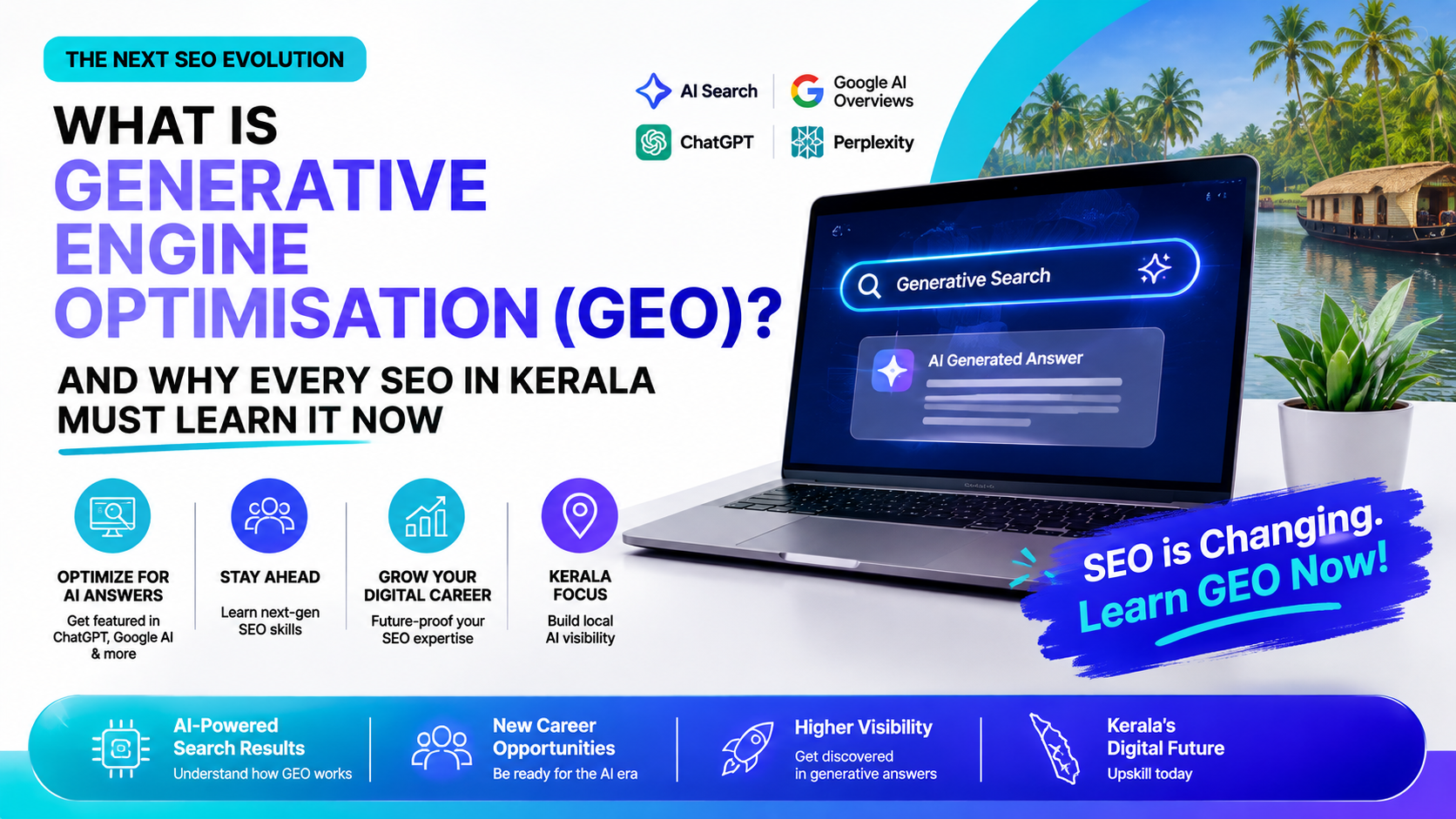
For over two decades, search engine optimization (SEO) followed a predictable rulebook: find target keywords, optimize meta tags, build backlinks, and compete for a spot among Google’s top ten blue links.
That rulebook is now fundamentally changing.
Today, millions of users no longer click through search results. Instead, they ask questions directly to AI-powered platforms like ChatGPT, Google AI Overviews, Perplexity, Claude, and Bing Copilot. Rather than returning a page of blue links, these engines synthesize information from across the web into a single, comprehensive answer citing only two to five trusted sources as footnotes.
This massive shift gives rise to Generative Engine Optimisation (GEO).
If your digital marketing agency or client business in Kerala relies solely on traditional keyword ranking techniques, you risk becoming invisible to a generation of users who get direct answers from AI.
Here is a complete breakdown of what GEO is, how it differs from classic SEO, and why every digital marketer, agency owner, and SEO practitioner in Kerala needs to master it today.
What Is Generative Engine Optimisation (GEO)?
Generative Engine Optimisation (GEO) is the practice of optimizing digital content and online brand authority so that large language models (LLMs) and AI search engines cite, reference, and recommend your business inside their generated answers.
While traditional search engines act as indexers that point users to web pages, generative engines act as synthesizers that digest information, evaluate trustworthiness, and generate a conversational answer on the spot.
GEO focuses on ensuring your brand's data, statistics, and expertise are part of the evidence pool these AI models draw from.
Traditional SEO vs. GEO: Understanding the Key Differences
To optimize effectively for AI engines, you must understand how GEO differs from traditional search practices.
Feature | Traditional SEO | Generative Engine Optimisation (GEO) |
Primary Target | Web Crawlers (Googlebot, Bingbot) | LLM Training Data & AI Web Retrieval (GPTbot, ClaudeBot, Perplexity) |
User Search Style | Short 2–3 word queries ("best dental clinic Kochi") | Long, conversational prompts ("Which dental clinic in Kochi offers laser treatment with flexible payment plans?") |
Content Focus | Keyword density, matching strings, meta tags | Entity relationships, factual density, direct answers, quotes & statistics |
Key Ranking Signals | PageSpeed, backlinks, domain authority, keyword placement | Brand mentions, structured JSON-LD schema, topical depth, clear source attribution |
Success Metric | Search engine rankings and Organic Clicks | Citation Frequency, Share of Synthesis, Brand Visibility |
Why SEO Specialists in Kerala Must Adopt GEO Now
Kerala's digital marketing scene is highly competitive. With thriving tech hubs in Kochi, Kozhikode, and Trivandrum, local businesses from real estate firms and healthcare providers to tourism operators and D2C brands rely heavily on search visibility.
Here are three core reasons why Kerala marketers cannot afford to ignore GEO:
1. The Rise of "Zero-Click" Search Behavior
A significant portion of searches now resolve without a single click. When a user asks an AI overview for the "Best digital marketing agency for real estate in Kerala," the AI provides a curated recommendation directly on the screen. If your content is not structured to be cited in that generated summary, you lose qualified leads before they ever reach a traditional website.
2. High-Intent Regional Buyers Use Conversational Prompts
Search behavior in Kerala is shifting from static English keywords to long-tail, conversational queries. Users type or speak detailed questions blending English and local context. Generative AI engines excel at understanding this contextual nuance, making GEO critical for local business discovery.
3. Early Adopter Advantage in Kerala’s Agency Market
Most marketing agencies in Kerala are still optimizing purely for traditional Google SERP positions. By offering GEO services such as AI citation audits, structured entity markup, and conversational content engineering you instantly position yourself or your agency ahead of local competitors.
Upgrade Your Search Marketing Career: Staying ahead in search requires mastering both classic search algorithms and generative AI models. Explore the practitioner-led Advanced SEO Course at Milaaj Digital Academy to learn hands-on GEO strategies, custom schema markup, and AI citation tracking.
How to Optimize Your Content for Generative Engines (GEO Action Plan)
To rank and get cited inside AI search outputs, implement these proven GEO tactics:
1. Increase Factual Density and Use Original Statistics
Research shows that content containing direct quotes, verified statistics, and technical data sees up to 30%–40% higher visibility in AI search responses compared to generic content. Fluffy marketing writing is ignored by AI crawlers. State clear facts, cite reputable primary sources, and publish original benchmark studies.
2. Implement Comprehensive JSON-LD Schema Markup
AI engines do not struggle through unstructured HTML. They read structured data. Implement clean JSON-LD schema across your site, including:
- Organization & LocalBusiness Schema: Clarifying who you are, your location, and your offerings.
- FAQPage Schema: Providing immediate, machine-readable question-and-answer pairs.
- Article & Author Schema: Establishing clear author credentials to boost E-E-A-T (Experience, Expertise, Authoritativeness, Trustworthiness).
3. Adopt a Conversational "Direct-Answer" Writing Style
Structure your web pages so that every major heading (H2/H3) mirrors a clear user question, followed immediately by a direct 2-to-3 sentence answer. Follow that direct answer with bullet points or structured data tables for easy parsing.
4. Build Unlinked Brand Mentions and Digital PR
Unlike classic SEO, where hyperlinked anchor text is king, LLMs evaluate your overall brand footprint across the web. Frequent, authoritative mentions of your brand on news portals, industry blogs, Reddit, Quora, and YouTube signal to AI models that your company is a recognized authority.
Mastering these cross-channel strategies is a core focus of the broader Digital Marketing Course at Milaaj Digital Academy, where students learn to coordinate SEO, AI workflows, content marketing, and brand performance.
Frequently Asked Questions (FAQs)
Will Generative Engine Optimisation (GEO) completely replace traditional SEO?
No. GEO works on top of traditional SEO foundations. AI search models still pull information from indexable, crawlable, and authoritative websites. Traditional technical SEO ensures your site is indexed, while GEO ensures your content gets synthesized into AI answers.
Which AI search platforms should Kerala businesses optimize for first?
Focus on Google AI Overviews (which directly impacts traditional Google search users), ChatGPT (the largest conversational search tool), and Perplexity AI (widely used for research and technical product evaluations).
How do I measure success in Generative Engine Optimisation?
Instead of tracking classic keyword ranking positions, measure GEO success by tracking Brand Citation Frequency (how often your site is linked in AI answers), Share of Synthesis (how often your brand is recommended for target industry prompts), and referral traffic originating from AI platforms.
Is GEO applicable for small local businesses in Kerala?
Yes. As local buyers increasingly use voice search and conversational AI queries to find regional services, having optimized LocalBusiness schema, clear FAQ answers, and positive local reviews ensures your business is recommended by AI assistants.
Conclusion: Adapt Your Search Strategy for the AI Era
Search engine optimization is not dying it is evolving into an AI-first discipline. By mastering Generative Engine Optimisation (GEO) today, digital marketers, agency professionals, and business owners in Kerala can secure their brand's visibility in the AI-driven search landscape.
Start updating your content with factual density, structure your data with clear schema markup, and ensure your business is the cited authority when customers ask AI for answers.