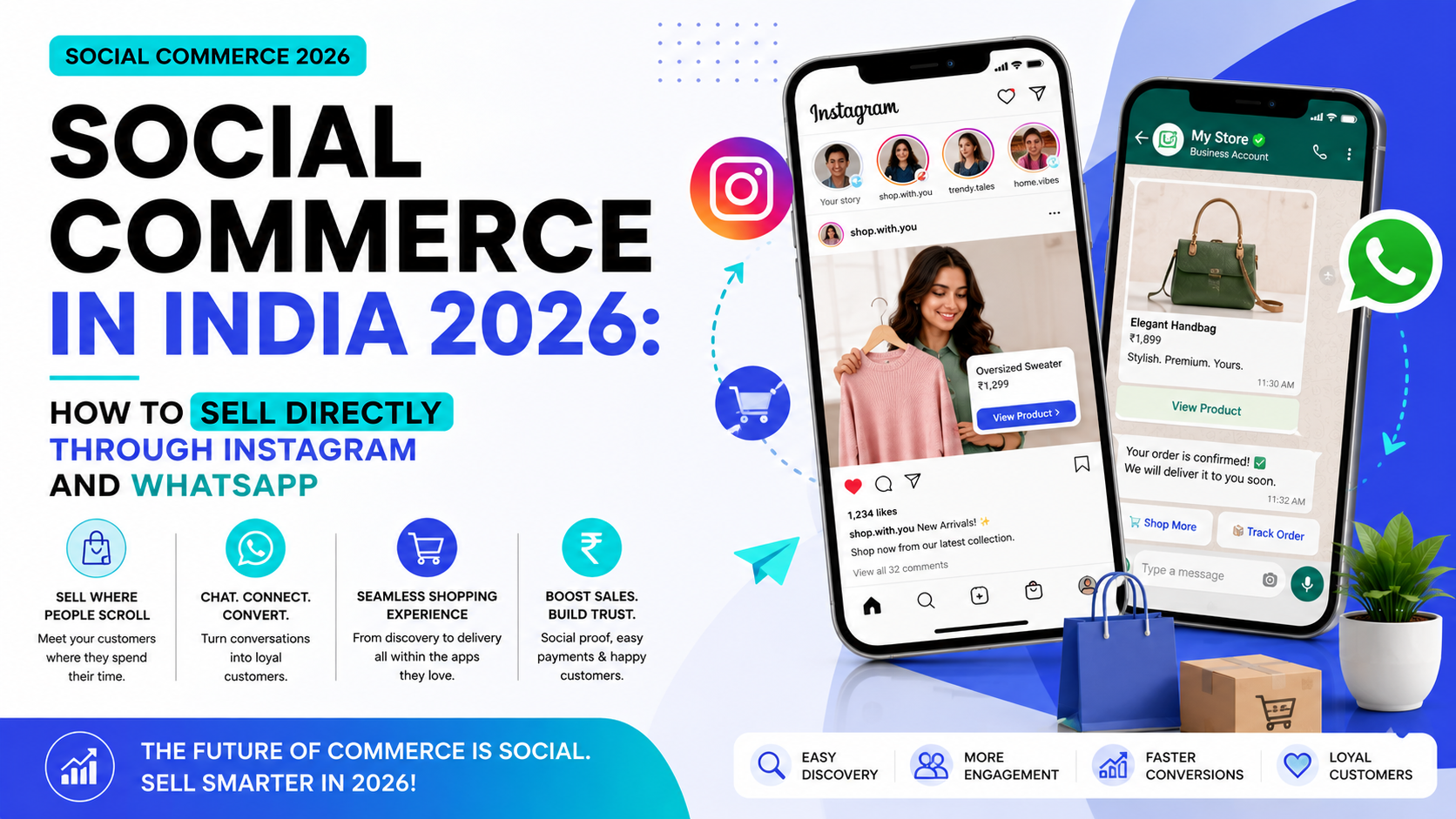
Shopping online in India used to follow a familiar pattern: open an e-commerce app, search for a product, scroll through reviews, add to cart, and check out.
Today, that journey has shifted dramatically. Indian consumers no longer go online to shop they are constantly online, discovering products while scrolling through Instagram Reels, chatting with friends on WhatsApp, or watching creator livestreams.
Welcome to the era of social commerce in India 2026. What began as informal reseller groups has transformed into a sophisticated multi-billion-dollar direct-to-consumer ecosystem. Brands no longer force potential buyers to leave their favorite social apps to complete a purchase. Instead, the entire shopping experience from product discovery to instant UPI payment happens directly inside Instagram and WhatsApp.
If your brand wants to lower customer acquisition costs, reduce friction, and capture high-intent digital buyers across Tier 1, Tier 2, and Tier 3 Indian cities, this comprehensive guide explains how to build a high-converting social commerce funnel step-by-step.
What Is Social Commerce and Why Is It Exploding in India?
Social commerce is the process of buying and selling products or services directly within social media and messaging platforms. Unlike traditional e-commerce, which redirects users from a social post to an external website, social commerce completes the transaction where the customer already spends their time.
[ Traditional E-Commerce ] ➔ Social Ad ➔ External Website ➔ Account Signup ➔ Checkout (High Drop-off)[ Social Commerce ] ➔ Social Discovery ➔ In-App Catalog / Chat ➔ UPI Payment (Instant Conversion)
In 2026, social commerce is expanding rapidly across India due to three structural shifts:
- Ubiquitous UPI Payments: Unified Payments Interface (UPI) integration inside social platforms allows frictionless, one-tap payments without entering credit card details or filling out tedious billing forms.
- Conversational First Culture: Indian consumers prefer interactive, chat-based buying experiences over static website storefronts. Asking a business questions on WhatsApp feels natural and builds trust.
- Video-Driven Discovery: Short-form video platforms like Instagram Reels act as modern product catalogs, allowing users to see products demonstrated live by authentic creators.
Selling Directly on Instagram: From Scroll to Sale
Instagram has evolved from an image-sharing platform into a visual discovery engine. To turn casual scrollers into paying customers, brands build integrated in-app buyer journeys.
1. Optimize Your Instagram Business Profile into a Digital Storefront
Your Instagram profile is your new homepage. Ensure your bio clearly states what you sell, includes a recognizable brand logo, and features a clear call-to-action (CTA). Use Instagram Shop tags on your posts, stories, and reels so users can tap a product photo to reveal its price and description instantly.
2. Leverage Shoppable Reels and Creator Collaborations
Short-form video drives the highest engagement rates across India. Use shoppable Reels to showcase your products in action:
- Fashion & Apparel: Show outfit styling ideas with tagged products.
- Skincare & Beauty: Post before-and-after routines with clickable tags.
- Electronics & Accessories: Share quick 15-second unboxing clips and feature highlights.
Collaborating with micro-creators through User-Generated Content (UGC) adds social proof, helping turn audience trust into direct sales.
[ High-Energy Reel ] ➔ [ Tagged Product Badge ] ➔ [ In-App Product Card ] ➔ [ Instant Checkout ]
3. Automate Instagram Direct Message (DM) Funnels
When users comment on your Reels with keywords like "Price" or "Link", use automated DM workflows (via tools like ManyChat) to send them a direct message immediately. The automated message delivers a personalized product link, a special discount code, or a direct link to open a WhatsApp sales conversation.
WhatsApp Commerce: The Ultimate Conversion Engine in 2026
If Instagram is where Indian consumers discover products, WhatsApp is where they close the deal. With over 500 million active users in India, WhatsApp offers unmatched open rates (often exceeding 90%) compared to traditional email marketing.
1. Implement the WhatsApp Business API and Interactive Catalogs
Moving beyond the basic WhatsApp Business app, growing brands deploy the WhatsApp Business API. This allows you to showcase rich interactive product catalogs directly inside chat threads. Customers can browse collections, select sizes or variants, and add items to a WhatsApp cart without leaving the conversation.
2. Deploy Conversational AI Bots for Instant Customer Support
Modern shoppers expect instant responses. Automated AI chatbots inside WhatsApp can:
- Answer frequent product sizing or material questions.
- Recommend products based on customer preferences.
- Process order status and tracking requests automatically.
- Recover abandoned carts with tailored reminder messages.
Mastering these conversational growth strategies requires a deep understanding of multi-channel funnels. Enrolling in a comprehensive digital marketing course provides hands-on experience in building automated chat flows, configuring Meta ad integrations, and tracking attribution across social channels.
3. Native UPI Integration and Automated Cash-on-Delivery (COD) Verification
Cart abandonment in India frequently happens at the payment stage. With WhatsApp Pay and integrated payment gateways (like Razorpay and PayU), customers can complete payments via PhonePe, Google Pay, or Paytm directly within the chat window.
For customers choosing Cash on Delivery (COD), automated WhatsApp flows send an instant message asking the user to confirm their order via a single click, dramatically reducing Return-to-Origin (RTO) losses.
Comparing Instagram and WhatsApp Social Commerce Strategies
To maximize revenue, deploy both platforms in tandem. Instagram drives top-of-funnel brand discovery, while WhatsApp manages middle-and-bottom-of-funnel conversion and retention.
Feature / Strategy | Instagram Commerce | WhatsApp Commerce |
Primary Funnel Role | Product discovery and brand awareness | Direct conversion and customer retention |
Content Format | Reels, Stories, Carousels, Creator UGC | Interactive chat flows, audio notes, catalogs |
Average Open/Engagement Rate | 2% – 5% engagement rate | 80% – 95% message open rate |
Best For | Visual impulse purchases & lifestyle products | Personalized selling, re-orders & customer support |
Primary Payment Method | In-app checkout links or website redirect | Native UPI in-chat payment flows |
4 Rules to Win at Social Commerce in India
To build a scalable social commerce operation in 2026, keep these four principles at the core of your execution:
Rule 1: Build Localized, Regional Language Content
India is a multi-lingual market. Brands that create conversational copy and video content in regional languages—including Hindi, Malayalam, Tamil, Telugu, and Kannada—connect more deeply with consumers in Tier 2 and Tier 3 cities.
Rule 2: Keep the Buying Path Under 3 Taps
Every extra click or page load between discovery and checkout increases customer drop-off. Audit your social purchasing steps regularly to ensure users can go from seeing an ad to confirming an order in three taps or fewer.
Rule 3: Use Automated Abandoned Cart Triggers
If a user adds an item to their WhatsApp cart or clicks an Instagram product link without buying, trigger an automated WhatsApp message within 30 minutes. Offering a small incentive—such as free shipping or a 5% discount—reclaims up to 25% of lost transactions.
Rule 4: Invest in Search Engine Visibility Beyond Social
Social commerce captures immediate demand, but sustainable businesses combine social selling with long-term organic search traffic. Optimizing your core platform through an advanced SEO course ensures your brand dominates both social feeds and search engine results pages simultaneously.
Frequently Asked Questions (FAQs)
What is social commerce in simple terms?
Social commerce is the buying and selling of goods or services directly within social media platforms like Instagram, WhatsApp, and Facebook, allowing customers to discover, evaluate, and pay for products without visiting an external website.
Is WhatsApp Business API free to use in India?
While the basic WhatsApp Business app is free for small businesses, the WhatsApp Business API involves costs based on conversation categories (utility, marketing, authentication, or service conversations) charged by Meta and your chosen Business Solution Provider (BSP).
How do I reduce Return to Origin (RTO) losses in Indian social commerce?
To lower RTO rates on Cash on Delivery (COD) orders, use automated WhatsApp verification flows that require customers to confirm their delivery address, send order tracking updates via chat, and offer small discounts for pre-paying via UPI.
Can small businesses use social commerce without a complex website?
Yes. Many independent brands and D2C startups operate successfully using an Instagram account for product showcase reels connected directly to a WhatsApp Business catalog with integrated UPI payments, bypassing the immediate need for a traditional e-commerce store.
Conclusion: Turning Social Media Followers into Loyal Customers
The shift toward social commerce in India 2026 represents a fundamental change in consumer behavior. By combining the visual discovery power of Instagram Reels with the conversational trust and instant UPI payment convenience of WhatsApp, your business can reduce sales friction and build direct relationships with modern buyers.
Audit your current social channels today, install interactive catalog flows, and start converting scrollers into long-term customers directly within their favorite apps.