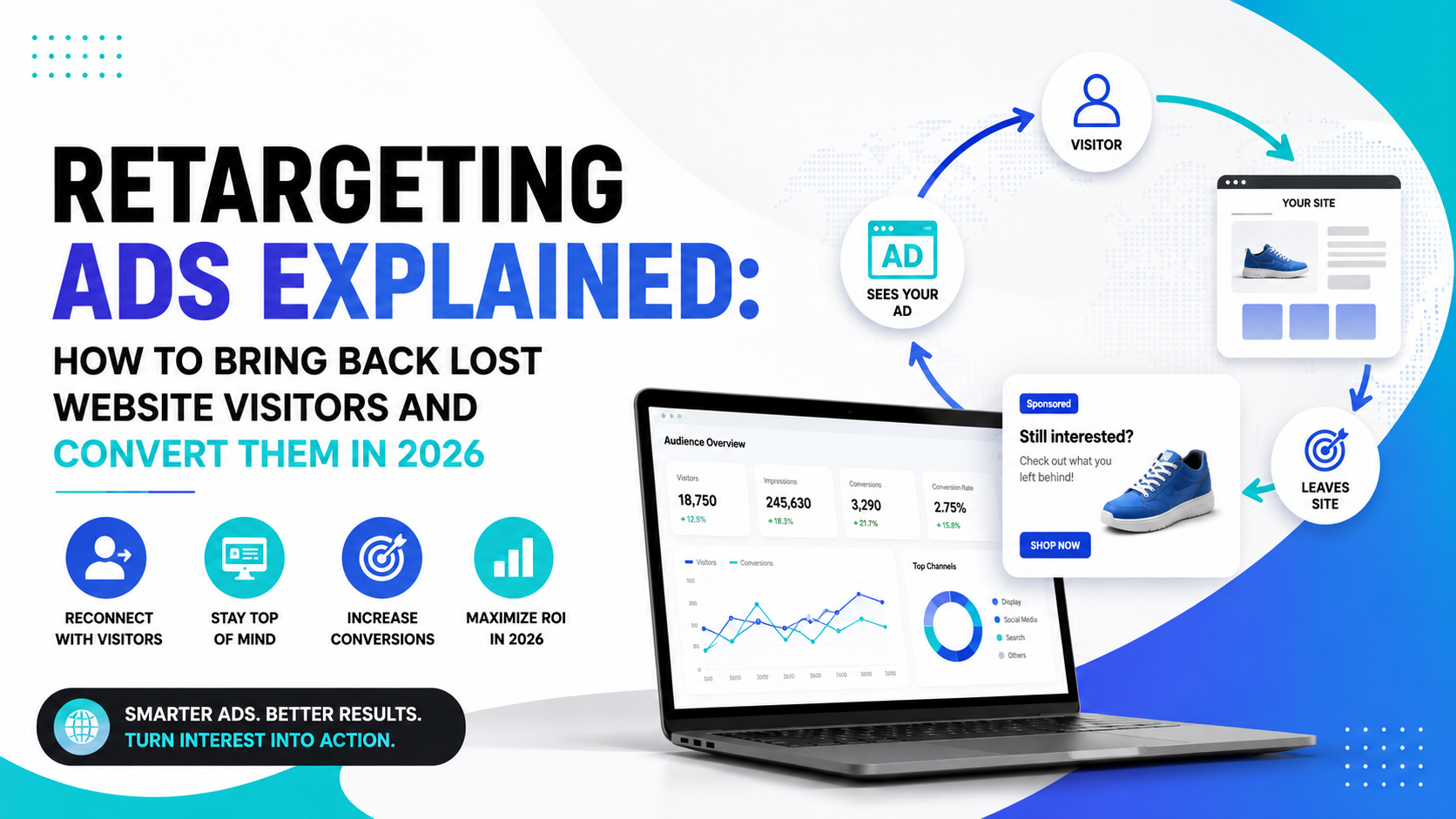
Imagine running an e-commerce store or a digital services agency where 97 out of every 100 visitors walk in, look around for two minutes, and then vanish forever.
You paid good money to get them there through organic search, pay-per-click advertising, or social media campaigns yet they leave without buying a product, filling out a form, or enrolling in a program.
This isn't a hypothetical nightmare; it is the reality of modern digital web traffic. The average website conversion rate lingers between 2% and 3%. That leaves roughly 97% to 98% of potential revenue walking out the door.
So, how do you re-engage those high-intent users without wasting your marketing budget on cold leads?
Welcome to retargeting ads explained. In this guide, you will learn how retargeting works, why privacy-first advertising changes the game in 2026, and how to build a high-ROI remarketing campaign that brings lost visitors back into your sales funnel.
What Are Retargeting Ads?
Retargeting ads (often called remarketing) are a form of digital advertising that serves targeted ads specifically to users who have previously visited your website or interacted with your brand online.
When a user visits your site, their activity creates a behavioral footprint. If they abandon their shopping cart, read a blog post, or view a service pricing page without taking action, retargeting allows you to show them relevant ads across display networks, Meta, Google, LinkedIn, and mobile apps.
[ User Visits Website ] ➔ [ Exits Without Buying ] ➔ [ Retargeting Ad Displayed on Web/Social ] ➔ [ User Returns & Converts ]
Retargeting vs. Prospecting Ads: The Critical Difference
Strategy Feature | Prospecting Ads (Cold Audience) | Retargeting Ads (Warm Audience) |
Primary Goal | Brand awareness and initial traffic generation | Lead conversion and sales recovery |
Audience Intent | Unfamiliar with your brand or solution | High intent; already familiar with your offer |
Conversion Rate | Typically lower (1% - 2%) | Significantly higher (5% - 14%+) |
Cost Per Acquisition (CPA) | Higher | Lower |
Instead of pitching to a complete stranger, retargeting acts as a gentle reminder to someone who already knows who you are and what you offer.
How Retargeting Ads Work in 2026
For years, retargeting relied almost entirely on third-party cookiest tiny snippets of tracking code placed on a user's browser that followed them across the web.
However, privacy regulations like GDPR and CCPA, combined with browser updates (Apple’s Safari ITP, Firefox ETP, and Chrome's Privacy Sandbox), have fundamentally changed how digital advertisers collect user data.
Old Method (3rd-Party Cookie Tracking) ➔ High Data Leakage & Browser BlockingModern Method (Server-Side Tracking + 1st-Party Data) ➔ Privacy-Compliant & Durable Signals
In 2026, high-performing retargeting relies on two modernized technical foundations:
1. Server-Side Tracking & First-Party Data
Instead of relying on browser-based scripts that ad-blockers can strip away, modern advertisers use server-side tagging (such as Google Tag Manager Server-Side). User interactions pass directly from your web server to advertising platforms like Meta or Google, preserving conversion signal accuracy while respecting privacy preferences.
If you want to master these tracking infrastructures, exploring dedicated digital marketing skills through hands-on training can shorten your learning curve immensely.
2. Authenticated Match Networks & Privacy Sandbox APIs
When visitors opt in such as by signing up for a newsletter or downloading a free resource their hashed data (like an encrypted email address) feeds into Customer Data Platforms (CDPs) or privacy-compliant identity networks like Unified ID 2.0 (UID2). This allows platforms to match warm leads securely without violating browser policies.
The Core Types of Retargeting Campaigns
Not all retargeting campaigns use the same strategy. To convert lost website visitors effectively, you should map your remarketing approach to specific stages of your sales funnel.
Pixel-Based vs. List-Based Retargeting
- Pixel-Based Retargeting: Displays ads automatically based on specific pages a user visited recently (e.g., viewing a specific product page 3 days ago).
- List-Based Retargeting: Uploads existing customer or lead contact lists (such as inactive email subscribers) to ad channels like LinkedIn or Facebook to run direct re-engagement campaigns.
Dynamic Retargeting
Dynamic ads show the exact product or service a user viewed on your website. For example, if a visitor leaves an e-commerce store with a blue jacket in their shopping cart, dynamic display ads will highlight that exact blue jacket across their social media feeds, often accompanied by an incentive like free shipping or a limited-time discount.
Why Every Business Needs a Retargeting Strategy
The internet is full of distractions. A visitor might fully intend to purchase your product or sign up for your course, but a phone call, a slow page load, or a low battery warning interrupts them. Retargeting removes that friction.
[ High-Intent Web Traffic ] │ ▼ ┌────────────────────────┐ │ Cart/Form Abandoned │ └────────────────────────┘ │ ┌───────────┴───────────┐ ▼ ▼ [ Standard Ads ] [ Dynamic Retargeting ] (Generic Offer) (Tailored Social Ad) │ │ ▼ ▼ Low ROI / High Cost Higher Conversion / Lower CPA
Key business benefits include:
- Massive Lift in Conversion Rates: Retargeting campaigns regularly deliver a performance lift of over 300% compared to targeting cold audiences.
- Better Return on Ad Spend (ROAS): Because your audience is already warm, you waste fewer impressions on low-intent users.
- Higher Brand Recall: It takes an average of 7 to 10 digital touchpoints before a consumer makes a purchase decision. Retargeting delivers those touchpoints naturally.
Understanding audience behavior and optimizing paid campaigns are core outcomes of a structured AI-powered digital marketing course, where marketers learn to automate audience segmentation for maximum ad performance.
5 Steps to Build a High-Converting Retargeting Campaign
To build a campaign that generates sales rather than ad fatigue, follow this step-by-step framework:
Step 1: Segment Your Website Audiences Deeply
Never send all website visitors to the exact same landing page or show them the same ad banner. Segment your custom audiences based on engagement depth:
- All Site Visitors (1–30 Days): Low intent; show brand storytelling or educational content.
- Product / Service Page Viewers: Medium-to-high intent; highlight testimonials, benefits, and case studies.
- Cart or Lead Form Abandoners: Extreme intent; deliver direct call-to-action (CTA) ads featuring social proof, FAQs, or localized incentives.
Step 2: Set Strict Ad Frequency Caps
Over-retargeting annoys potential customers and harms brand equity. Set an ad frequency cap limiting display to 2 to 4 impressions per user per day. If a user does not convert within 14 to 30 days, move them out of the active retargeting sequence.
Step 3: Match Ad Copy to the Buyer's Objections
If someone left your page, something stopped them—usually price uncertainty, lack of trust, or poor timing. Address those barriers directly in your retargeting copy:
- Price Objection? Highlight value, guarantee, or payment plans.
- Trust Objection? Display star ratings, customer reviews, or industry awards.
- Timing Objection? Use soft urgencies like limited-seat enrollments or seasonal offers.
Step 4: Use Exclusion Lists Aggressively
One of the fastest ways to waste ad budget is showing conversion ads to people who have already bought from you. Always add recent purchasers to your negative/exclusion audience list. Instead, move existing buyers into a separate post-purchase cross-sell campaign.
Step 5: Test Creative Formats Continuously
Rotate ad visuals every 2 to 3 weeks to prevent banner blindness. Test a mix of short-form video reels, carousel ads showing features, and simple static image ads with high-contrast buttons.
Frequently Asked Questions (FAQs)
What is the main purpose of retargeting ads?
The primary goal of retargeting ads is to bring back lost website visitors who left without completing a key action (such as purchasing a product, requesting a quote, or filling out a form) and convert them into paying customers or leads.
Are retargeting and remarketing the same thing?
While the terms are often used interchangeably, they traditionally differ by channel. Retargeting generally refers to paid display or social ad campaigns based on web tracking. Remarketing usually refers to email-based re-engagement campaigns targeting existing contacts. Modern marketing blends both approaches into a unified strategy.
How does retargeting work without third-party cookies in 2026?
Modern retargeting relies on first-party data collection, server-side tagging (e.g., GTM Server-Side), hashed customer match lists, and privacy-preserving APIs like Google's Privacy Sandbox.
What is a good conversion rate for retargeting campaigns?
While cold audience conversion rates hover around 1%–2%, well-optimized retargeting campaigns frequently achieve conversion rates between 5% and 14%, depending on the industry, channel, and audience segment.
Final Thoughts: Turning Bounces into Business Growth
A website without a retargeting campaign is like a bucket with a hole in the bottom—no matter how much new traffic you pour in, revenue continues to leak out.
By upgrading your tracking to privacy-first, server-side setups and crafting personalized ad creatives for distinct audience segments, you can turn forgotten website visits into long-term customer relationships. Start auditing your traffic exit points today, build tailored retargeting segments, and reclaim the lost revenue your brand deserves.