For decades, digital marketing in India revolved around a simple playbook: find high-volume keywords, optimize web pages, build backlinks, and claim a spot in Google's traditional "top 10 blue links".
That playbook is no longer enough.
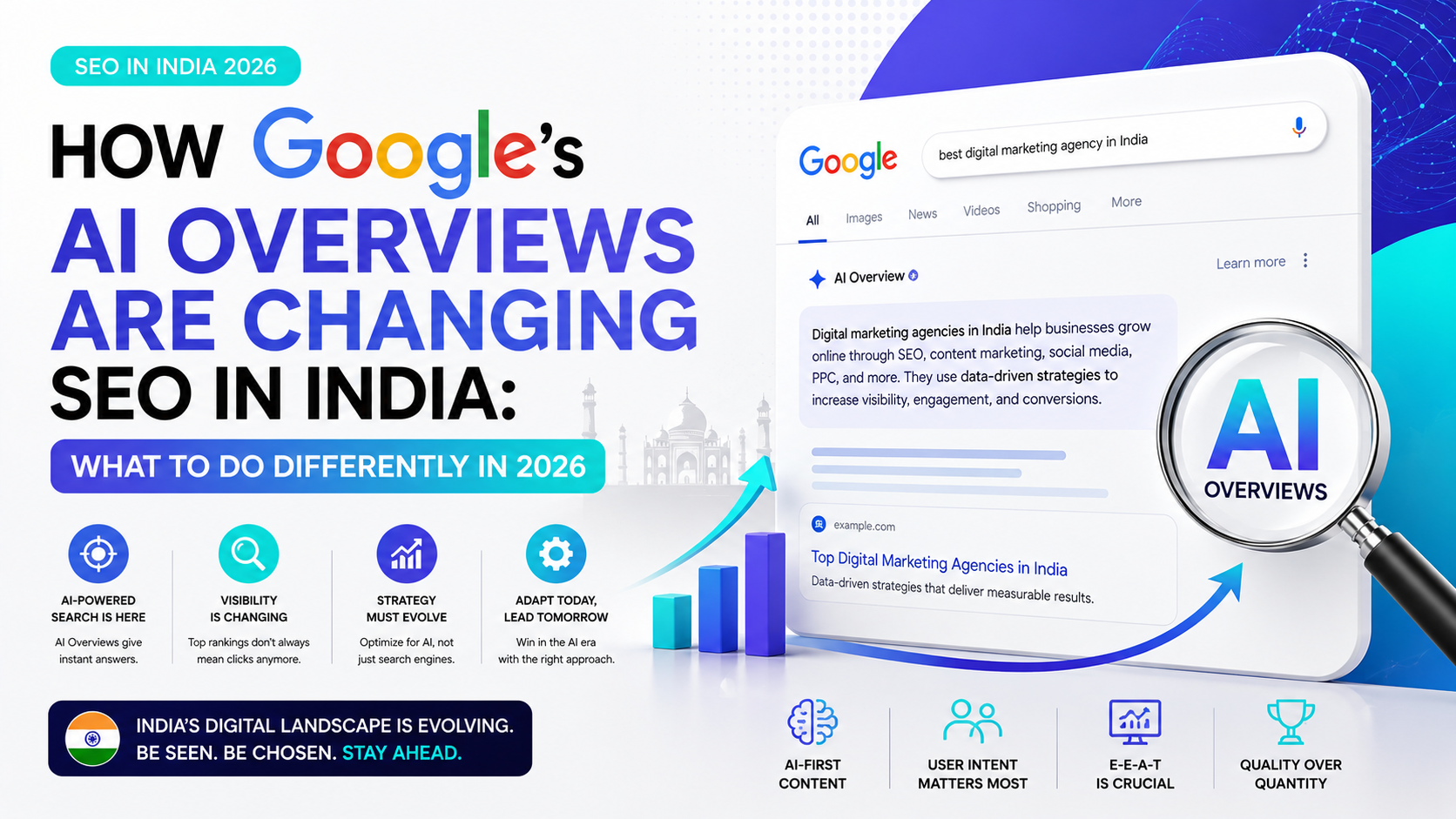
Google’s AI Overviews (powered by advanced Gemini models) sit at the top of search results across India. Instead of browsing multiple websites, users searching for answers receive a synthesized, multi-paragraph AI summary right on the results page with source links embedded directly alongside the text.
This change has accelerated the rise of zero-click searches. Users frequently get their answers immediately without clicking through to a website.
However, this shift also brings a huge opportunity. Websites cited within AI Overviews experience significantly higher brand trust and attract more qualified, high-intent traffic.
Here is how Google's AI Overviews are changing SEO in India and the exact strategies you must implement to stay ahead.
3 Core Ways AI Overviews Impact Indian Web Search
AI Overviews do not eliminate organic search; they change how users consume information online.
1. The Death of Low-Value "Definition" Traffic
Simple informational queries such as "What is inflation?" or "GST rate for laptops"—are now answered directly by Gemini. If your content strategy relies on high-volume, low-effort informational posts, expect organic click volume for those basic keywords to decline.
2. The Rise of High-Intent "Synthesis" Clicks
When users do click on source links inside an AI Overview, their purchase or engagement intent is significantly higher. They have already read the summary and are clicking to perform deep research, evaluate service providers, or complete a transaction.
3. A Shift from Keyword Matching to Entity Relationships
Google no longer evaluates content purely on matching search terms. The AI breaks down content into semantically complete, self-contained concepts. It evaluates whether your brand is a trusted entity with real, verifiable authority on the topic.
What to Do Differently: Your 2026 AI SEO Playbook
To win search visibility today, adapt your technical and content creation workflows for AI extraction.
Strategy 1: Implement "Atomic" Direct Answers
Structure your section openers so AI crawlers can easily extract direct answers.
- Place a clear, direct 40-to-60-word answer immediately below your question-based H2 or H3 subheadings.
- Follow that concise summary with supporting details, bulleted lists, and step-by-step breakdowns.
Strategy 2: Use Tables, Lists, and Structural Formatting
AI models prioritize structured formats because they are easy to evaluate and verify.
[ Unstructured Paragraph Copy ] ➔ Hard for AI to parse ➔ Excluded from Overviews [ Markdown Data Tables & Lists ] ➔ Easy for AI to digest ➔ Featured as AI Citation
Replace dense text blocks with clean Markdown tables for price comparisons, feature matrices, and procedural steps.
Strategy 3: Double Down on First-Hand Expertise (E-E-A-T)
Generic AI-generated fluff will not be cited in AI Overviews. Google actively rewards original experience, expert quotes, case study data, and unique insights. Include verified author bios with credentials on every article.
Upgrading your strategy for this landscape requires mastering modern search frameworks. Enrolling in a comprehensive digital marketing course equips you with practical skills in performance marketing, search intent mapping, and multi-channel campaign management.
Measuring Success: New Search Console Tools in 2026
Measuring search performance solely by organic web clicks is an outdated practice. Google Search Console includes dedicated reporting for generative AI features.
Track whether your domain appears in the citation carousel for your primary target keywords. Even if a user doesn't click immediately, appearing as the cited source builds immense brand equity and drives downstream branded searches.
For practitioners looking to master AI-first optimization, custom JSON-LD schema, and advanced search strategy, taking a specialized advanced SEO course provides hands-on technical training to keep your brand visible.
Frequently Asked Questions (FAQs)
Are AI Overviews rolling out to all searches in India?
Google AI Overviews appear on a majority of complex informational, research, comparison, and procedural searches in India. Navigational searches (e.g., logging into a bank) and simple local queries often show traditional interfaces or map packs.
Will AI Overviews destroy organic search traffic in India?
They reduce traffic for simple, definition-style queries. However, for deep research and high-intent buyer journeys, appearing as a cited source in an AI Overview generates highly qualified leads with strong conversion potential.
How do I get my website cited inside a Google AI Overview?
To get cited, publish original expertise, format your subheadings as explicit questions, provide immediate 40-to-60-word answers, use structured data schema (FAQ and Article), and build strong topical authority across your domain.
Conclusion: Adapt Your Strategy for the AI Search Era
Google AI Overviews represent a permanent shift in how Indian consumers discover information online. Instead of fighting this evolution, embrace it by publishing original, well-structured, and authoritative content that AI models trust and cite.
Audit your top informational pages today, add direct answer summaries, format key data into scannable tables, and secure your place at the top of the AI-powered search results.