You are a fresh graduate, scrolling through three job listings. One asks for a frontend developer, one for a backend developer, and one for a full-stack developer. The skills lists look almost the same, and you are not sure which role is meant for you.
Take a breath. The difference between a frontend vs backend vs full stack developer is simpler than the job titles make it sound. This guide explains each role in plain words, so you can pick a starting point with confidence.
Quick Answer
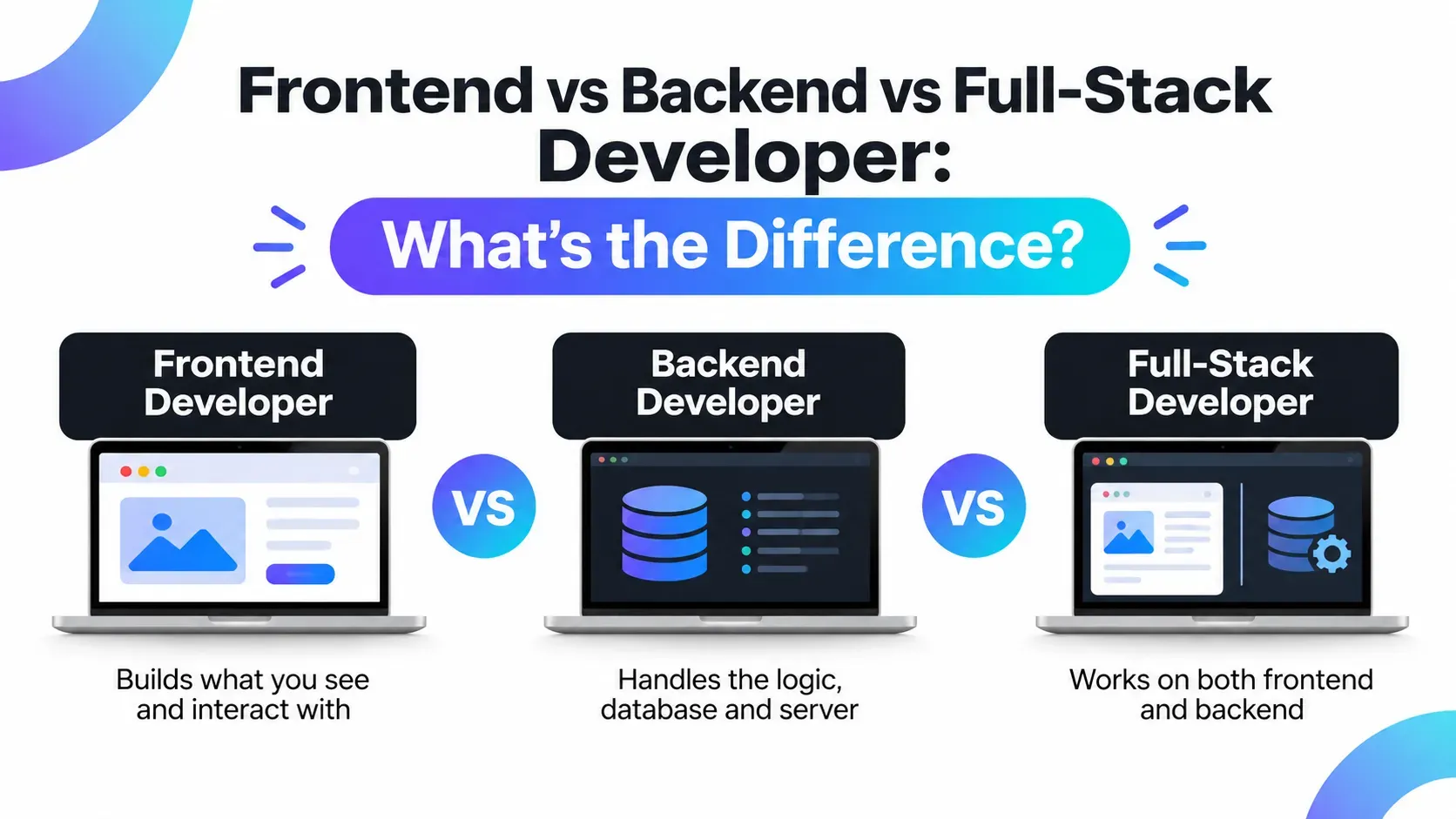
Frontend developers build the part of a website you see and use in your browser. Backend developers build the server side that stores data, checks logins and decides what content to send. Full-stack developers work on both sides. The roles overlap, so choose a starting point by what you enjoy building.
Key Takeaways
- Frontend is what you see and click. Backend is what runs behind the screen.
- Full-stack means working across both sides, not knowing everything.
- JavaScript can be used on both sides of a website.
- You can start on either side, and the roles can change over a career.
What do frontend and backend actually mean?
Every website has two sides, and the two role names come from that split. Here are both terms in plain words:
- Frontend (client-side): code that runs in your browser and shapes how a page looks and behaves.
- Backend (server-side): code that runs on a server and controls what information is sent to the browser.
Think of a restaurant. The dining room is the frontend: the tables, the menu and the service you see. The kitchen is the backend: where orders are checked, food is prepared and the right dish is sent out.
MDN Web Docs explains in its introduction to the server side that server-side code decides which content is returned to the browser. Its main role is to control what information is sent to the user.
What does a frontend developer do?
A frontend developer works on everything you can see and touch on a web page. These are the usual responsibilities:
- Building the layout and structure of pages.
- Styling buttons, menus, forms and other parts of the screen.
- Creating navigation, so visitors can move around easily.
- Checking forms in the browser before data is sent.
- Making sure pages work properly across different browsers.
Core frontend skills
Most frontend work starts with three tools:
- HTML for the structure of a page.
- CSS for its look and layout.
- JavaScript for how it behaves when you click, type or scroll.
If you want free, beginner-friendly lessons on all three, MDN's learn web development section is a good place to look.
What does a backend developer do?
A backend developer builds the logic that works behind the page. These are the usual responsibilities:
- Deciding which content is returned when a browser asks for a page.
- Checking and validating the data people send, such as order forms.
- Storing and fetching information from databases.
- Handling logins, user sessions and notifications.
Core backend skills
Most backend work starts with these three areas:
- A server-side language. MDN lists options such as PHP, Python, Ruby, C# and JavaScript (with Node.js).
- A database, which is where information is stored and found again.
- APIs, the doorways the frontend uses to ask the backend for data.
An API can sound abstract at first. This guide on what an API is, in simple words uses everyday examples to make it clearer.
What does a full-stack developer do?
A full-stack developer is comfortable working on both sides of a website. They can build the page a visitor sees and the server logic behind it.
"Full-stack" does not mean mastering everything. Many full-stack developers are stronger on one side and capable on the other.
Here is what that looks like in practice:
- Building a small feature from start to finish, from the screen to the database.
- Connecting a page to stored data through an API.
- Moving between frontend and backend tasks in a small team.
One well-known combination of tools for this kind of work is the MERN stack. This guide covers whether the MERN stack is worth learning as a beginner.
Frontend vs backend vs full-stack developer: how do they compare?
The three roles overlap, so a side-by-side view helps. This table shows the main differences.
Role | What they build | Typical skills | Often works with |
|---|---|---|---|
Frontend developer | The pages visitors see and use | HTML, CSS, JavaScript | Designers and backend developers |
Backend developer | Server logic, data storage and logins | A server language, databases, APIs | Frontend developers |
Full-stack developer | Features across both sides | A mix of frontend and backend skills | The whole product team |
Here is a scenario to picture it. A small shop wants customers to place orders online.
- The frontend is the order form the customer fills in.
- The backend receives the order, checks it, saves it and sends a confirmation.
- A full-stack developer can build both parts of that feature.
Frontend, backend or full-stack developer: which should you start with?
You do not need to decide your whole career today. Use these steps to choose a first move:
- Do you enjoy seeing results on screen quickly? Start with frontend.
- Do you enjoy logic, data and how systems fit together? Start with backend.
- Not sure yet? Build one small project end to end, such as a simple order form, and notice which part you enjoyed most.
Starting on one side does not lock you in. Many developers pick up basics of the other side along the way, because the two sides talk to each other constantly.
If you would like a structured route later, a modular full-stack course is one option to explore.
Is learning with guidance worth it?
Many beginners learn from free resources and practise on small projects. Others want order, feedback and a clear sequence. Both routes are valid, and the right one depends on how you like to learn.
If you prefer guided learning, Milaaj Digital Academy is one place to look. Whichever route you choose, your progress depends on regular practice, and no course can promise you a job.
Frequently Asked Questions
What is the difference between frontend and backend development?
Frontend development covers what runs in the browser: the layout, styling and behaviour of a page. Backend development covers what runs on a server: storing data, checking requests and deciding what content to send. Together, they make a working website.
Which should a beginner learn first, frontend or backend?
Either can be a good start. Frontend gives quick visual results, which many beginners find motivating. Backend suits people who like logic and data. If you are unsure, build one small project that uses both and see which part you enjoy more.
Do frontend developers need to know backend?
You can work as a frontend developer without being a backend expert. Still, knowing how data reaches the page through an API makes your work easier and helps you talk with backend teammates. A little backend knowledge goes a long way.
Is a full-stack developer better than a frontend or backend developer?
Not better, just different in scope. A full-stack developer can work across both sides, while a specialist can go deeper on one. Which suits you depends on the kind of work you enjoy and the team you join.
Can you use JavaScript for both frontend and backend?
Yes. JavaScript runs in the browser for frontend work, and it can also run on a server through Node.js for backend work. That is one reason many beginners like starting with it.
Your next step
So, what separates a frontend vs backend vs full stack developer? Where the work happens: the screen, the server, or both. Pick the side that sounds more fun, build one small project, and let your own interest guide the next step.
If you have questions about learning web development, you can get in touch with the team.