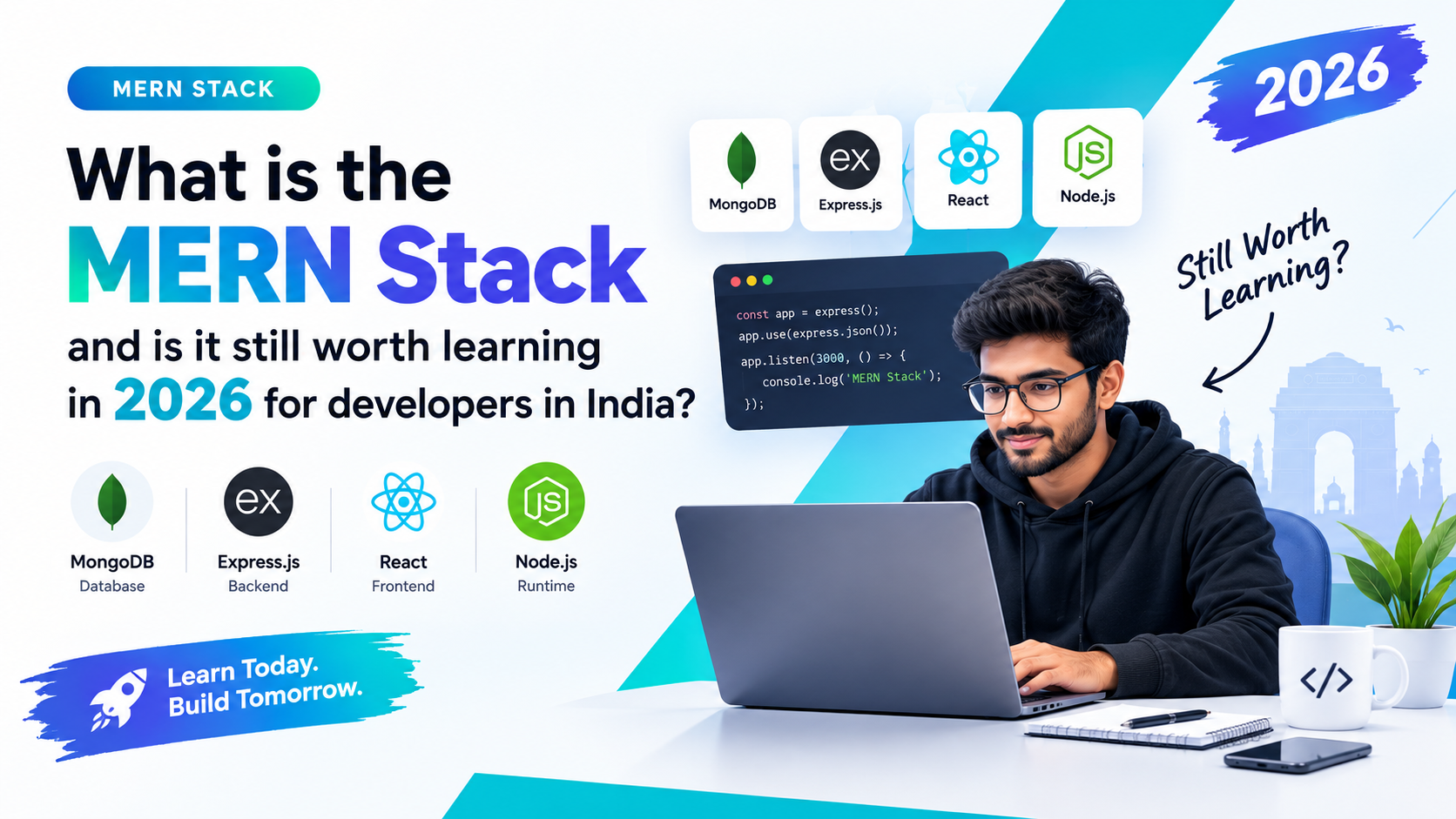
If you’ve searched for full stack development courses, tutorials, or job listings anytime over the past few years, you’ve definitely come across the term MERN stack. However, with newer frameworks, AI tools, and changing hiring trends, it’s genuinely fair to wonder whether this stack still holds up in 2026. So, let’s break down what is the MERN stack and is it still worth learning in 2026 for developers in India, based on real job market demand and practical relevance.
What Is the MERN Stack, Exactly?
MERN is an acronym representing four technologies that work together to build full stack JavaScript applications: MongoDB, Express.js, React, and Node.js. Since all four components use JavaScript, developers can build both the frontend and backend of an application using a single programming language, which genuinely simplifies the learning curve and development workflow.
MongoDB
MongoDB is a NoSQL document database that stores data in flexible, JSON-like documents rather than rigid tables, making it well-suited for applications where data structures evolve frequently.
Express.js
Express is a lightweight backend framework built on top of Node.js, handling routing, middleware, and server-side logic with minimal setup required.
React
React is a frontend JavaScript library, maintained by Meta, used for building dynamic, component-based user interfaces that update efficiently as data changes.
Node.js
Node.js allows JavaScript to run on the server side, rather than just inside the browser, enabling developers to build the entire application backend using the same language as the frontend.
Why MERN Became So Popular in the First Place
Before MERN gained traction, developers typically needed separate languages for frontend and backend development, like JavaScript for the browser and PHP, Java, or Python for the server. Therefore, MERN’s biggest appeal was genuinely simplifying this process, allowing developers to work across the entire application using just one language. Consequently, this reduced context-switching, sped up development, and made full stack development significantly more accessible to beginners.
Is the MERN Stack Still Relevant in 2026?
Job Market Demand in India
Checking current listings on Naukri, LinkedIn, and Indeed India reveals that MERN stack skills remain consistently requested, particularly among startups and mid-sized companies building web applications and SaaS products. Therefore, while newer technologies have emerged, MERN hasn’t disappeared from hiring requirements, it’s simply evolved alongside the broader JavaScript ecosystem.
React’s Continued Dominance
React remains one of the most widely used frontend libraries globally, and its ecosystem continues expanding with tools like Next.js, which builds directly on React’s foundation. Since React skills transfer directly into numerous modern frameworks, learning it through MERN still provides genuine long-term value.
Node.js in Modern Backend Development
Node.js also remains a dominant choice for backend development, particularly for applications requiring real-time features, APIs, or microservices architecture. Therefore, understanding Node.js fundamentals continues to matter significantly, regardless of which specific framework sits on top of it.
MongoDB’s Role Has Evolved
While MongoDB remains popular, particularly for startups prioritizing rapid development, many companies now use it alongside, rather than instead of, relational databases like PostgreSQL. Consequently, understanding MongoDB alongside SQL databases makes you more versatile than knowing just one database type alone.
What Has Changed Since MERN’s Peak Popularity
Next.js Has Become the Preferred React Framework
Rather than building React applications from scratch using Create React App, most modern projects now use Next.js, which adds server-side rendering, routing, and performance optimizations directly on top of React. Therefore, learning MERN today often naturally extends into learning Next.js as well.
TypeScript Has Become Increasingly Standard
Many companies now expect TypeScript alongside JavaScript, adding type safety to MERN applications. Consequently, modern MERN developers increasingly need to understand TypeScript fundamentals alongside the original four technologies.
AI Integration Has Become Common
Increasingly, full stack applications now integrate AI features, like chatbots or content generation, directly into MERN-based projects. Therefore, understanding how to connect APIs like OpenAI or Claude into your Node.js backend has become a genuinely valuable additional skill.
Should Developers in India Still Learn MERN in 2026?
Honestly, yes, but with a slightly updated approach. Rather than learning MERN in isolation, treating it as your foundation while layering in TypeScript, Next.js, and basic AI integration makes you significantly more competitive in today’s job market. Therefore, MERN remains a genuinely solid starting point, not because it’s the newest technology available, but because it teaches transferable, widely-used skills across the JavaScript ecosystem.
Who Should Learn MERN in 2026?
Complete Beginners to Web Development
Since MERN uses JavaScript throughout, beginners avoid the complexity of learning multiple languages simultaneously, making it a genuinely approachable entry point into full stack development.
Developers Targeting Startup Jobs
Many Indian startups continue building products using MERN or similar JavaScript-based stacks, prioritizing fast development cycles over heavily structured enterprise architecture.
Freelancers Building Client Projects
Since MERN allows rapid prototyping and deployment, freelancers often find it genuinely practical for building client websites, dashboards, and small to medium-sized applications efficiently.
Who Might Consider Alternatives Instead?
Developers Targeting Enterprise or Fintech Roles
Companies building large-scale, heavily regulated applications, particularly in banking or fintech, often prefer stacks involving Java, Python, or .NET alongside relational databases like PostgreSQL.
Developers Interested in Data-Heavy Applications
If your interests lean toward data science, machine learning, or heavily data-driven applications, learning Python alongside Django or FastAPI might align better with your specific career goals.
A Practical Learning Path for MERN in 2026
- Start with JavaScript fundamentals – Ensure you genuinely understand core JavaScript before jumping into frameworks.
- Learn React basics – Build small projects focusing on components, state, and props.
- Move into Node.js and Express – Build simple APIs and understand server-side logic.
- Add MongoDB for data storage – Practice connecting your backend to a database.
- Build a complete MERN project – Combine everything into a functional full stack application.
- Layer in TypeScript and Next.js – Once comfortable with the basics, modernize your skillset further.
This approach genuinely builds practical, job-ready experience rather than just theoretical knowledge.
Why This Matters for Kerala and India’s Growing Tech Market
As more companies across India, including Kerala’s expanding tech hubs, continue building web applications and digital products, developers who understand the full MERN ecosystem, alongside modern additions like TypeScript and Next.js, genuinely stand out during interviews and freelance opportunities. If you’re serious about building real, deployable projects rather than just following isolated tutorials, exploring a structured full stack development course can help you learn MERN alongside modern tools like AI integration, properly connected to real-world application architecture.
Additionally, since many MERN-based projects eventually need visibility online, understanding how SEO and site performance connect to frontend development gives you a broader perspective on how technical decisions affect real business outcomes.
Final Thoughts
At the end of the day, what is the MERN stack and is it still worth learning in 2026 for developers in India comes down to this: MERN remains a genuinely solid, relevant foundation, especially for beginners and startup-focused developers, provided you layer in modern additions like TypeScript and Next.js along the way. Rather than viewing it as outdated, think of MERN as your entry point into a much broader, continuously evolving JavaScript ecosystem that remains firmly in demand across India’s tech industry.
Frequently Asked Questions (FAQs)
1. Is MERN stack enough to get a job in India in 2026?It can be, especially for startup and mid-sized company roles, though adding TypeScript and Next.js knowledge significantly improves your competitiveness.
2. Should I learn MEAN or MERN stack first?MERN is generally recommended for beginners, since React has a larger community, more learning resources, and broader industry adoption compared to Angular.
3. Do I need to learn TypeScript along with MERN?While not mandatory, many companies now expect TypeScript knowledge alongside MERN, so learning it genuinely strengthens your job prospects.
4. How long does it take to learn the MERN stack from scratch?With consistent practice, most beginners become comfortable building basic MERN projects within three to four months.
5. Is MongoDB still relevant, or should I learn PostgreSQL instead?Both remain relevant. MongoDB suits flexible, startup-style projects well, while PostgreSQL is often preferred for structured, relationship-heavy applications, so learning both eventually makes you more versatile.