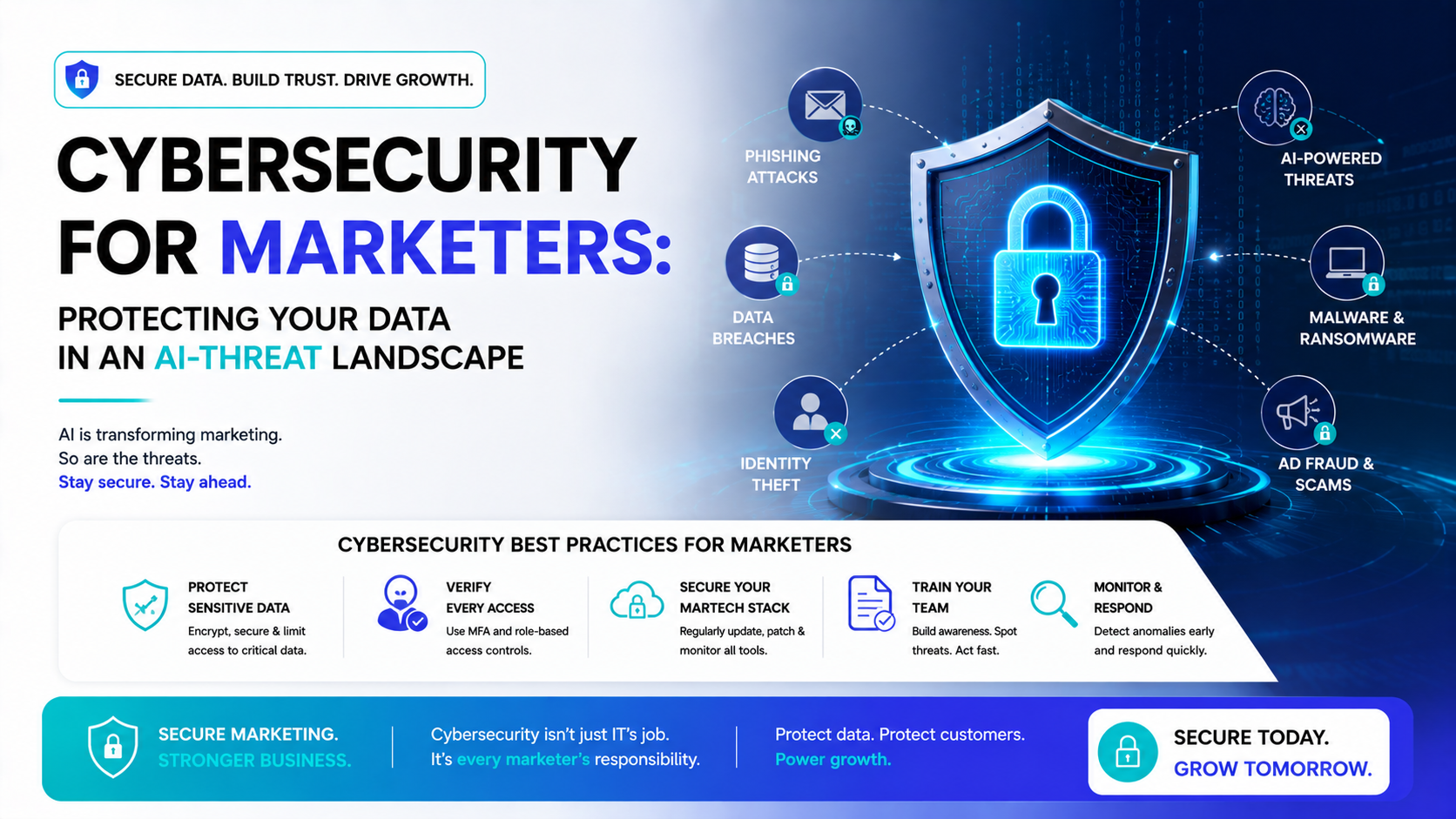
Think about the sheer volume of valuable data your growth team handles every day. Between email subscriber lists, customer relationship management (CRM) systems, behavioral tracking, and pixel data, marketing teams sit on a goldmine of sensitive consumer information. Unfortunately, malicious hackers know this.
As modern growth teams rapidly adopt artificial intelligence in marketing to automate campaigns and scale personalization, they unintentionally open new doors for cybercriminals. The tools we rely on to optimize conversions are the exact same entry points hackers exploit to orchestrate sophisticated data breaches.
To survive this shift, understanding cybersecurity for marketers is no longer optional it is a core business operational requirement. If you want to build high-performance campaigns without compromising user privacy, you must learn to recognize AI-powered threats and defend your brand’s digital infrastructure.
Why Marketing Teams Are the New Primary Target for Hackers
Historically, IT departments bore the brunt of security engineering, while marketing worked relatively independently in the public eye. Today, the decentralization of software deployment has shifted the focus. Marketing departments purchase, integrate, and manage more third-party software-as-a-service (SaaS) platforms than almost any other sector in an enterprise.
Every single landing page builder, analytics tag, tracking pixel, and automated email tool represents a potential vulnerability. If a malicious actor breaches just one third-party integration, they can compromise your entire system.
The Financial and Brand Equity Risks of a Marketing Data Breach
When a data breach occurs, the immediate fallout extends far beyond a temporary IT system outage:
- Erosion of Customer Trust: Consumers trust your brand with their personal details, phone numbers, and buying habits. If that data leaks, regaining that trust can take years.
- Hefty Legal Fines: Modern global data privacy regulations mandate severe financial penalties for companies that fail to implement sufficient customer data protection.
- Ad Account Disruptions: Hackers frequently target corporate ad accounts to run fraudulent campaigns, burning through your ad budget in a matter of hours.
The Evolving AI-Threat Landscape: What Marketers Face Today
Artificial intelligence has completely rewritten the playbook for cybercriminals. Legacy security tools often fail to catch these new, hyper-targeted attack variants because they simulate legitimate human user behavior perfectly.
Hyper-Realistic, AI-Generated Phishing Attacks
Traditional phishing attacks used to be easy to spot due to broken grammar, weird formatting, or obvious spelling errors. Today, bad actors use generative large language models to construct flawless, highly persuasive emails.
An attacker can easily scan your team's LinkedIn profiles, identify your marketing director, and use AI to generate an automated message that perfectly mimics the tone of an internal executive or an active software vendor. These highly targeted spear-phishing campaigns usually contain malicious links designed to steal your platform credentials.
Smart Malware and Automated Credential Stuffing
Cybercriminals now deploy automated bots powered by artificial intelligence to guess system passwords across various applications. If your team members reuse simple passwords across multiple marketing automation tools, these bots can gain administrative access within seconds, compromising your entire data stack.
Deepfakes and Brand Impersonation
AI video and audio generation tools have advanced to a point where bad actors can easily replicate executive voices or faces. Attackers can use deepfakes to impersonate brand advocates or company leaders, spreading misinformation or deceiving staff into transferring corporate funds and sharing secure customer databases.
Critical Vulnerabilities Inside the Modern Marketing Tech Stack
To build a robust defense strategy, you first need to identify where your current workflows leak information. Most risks stem from improper software administration and a lack of standardized digital marketing privacy guidelines.
[Marketing Stack Vulnerabilities] │ ├── 1. Generative AI Tools ── Risk: Data leakage via prompt history │ ├── 2. Marketing Automation ── Risk: API vulnerabilities & unauthorized access │ └── 3. Shadow IT ───────────── Risk: Unvetted browser extensions & tools
1. Unsecured Generative AI Tools and Data Leakage
When your team pastes proprietary data, customer lists, or unreleased source code into free, public generative AI tools to write copy or analyze metrics, that data often trains the public AI model. This means your competitors or outside entities could potentially extract your proprietary business information via their own prompts.
2. Marketing Automation Security Flaws
Your marketing automation platform coordinates your entire lead generation pipeline. If your APIs are poorly configured, or if you grant overly broad access permissions to junior staff members or external freelancers, you risk exposing your customer databases to unauthorized parties.
3. The Proliferation of "Shadow IT"
Shadow IT occurs when employees download and use software, browser extensions, or plugins without explicit approval from an IT manager. A team member downloading a free graphic design plugin or an unverified keyword scraping extension could accidentally install hidden malware that logs keystrokes and steals master session passwords.
Actionable Cybersecurity for Marketers: A Step-by-Step Defense Framework
Protecting your business requires a proactive approach that blends smart daily digital habits with concrete administrative settings. Use the following framework to seal structural gaps in your workflows.
Implement Strict Identity and Access Management
- Enforce Multi-Factor Authentication (MFA): Require MFA across every single platform, including your CRM, email tools, social media profiles, and ad managers. MFA stops over 99% of automated account takeover attempts.
- Apply the Principle of Least Privilege (PoLP): Only give team members the exact level of system access required to fulfill their roles. A content writer rarely needs administrative billing or data export privileges on your CRM. Immediately revoke access tokens for external agencies or contractors once a project concludes.
Establish Secure AI Usage Guidelines
Create a formal company policy regarding how your team interacts with artificial intelligence platforms. If you use AI for data analysis, ensure you purchase enterprise-grade subscriptions that explicitly state your input data will not be used for model training.
Audit Your Third-Party Integrations Frequently
Run a monthly inventory check on your website's plugins, tracking tags, and connected API webhooks. Delete any legacy software, inactive tracking pixels, or outdated extensions that your brand no longer uses to keep your attack surface as small as possible.
Aligning Security Protocols with Modern Data Privacy Regulations
Good security directly enables legal compliance. As governments around the world crack down on improper data collection, marketers must closely align their campaigns with evolving legal frameworks.
Regulation | Primary Geographical Focus | Core Requirement for Marketers |
GDPR | European Union / Global Citizens | Requires explicit user consent before activating tracking cookies; grants users the right to total data deletion. |
CCPA / CPRA | California, USA | Dictates clear "Do Not Sell My Info" opt-outs and demands complete transparency regarding data processing. |
Local UAE Frameworks | United Arab Emirates | Mandates localized storage rules for sensitive data and strict consumer privacy controls. |
Maintaining airtight data breach prevention strategies ensures you never run afoul of these rules. Transitioning your organization toward privacy-first marketing tactics like relying on zero-party data directly volunteered by consumers rather than aggressive third-party scraping keeps your brand safe, compliant, and highly respected.
To build the advanced skills required to balance data compliance with technical execution, check out the specialized training paths offered through the Milaaj Digital Academy AI-Based Digital Marketing Course. Developing a deep comprehension of technical infrastructure ensures you stay ahead of both search algorithms and data security vulnerabilities.
Frequently Asked Questions (FAQs)
Why should digital marketers care about cybersecurity?
Digital marketers manage massive databases of consumer information, making them prime targets for data theft. A security failure can ruin brand reputation, stop active ad accounts, and trigger immense regulatory compliance fines.
How do cybercriminals use AI to target marketing teams?
Bad actors leverage AI to craft hyper-realistic phishing emails, deploy fast password-cracking tools, and create convincing deepfakes to trick staff into revealing administrative login credentials.
What is the safest way to use generative AI tools without leaking proprietary data?
Avoid pasting sensitive customer lists, private corporate metrics, or unique source code into free public AI platforms. Use enterprise versions that offer explicit data opt-outs, ensuring your entries remain confidential and never train public models.
What is the first security step a marketing team should take?
Enforce mandatory Multi-Factor Authentication (MFA) across every single piece of software, asset manager, and ad platform your team uses. This single setting stops the vast majority of automated profile hacks.
Preparing Your Team for the Future of Secure Marketing
The intersection of artificial intelligence and cybersecurity will continue to shape the digital landscape. As tools evolve, growth professionals must transition from passive users of technology into active guardians of consumer trust.
By building strong security cultures, using encrypted systems, and maintaining comprehensive visibility over your entire software suite, you protect your business from sophisticated data liabilities. If you are ready to master modern campaign deployment, explore the comprehensive resources available on the Milaaj Digital Academy to position your business for resilient, secure growth.