Imagine asking your company's AI tool to analyze last quarter's financial performance against your current inventory data. Standard AI models might freeze, give you outdated public facts, or worse make up plausible-sounding lies.
For years, businesses used standard Retrieval-Augmented Generation (RAG) to solve this by feeding specific documents to an AI. But standard RAG has hit a wall. It is static, literal, and easily confused by complex, multi-step business questions.
Enter the next evolution of business intelligence: Agentic RAG.
This technology changes how companies interact with internal data. By combining autonomous AI agents with a secure private knowledge base, businesses can finally deploy AI that thinks, verifies, and executes complex tasks independently.
Let us break down exactly what this technology is, how it works, and why your organization needs a private infrastructure today.
Understanding the Core Architecture
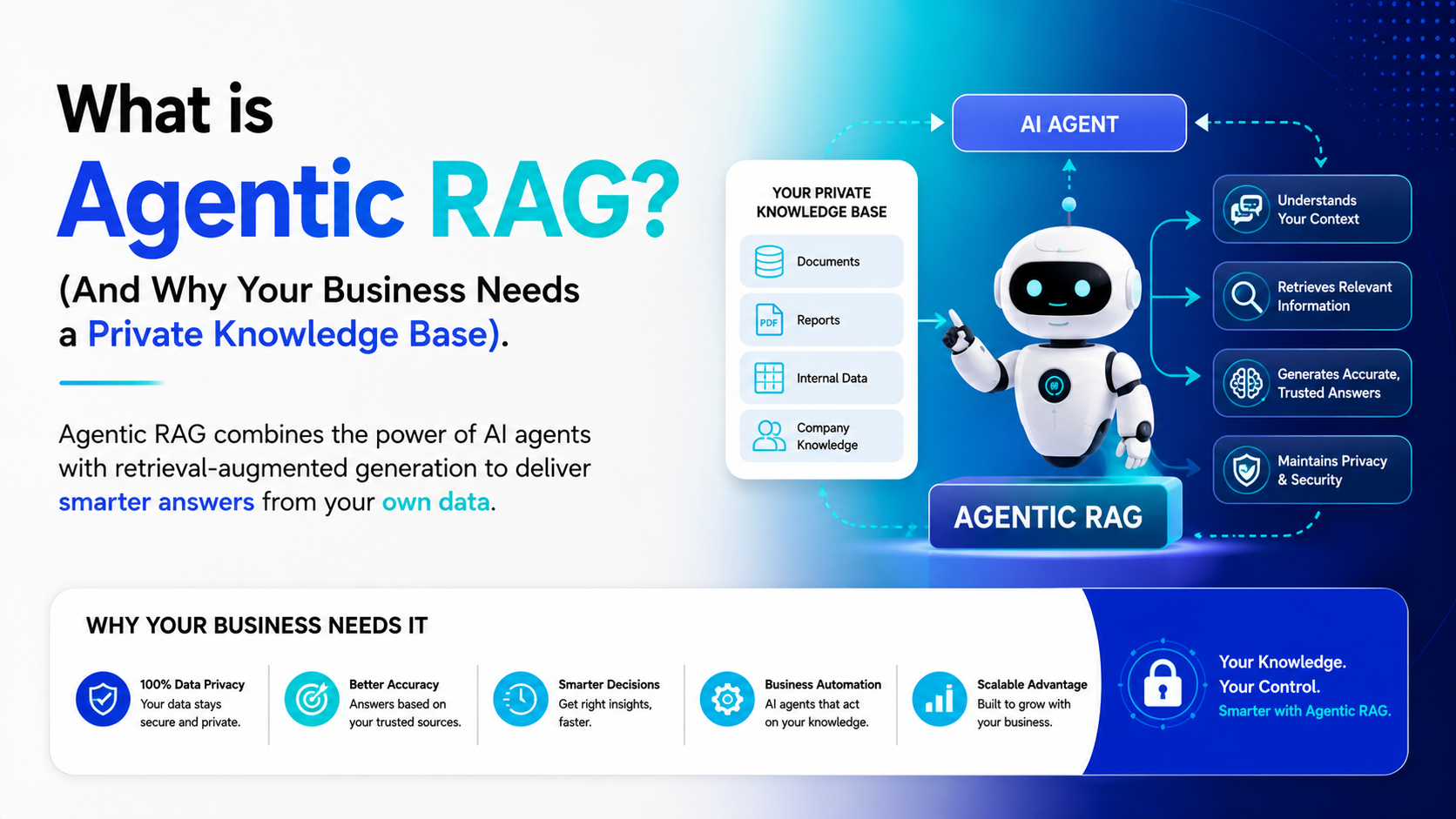
To see why Agentic RAG is a massive leap forward, we must look at how it improves upon regular data search methods. The diagram below highlights this structural flow, showing how an autonomous agent acts as the brain between your multi-document private knowledge base and the large language model.
What is Agentic RAG? Defining the Next Era of AI
To answer what is Agentic RAG, we first need to understand its predecessor. Traditional Retrieval-Augmented Generation (RAG) acts like a simple keyword search engine attached to a smart writer. When you ask a question, the system pulls relevant document snippets from a vector database and hands them to large language models (LLMs) to write a clean response.
While helpful, standard RAG is passive. If the first search results are bad, the AI gives a bad answer. It cannot double-check its work or reformulate its search query.
Agentic RAG introduces an active decision-making layer. It replaces simple text retrieval with intelligent AI agents. These agents do not just fetch data; they plan, evaluate, cross-reference, and reason. If an agent searches your company database and finds incomplete information, it autonomously recognizes the gap, alters its search strategy, looks into another document folder, and compiles a comprehensive answer.
Key Takeaway: Traditional RAG is a one-way street: Query → Retrieve → Answer. Agentic RAG is a dynamic, iterative loop: Query → Plan → Retrieve → Evaluate → Refine → Answer.
How Agentic RAG Systems Process Complex Queries
Standard search tools struggle with multi-layered questions like: "Should we increase our marketing budget for our advanced AI course based on last month's conversion rate and current team capacity?"
An Agentic RAG framework handles this easily through a sophisticated multi-step process:
- Query Deconstruction: The system breaks your complex prompt into smaller, bite-sized tasks.
- Autonomous Tool Selection: The agent decides which specific tools or private databases it needs to access first (e.g., CRM data vs. HR schedules).
- Iterative Evaluation: It reads the retrieved data. If the numbers look conflicting, it queries an alternate internal document to verify the accuracy.
- Synthesized Execution: Once satisfied with the quality of the information, it compiles a verified, context-aware answer for the user.
This loop dramatically reduces LLM hallucinations the technical term for when an AI invents false data making it reliable enough for high-stakes corporate operations.
Why Your Business Needs a Private Knowledge Base
Deploying advanced AI agents is pointless if they lack secure access to your proprietary business information. Building a private knowledge base is the critical foundation that makes enterprise AI both useful and safe.
1. Ironclad Data Security and Privacy
You cannot upload proprietary source code, client records, or sensitive financial data to public AI models. Doing so risks massive regulatory penalties and data leaks. A private knowledge base keeps your information locked inside your own secure servers or private cloud instances. Your data is never used to train public algorithms, ensuring your intellectual property remains yours.
2. Eliminating LLM Hallucinations
Public AI models excel at creative writing but fail at absolute factual accuracy regarding your specific brand. When you hook up an agentic system to an internal vector database filled with your verified manuals, PDFs, and spreadsheets, the AI restricts its answers to your verified data. It stops guessing and starts cross-referencing.
3. Streamlining Enterprise AI Workflows
In modern business, data lives across isolated silos: Slack channels, Google Drive, Notion, and local hard drives. A centralized private knowledge base consolidates these fragmented data points. Smart AI agents can then navigate these unified channels to automate tedious enterprise AI workflows like onboarding employees, drafting compliance reports, or auditing customer service logs.
Strategic Implementation of Agentic RAG
Moving from traditional data management to an agentic model requires a clear roadmap. If you want to master these implementation strategies and learn how to build modern systems from scratch, checking out an ai based digital marketing course can provide you with the foundational framework needed to understand user intent, digital structures, and automation design.
Here is how a successful rollout looks in practice:
1.Data Auditing and Cleaning:Phase 1.
Identify all internal documents, PDFs, CRM logs, and training materials. Clean out outdated files to ensure the AI does not reference obsolete corporate policies.
2.Vector Database Setup:Phase 2.
Convert your unstructured text into numerical formats (embeddings) and store them in a secure vector database like Pinecone, Milvus, or Qdrant for lightning-fast retrieval.
3.Agent Configuration and Tooling:Phase 3.
Define the rules, boundaries, and tools for your AI agents. Program them to recognize when to look for internal metrics and when to flag a query for human review.
4.Testing and Guardrail Optimization:Phase 4.
Run simulations with complex corporate prompts. Fine-tune system guardrails to ensure data privacy boundaries are rigidly maintained across different user access tiers.
Real-World Use Cases: Agentic RAG in Action
How does this setup change daily business operations? Let us look at three distinct industries:
Automated Customer Support and Technical Support
Standard chatbots can only regurgitate pre-written FAQ answers. If a customer has a complex, multi-part hardware issue, traditional systems break down. An Agentic RAG chatbot can look up the user's specific purchase history, search the technical engineering manual inside the company database, verify if a fix applies to that specific model version, and walk the customer through a custom troubleshooting protocol.
Corporate Legal and Compliance Audits
Legal teams spend thousands of hours checking contracts against shifting regional regulations. An agentic framework can review a 100-page contract, independently query local compliance databases, compare clauses against past corporate templates, and highlight hidden legal risks automatically.
Deep Market Intelligence and Trend Analysis
Instead of manually scraping news and building spreadsheets, marketing teams can use agents to monitor competitive shifts. The agent scans market trends, cross-references findings with internal inventory data, and outputs an optimized product launch timeline. For modern marketers looking to lead this shift, gaining expertise via specialized institutions like the Milaaj Digital Academy ensures you stay ahead of these rapidly evolving automated landscape changes.
Comparison: Traditional Search vs. Standard RAG vs. Agentic RAG
Capability | Traditional Search | Standard RAG | Agentic RAG |
Core Search Style | Exact Keyword Match | Semantic Meaning | Intent-Driven Reasoning |
Multi-Step Tasks | Impossible | Fails Frequently | Excels via Iterative Loops |
Handling Missing Data | Returns Zero Results | Hallucinates or Panics | Searches Alternate Folders |
Verification Level | None | Low | High (Self-Reranking) |
Summary: Future-Proof Your Business Intelligence
As data grows exponentially, companies that rely on manual searching will fall behind. Understanding what is Agentic RAG is no longer just an academic tech exercise it is a core competitive necessity.
By building a secure, private knowledge base and letting autonomous AI agents navigate it, you protect your sensitive corporate data, streamline complex enterprise AI workflows, and completely eliminate costly LLM hallucinations. Give your teams the ability to make fast, data-backed decisions with absolute confidence.
Frequently Asked Questions (FAQs)
What is the main difference between RAG and Agentic RAG?
Standard RAG fetches documents once based on a user's prompt and summarizes them. Agentic RAG uses an iterative agent loop that evaluates search results, rewrites queries if the data is poor, checks multiple sources, and reasons through complex problems before delivering an answer.
Can Agentic RAG work without a private knowledge base?
While it can connect to public web sources, using Agentic RAG without a private knowledge base misses the core enterprise benefit. A private knowledge base provides the secure, proprietary context that allows agents to solve internal business problems safely without leaking data.
How does Agentic RAG minimize LLM hallucinations?
It minimizes hallucinations by forcing the large language models to ground their answers in your verified documentation. The autonomous agent layer acts as a strict fact-checker, reviewing retrieved snippets and self-correcting errors before displaying any output to the user.
Is it difficult to implement Agentic RAG for small businesses?
Setting up a custom framework from scratch requires development expertise, but the availability of modern vector databases and agent frameworks (like LangChain or LlamaIndex) is making deployment faster and more accessible for growing organizations every day.