How many mobile applications do you have installed on your smartphone right now? Fifty? Over a hundred? Now, think about how many of those you actually open every single week. If you are like most users, you rely heavily on just a handful of platforms while the rest sit idle, gathering digital dust and demanding constant updates.
For more than fifteen years, the smartphone market operating model has remained identical: a grid of colorful, square icons waiting for a physical finger tap. This approach requires you to act as the human coordinator between fragmented services. If you want to plan an evening out, you must open a food delivery platform, close it, launch a ride-hailing software tool, toggle over to a calendar interface, and manually copy data between them.
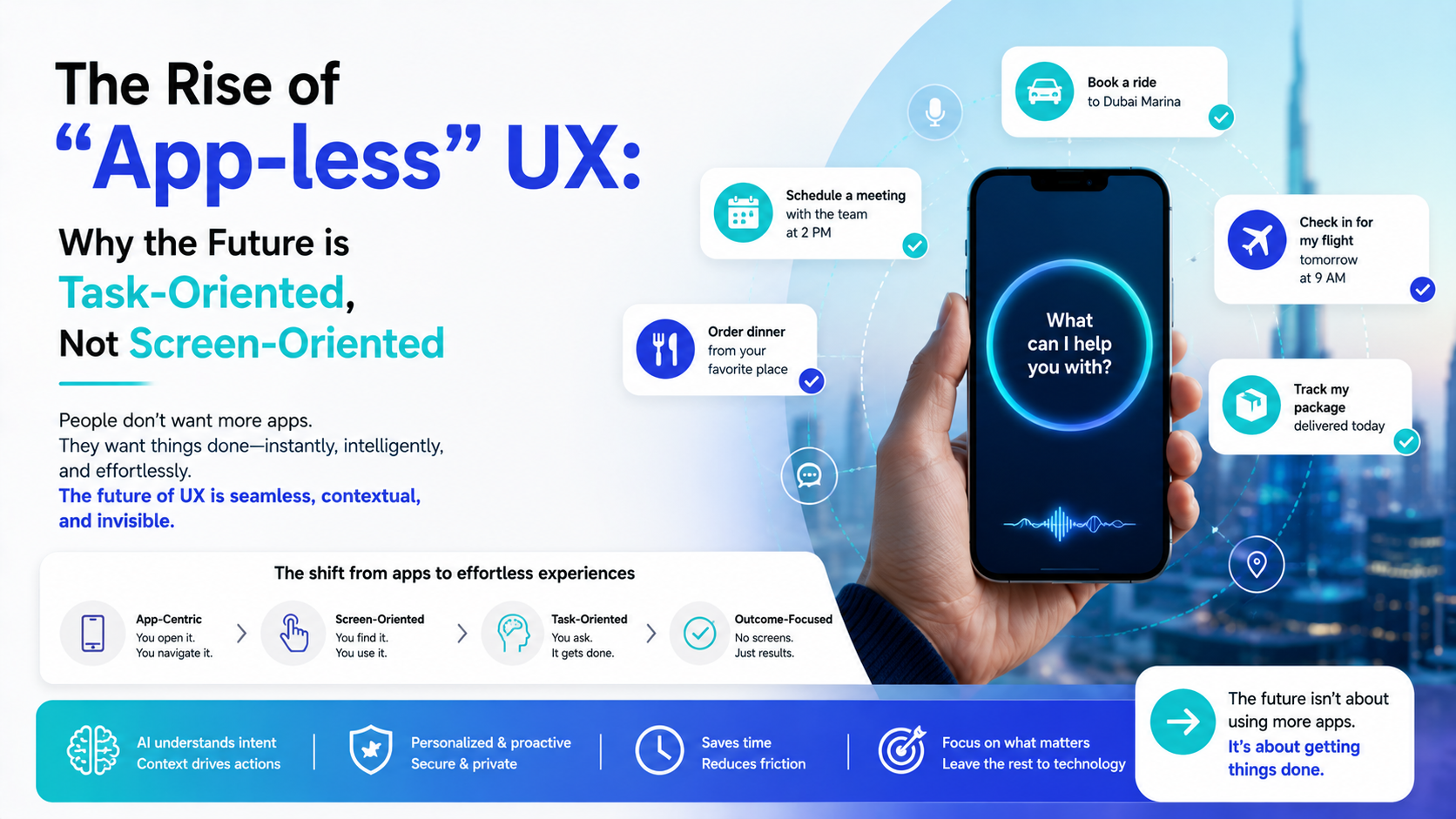
But the digital landscape is undergoing a massive architectural shift. We are witnessing the rapid rise of App-less UX a profound transformation where digital ecosystems move away from isolated, screen-oriented silos toward ambient, task-oriented design.
The future of technology will not be about building more applications. Instead, it will focus entirely on fulfilling user intentions seamlessly across a unified layer of intelligence.
What Exactly is App-less UX?
To understand this paradigm shift, we must first analyze the fundamental constraints of our current digital framework. Traditional user experience trends require the consumer to adapt to the computer's organizational structure. You must know which specific micro-service houses the utility you need, navigate its unique onboarding screen, and conform to its particular menu layout.
Traditional Screen-Oriented UX (Fragmented Silos)[User] ──> [Open App A] ──> [Execute Step 1] ──> [Close App A] ──> [Open App B] ──> [Execute Step 2] ──> [Close App B]Modern Task-Oriented App-less UX (Unified Layer)[User Intent] ──> [Omnipresent AI Engine] ──> [Automated Backend Execution across Providers]
App-less UX flips this dynamic entirely. Powered by high-level AI-driven interfaces, this design philosophy strips away the structural friction of opening, logging into, and switching between discrete software programs. Instead of interacting with individual applications, users interact directly with an adaptive, invisible operating plane.
Instead of saying, "I need to open my airline app to check my flight status," you simply state your intent: "What is my gate status?" The system retrieves the information instantly, drawing data from backend web engines without ever forcing you to see or interact with a dedicated native app interface.
The Core Pitfalls of the Screen-Oriented Paradigm
The app ecosystem has reached a breaking point. App stores are fundamentally overcrowded, user acquisition costs are at an all-time high, and consumers are suffering from intense digital fatigue.
1. High Cognitive Load and App Fatigue
Every new application forces users to learn a fresh navigational language. Buttons move, search bars change positions, and payment checkouts use different authentication flows. This structural fragmentation elevates the baseline cognitive load, making routine online management feel increasingly tedious.
2. Information and Service Silos
Data does not flow naturally between standalone mobile apps. If you purchase an event ticket online, that confirmation barcode remains locked behind a specific company wall until you manually export it or transfer it to a native mobile wallet. This continuous friction contradicts the fundamental goal of modern human-computer interaction: making execution friction-free.
The Pillars of Task-Oriented Design
Transitioning to an App-less UX infrastructure requires designers and developers to embrace an entirely new set of foundational mechanics. This shift requires moving away from visual page layouts and moving toward contextual automation frameworks.
1. Intent Recognition Over Form Filling
In a screen-oriented setup, executing a command requires inputting variables into defined text boxes, radio buttons, and drop-down selectors. In a task-oriented model, advanced natural language processing parses your core intent from raw voice or text input, matching requests directly with corresponding backend APIs.
2. Context-Aware Design
True task-oriented computing thrives on deep environmental context. A smart system continuously analyzes your physical location, current time, historical habits, and schedule constraints to predict what actions you need next.
If you are walking past a terminal gate at Dubai International Airport, an ambient interface should display your boarding pass automatically on your lock screen without requiring a manual search or swipe.
3. Progressive Disclosure via Micro-Interfaces
App-less design does not imply that visual interfaces will vanish completely. Instead, standard full-page applications will give way to lightweight, temporary micro-interfaces. These small, dynamic widgets render on demand to display vital data or confirm a transaction, dissolving completely the moment you complete the task.
Technological Drivers Powering the App-less Shift
This architectural pivot is not just a speculative design theory. It is a tangible reality enabled by several massive technological shifts reaching structural maturity.
1. Large Language Models (LLMs) as Operating Systems
Modern foundational AI models excel at translating human conversation into actionable machine code. Operating systems can now use AI agents to act as intermediaries, translating a single voice prompt into a sequence of backend web API requests that span multiple service providers effortlessly.
2. The Maturation of Ambient Computing
As hardware ecosystems diversify into smart glasses, advanced wearables, and connected home nodes, the concept of a static screen becomes obsolete. If you want to check out the latest high-performance tech hardware, tracking specifications across multiple application storefronts is inefficient. You need an environment where information flows fluidly to whatever surface or audio channel is closest to you.
For instance, if you look at the technical ecosystem outlined on the Milaaj Platform, modern hardware procurement requires fluid access to real-time specifications, pricing indexes, and compatibility tools across diverse devices, demonstrating the clear need for zero-friction interaction spaces.
3. Universal APIs and Headless Architectures
For services to participate in an app-less landscape, they must decouple their underlying functionality from their visual front-ends. Headless platforms expose deep utility via robust APIs, letting external AI agents check inventory, process payments, and modify bookings without requiring a human to click a physical button on a proprietary page.
Real-World Examples of App-less Interfaces in Action
We can already witness the foundational layers of this design paradigm taking shape across the consumer technology market.
- Dynamic Lock Screen Widgets: Both iOS and Android continue to expand live-updating notifications that let you track an incoming ride share, view sports scores, or control home automation devices directly from your lock screen without opening the root app.
- Super Apps and Chat Interfaces: In various regional markets, platforms combine communication, digital payments, commerce, and transit into a single conversational interface, lowering the barriers of traditional application switching.
- AI Hardware Innovations: New experimental consumer electronics devices attempt to bypass the application grid entirely, relying on standalone natural language interfaces to execute complex digital workflows on behalf of the user.
The Strategic Impact on Digital Creators and Businesses
As the digital ecosystem shifts toward an app-less reality, the strategies that companies use to build digital products must evolve concurrently. Organizations that fail to adjust their approach risk becoming completely invisible to AI-driven search agents.
┌────────────────────────────────────────────────────────┐│ THE APP-LESS UX EVOLUTION MAP │├───────────────────────────┬────────────────────────────┤│ Old Screen-Oriented Focus│ New Task-Oriented Focus │├───────────────────────────┼────────────────────────────┤│ • App Store Optimization │ • API Discoverability ││ • Screen Session Time │ • Task Completion Speed ││ • Rigid Visual Branding │ • Structured Schema Data │└───────────────────────────┴────────────────────────────┘
Businesses must stop evaluating user engagement purely by app downloads or page views. In a task-oriented economy, the defining metric of success is the speed and accuracy of task completion.
If your service can answer a user's question or process a transaction via an API in three seconds, your brand creates far more long-term value than a slow, bulky native application that demands an 80-megabyte download. For professionals looking to navigate this changing landscape, staying ahead of these paradigm shifts requires structured modern technical training. Exploring resources like the Milaaj Academy Blog Guides can provide deep insights into building agile digital products ready for an AI-first economy.
Conclusion: The Horizon Beyond the Icon Grid
The app-centric model was a vital stepping stone in the history of personal computing. It gave us a clean, visual method to interact with complex cloud servers when web design was primitive. However, as computational intelligence scales up, forcing humans to act as mechanical routers between siloed interfaces is no longer an efficient approach.