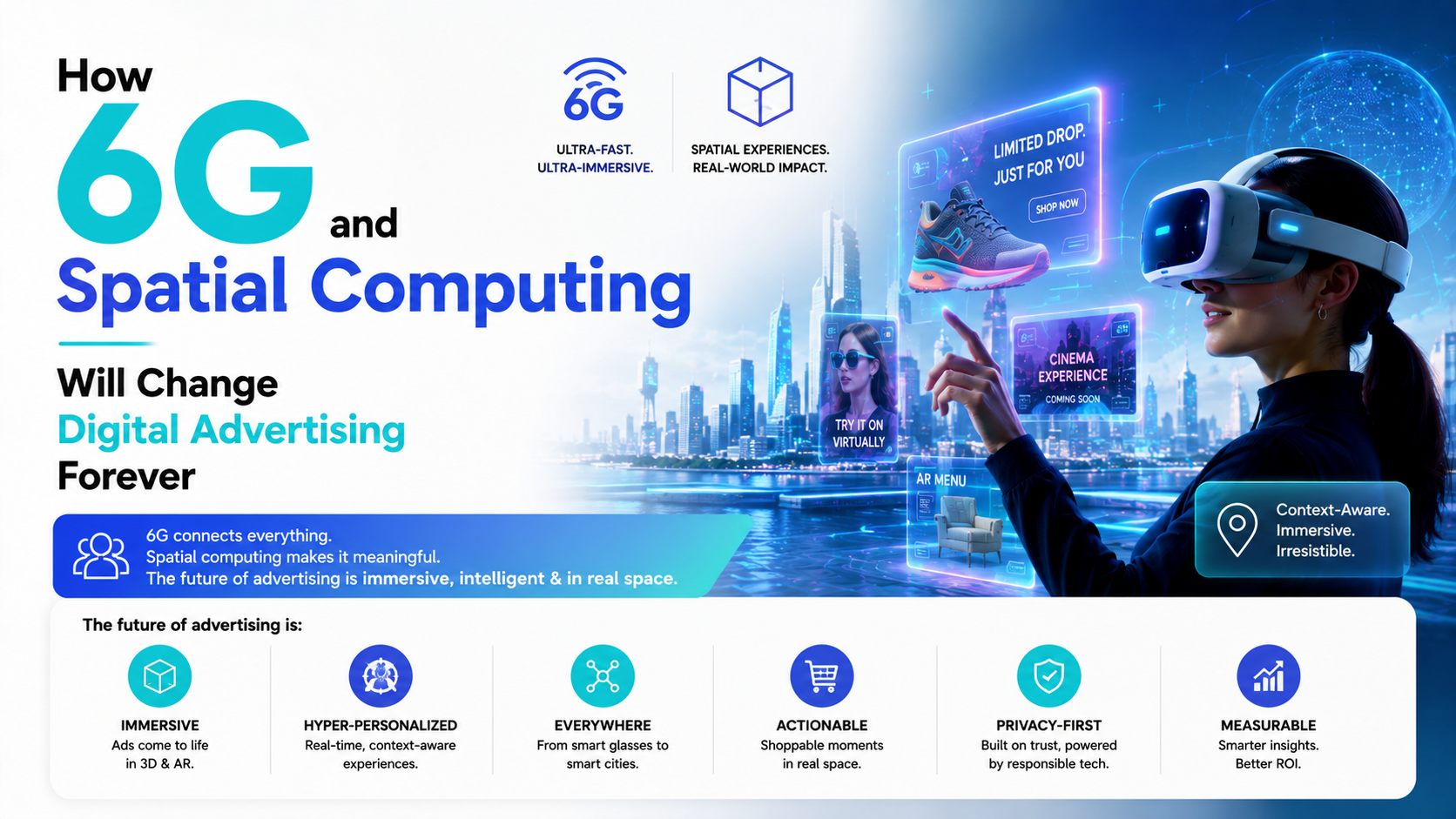
The digital advertising landscape undergoes a massive transformation every decade. We migrated from desktop banners to mobile-first video ads, and we optimized campaigns for algorithm-driven social feeds. Today, static screens limit our digital reach. However, a massive technological convergence is preparing to shatter these physical boundaries. The rapid development of 6G networks alongside breakthrough spatial computing hardware promises to shift how brands interact with consumers. Soon, static 2D ad formats will feel completely obsolete.
When you merge ultra-fast connectivity with immersive environment mapping, the physical world transforms into an active canvas for brands. This deep integration represents a profound evolutionary shift in user engagement. In this deep-dive article, we explore how 6G and spatial computing in digital advertising will rewrite the rules of modern marketing, establish new formats, and demand a completely fresh set of skills from future digital marketers.
The Dynamic Duo: Defining the Core Technologies
To grasp the scale of this disruption, you must look at how these two parallel technologies complement each other perfectly. Without high-speed infrastructure, hardware lags; without intelligent hardware, networks have nothing meaningful to transmit.
What is Spatial Computing?
Spatial computing blends the physical world with digital data in a seamless, interactive format. Devices like advanced mixed-reality glasses, smart visors, and gesture-controlled sensors track user eye movements, environmental dimensions, and real-time hand gestures. Instead of staring down at a handheld smartphone screen, users consume data projected cleanly onto their physical surroundings. This changes digital media consumption from an isolated, detached viewing activity into a fully physical, spatial experience.
What is 6G and Why Does It Matter?
While 5G laid a sturdy foundation for mobile video streaming, 6G accelerates wireless infrastructure to sub-terahertz frequencies. Experts estimate that 6G networks will deliver speeds up to 100 times faster than 5G, featuring virtually zero latency. This microsecond responsiveness allows billions of connected devices to process heavy datasets instantly. For marketers, 6G represents the ultimate pipeline. It handles the continuous rendering of complex, interactive 3D assets directly within your user's physical vision without stutter or loading screens.
How 6G and Spatial Computing in Digital Advertising Alters Brand Engagement
The combination of these tools gives birth to immersive advertising. In a spatial ecosystem, advertising shifts away from interrupting an active user. Instead, it embeds contextually relevant, highly interactive utilities directly into the consumer's environment. Advertisers will transition from buying pixels on a rectangular mobile screen to purchasing spatial coordinates in the physical world.
1. Contextual Hyper-Personalization in Real-Time
Imagine walking down a busy shopping district. Your spatial computing visor checks your localized data preferences via secure cloud edge nodes over 6G. Rather than displaying generic pop-up banners, the storefront ahead shifts color, displaying a personalized interactive menu tailored specifically to your exact tastes. A digital preview showcases how a pair of shoes on display looks on your feet in real time. This frictionless blend of augmented reality ads and immediate consumer intent redefines retail discovery.
2. Interactive and Gamified Branded Worlds
Brands will no longer rely solely on producing short video commercials to explain value propositions. Instead, next-gen marketing relies heavily on experiential storytelling. An automotive company can launch a global spatial computing campaign where users place a life-sized, fully functional 3D rendering of a new electric SUV right into their own garage. Consumers can open the virtual doors, inspect the digital battery architecture, and even initiate an immersive test drive through custom virtual landscapes, all powered by rapid 6G edge computing workflows.
3. Seamless Commerce Without App Disruptions
Spatial marketing eliminates typical web checkout steps. If you see a digital avatar wearing an appealing jacket during an immersive live event broadcast, a simple hand gesture brings up product details. The 6G network instantly processes biometric payment confirmation, confirms stock availability at the nearest local warehouse, and schedules immediate drone delivery. This entirely bypasses the traditional steps of opening an external browser, entering card info, and waiting on slow redirects.
The Technical Architecture Supporting Next-Gen Marketing
Deploying these immersive campaigns requires a massive technical paradigm shift behind the scenes. Moving 3D spatial files instantly to millions of global users demands unprecedented infrastructure optimizations:
- Edge Computing Nodes: 6G processes massive graphical assets close to the end user rather than relying on distant data warehouses, preventing spatial tracking disorientations.
- Real-Time Data Processing: Marketers analyze active user gazes, posture variables, and immediate emotional indicators to dynamically tweak ad messaging mid-experience.
- Bandwidth Efficiency Protocols: Dynamic AI compression algorithms compress dense volumetric video, rendering only the specific elements directly within the consumer's line of sight to save bandwidth.
Overcoming the Barriers: Privacy and Technical Hurdles
This major shift brings critical industry responsibilities. Tracking user surroundings, gaze patterns, and biometrics raises major data privacy concerns. Advertisers must build robust, transparent user-consent frameworks to protect consumer trust. Strict local data storage and secure decentralized processing solutions must become baseline corporate standards. Furthermore, hardware accessibility must scale globally; spatial eyewear needs to remain light, affordable, and highly energy efficient for mainstream audiences to adopt it fully.
Preparing for the Future: Up-skilling Your Marketing Career
As standard text and video banners decline, the demand for specialized talent will skyrocket. The future marketing agency looks less like a traditional copywriting shop and more like an advanced spatial software studio. Creative teams must develop deep expertise in 3D modeling, spatial environment psychology, and agile data structures to stay competitive.
If you want to master these foundational frameworks, learning core digital methodologies remains essential. Aspiring professionals should explore an ai based digital marketing course to gain comprehensive skills in modern automation and programmatic setups. Building data fluency early ensures you stay highly valuable as the industry transitions into spatial, real-time setups. Discover structured growth options by visiting Milaaj Digital Academy to adapt your skillset for tomorrow's complex digital economy.
Conclusion: The Dawn of Spatial Advertising
The combination of 6G and spatial computing in digital advertising represents far more than an incremental media upgrade. It completely redefines how humans consume informational assets and connect with businesses. By dissolving the old boundaries between the physical world and digital code, it introduces an era of immersive, helpful, and hyper-personalized interaction. Brands that embrace this technology early will capture unmatched consumer loyalty, while slower organizations risk becoming invisible in an increasingly augmented world.
Frequently Asked Questions (FAQs)
Q1: How soon will 6G and spatial computing affect digital advertising campaigns? A1: While early spatial computing platforms are active today, widespread 6G rollout is expected around late 2028 to 2030. Early ad format experimentation and spatial asset preparation are happening right now among global brands.
Q2: Will spatial computing ads completely replace traditional social media marketing? A2: It will not replace it instantly, but rather reshape it. Social channels will evolve from two-dimensional feeds into fully shared 3D spatial hubs, where users interact with branded virtual objects and immersive community events seamlessly.
Q3: What specific skills do modern creative designers need for spatial marketing? A3: Designers must transition from standard 2D layouts (like Canva or Photoshop) into learning 3D asset generation engines, spatial interface design, and programmatic asset automation workflows.