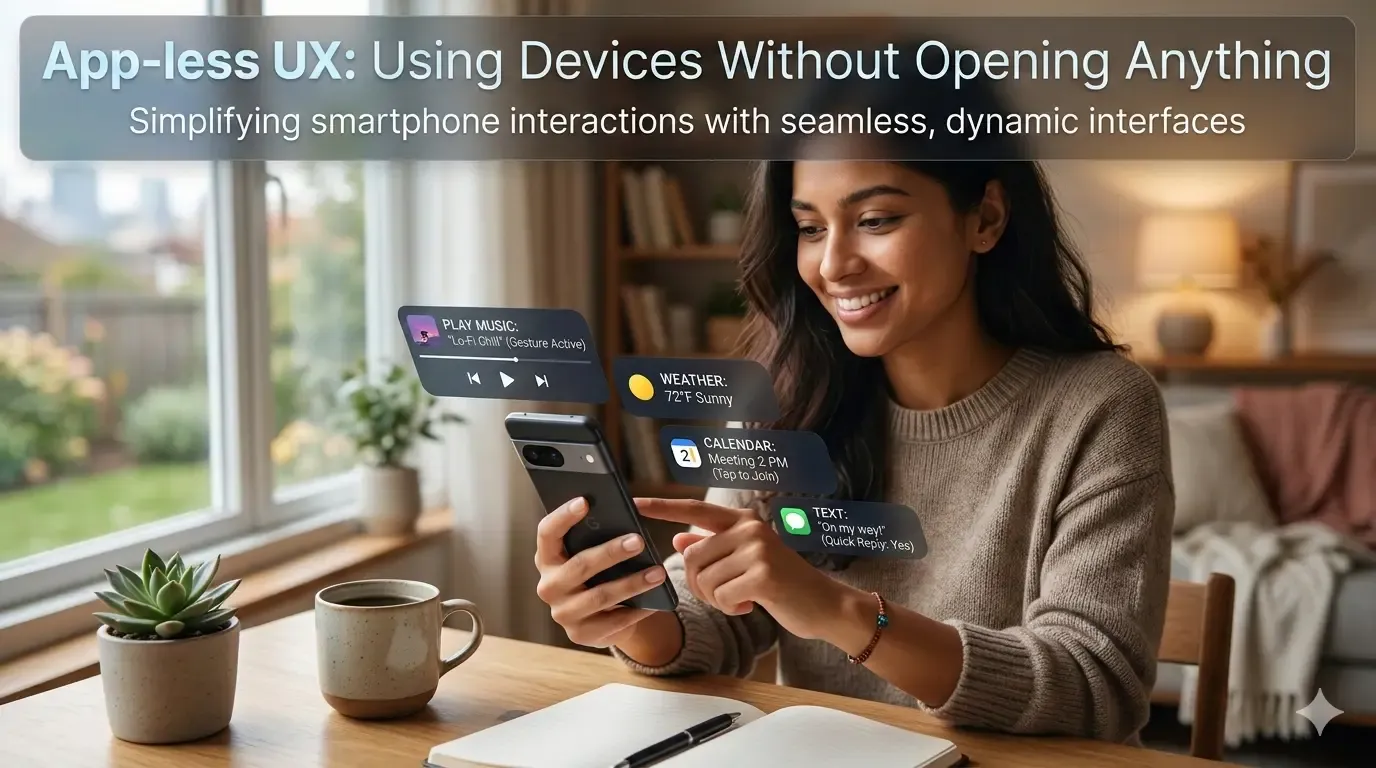
Think about how many times you unlock your phone just to open an app for a simple action. Checking the weather, turning off lights, replying to a message, or setting a reminder often requires multiple taps and switching between apps.
This is where App-less UX is transforming digital experiences.
Instead of forcing users to open applications for every task, app-less UX allows devices to perform actions instantly through contextual interaction. You no longer need to navigate menus or launch interfaces. The device understands intent and responds directly.
This article explores how app-less UX works, why it matters, and how it is shaping the future of seamless device interaction.
What Is App-less UX?
App-less UX refers to a user experience approach where interactions happen without requiring users to open or switch between apps.
Rather than relying on traditional app-based workflows, app-less UX uses:
- Context-aware interfaces
- Voice commands
- Gesture-based interactions
- Predictive automation
- Embedded system intelligence
This enables users to perform tasks directly from their device environment without navigating through multiple layers of software.
In simple terms, app-less UX replaces interaction-heavy workflows with action-first experiences.
Why Traditional App-Based Interaction Creates Friction
Apps were designed to organize digital services, but they also introduce unnecessary complexity. Every app-based action usually involves:
- Unlocking the device
- Searching for the app
- Opening the interface
- Navigating through menus
- Completing the task
Each step interrupts the user journey and increases cognitive load.
App-less UX removes these interruptions by enabling seamless interactions that respond instantly to user intent. This creates faster, more intuitive experiences that align with modern expectations for speed and convenience.
How App-less UX Works
App-less UX relies on a combination of technologies that enable devices to interpret user needs and act without requiring manual navigation.
Contextual Awareness
Devices analyze location, time, behavior patterns, and usage history to anticipate user needs.
For example:
- A calendar reminder appears when you arrive at a meeting location
- Smart lights turn on when you enter a room
- Navigation directions appear automatically before your commute
These interactions happen without opening any apps.
Voice and Gesture Interfaces
Voice assistants and gesture controls allow users to interact with devices naturally.
Instead of launching a music app:
- You ask your device to play a playlist
- The system performs the action immediately
This removes the need for traditional interfaces.
Predictive Automation
Predictive systems use machine learning to identify recurring behavior and automate tasks.
Examples include:
- Automatically silencing notifications during meetings
- Launching navigation during daily commutes
- Displaying frequently used contacts during calls
App-less UX allows these actions to occur seamlessly in the background.
Embedded Micro-Interactions
Small interactive elements can appear directly on screens or environments.
These may include:
- Quick reply prompts
- Inline payment confirmations
- Smart notification actions
- Lock screen task options
Users can complete tasks instantly without switching contexts.
Benefits of App-less UX
App-less UX improves both usability and efficiency for users and organizations.
Faster Task Completion
Users can perform actions immediately without opening applications.
Reduced Cognitive Load
Simplified workflows prevent users from becoming overwhelmed by multiple interfaces.
Improved Accessibility
Voice and gesture-based interaction supports users with diverse needs.
Seamless Cross-Device Experience
App-less UX works across phones, wearables, smart homes, and connected devices.
Higher User Satisfaction
Frictionless experiences create smoother and more intuitive engagement.
Real World Applications of App-less UX
Smart Home Systems
Devices adjust lighting, temperature, and security automatically based on presence or preferences.
Automotive Interfaces
Cars display directions, adjust settings, and respond to voice commands without requiring manual input.
Wearable Technology
Smartwatches provide health alerts and notifications without launching apps.
Retail and Payments
Contactless payments enable purchases instantly without opening financial applications.
Workplace Productivity Tools
Inline scheduling or reminders appear contextually during communication workflows.
Designing for App-less UX
To implement effective app-less UX, designers should focus on:
- Intent-driven interaction design
- Minimal visual distraction
- Seamless contextual integration
- Predictive user modeling
- Continuous feedback loops
Interfaces should guide actions naturally rather than requiring manual exploration.
Challenges to Consider
Despite its benefits, app-less UX introduces certain challenges:
- Privacy concerns with behavioral data
- Security risks in automated actions
- Integration complexity across devices
- Dependence on accurate prediction models
Designers must balance convenience with transparency and user control.
The Future of App-less UX
App-less UX is closely aligned with emerging trends such as:
- Ambient computing
- AI-driven personalization
- Smart environments
- Context-aware automation
- Invisible user interfaces
As devices become smarter, interactions will shift from interface-based navigation to intent-based execution.
Users will no longer think in terms of apps. They will simply perform actions within their digital environment.
Final Thoughts
App-less UX represents a shift from traditional interaction models toward seamless, action-focused experiences.
By eliminating the need to open apps, users can:
- Save time
- Reduce effort
- Maintain focus
- Interact more naturally with technology
Organizations that adopt app-less UX will deliver faster, smarter, and more user-friendly digital experiences that meet modern expectations for efficiency and simplicity.
App-less UX is not just a design trend. It is the foundation for the future of device interaction.