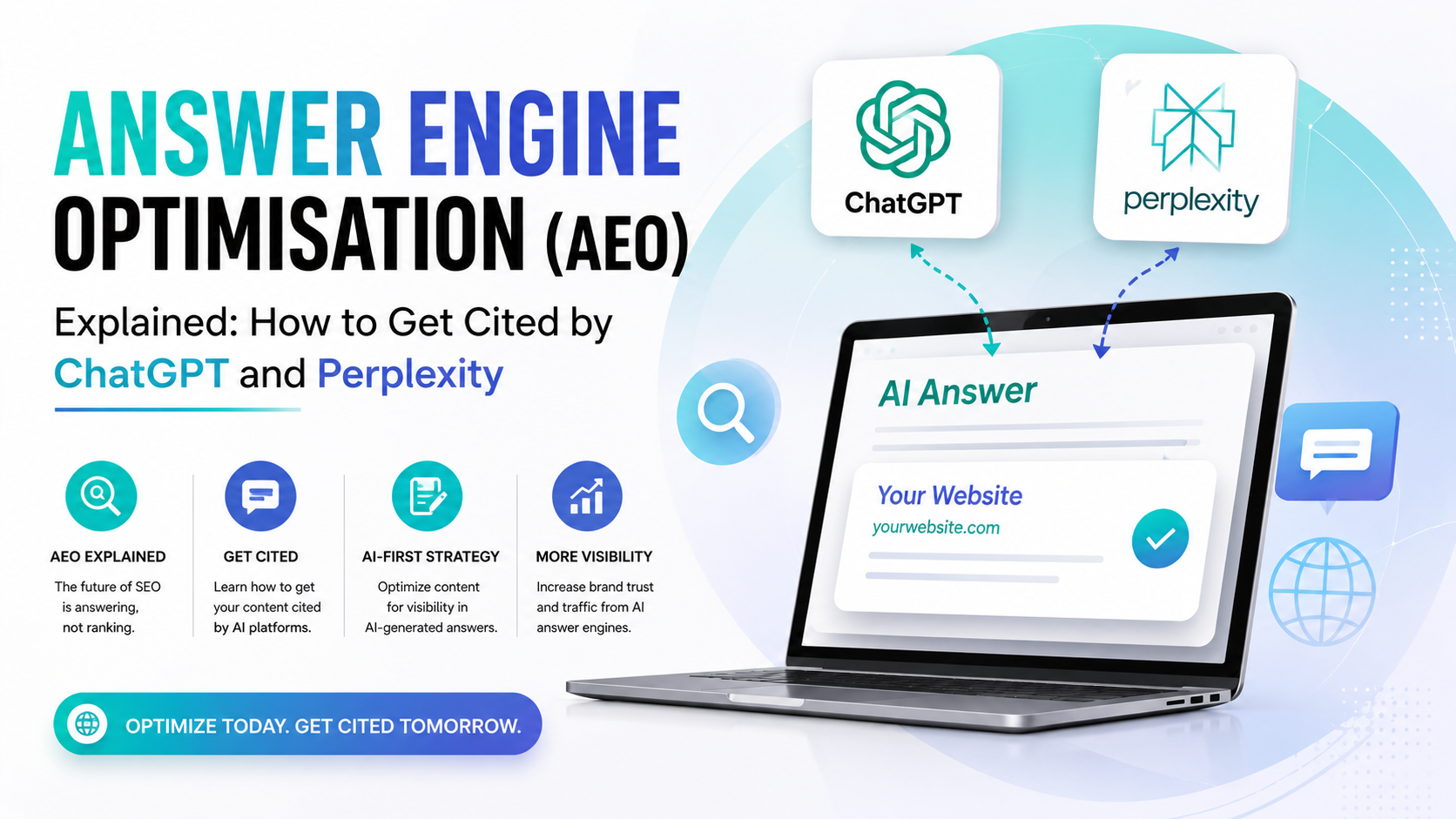
For decades, digital marketing relied on a straightforward agreement with search engines: you optimized content for specific keywords, and in return, Google sent visitors to your website via a list of ten blue links.
That agreement has fundamentally changed.
Today, hundreds of millions of users ask complex questions directly to AI-powered platforms like ChatGPT, Perplexity, and Google AI Overviews. Instead of clicking through five different websites to piece together information, users receive a single, synthesized answer delivered instantly.
These AI models do not generate answers from thin air they scan, extract, and cite trusted online sources as live references.
This shift introduces Answer Engine Optimisation (AEO).
If your digital strategy focuses entirely on traditional keyword rankings, you risk becoming invisible to buyers who get direct answers from AI.
This detailed guide provides Answer Engine Optimisation (AEO) explained alongside practical strategies to get your business cited by ChatGPT and Perplexity in 2026.
What Is Answer Engine Optimisation (AEO)?
Answer Engine Optimisation (AEO) is the practice of structuring, writing, and formatting web content so that AI engines (such as ChatGPT, Perplexity, and Claude) can easily parse, trust, and quote your content as a verified source in synthesized answers.
While classic SEO aims to attract a click to your website, AEO aims to turn your content into the definitive answer that the AI quotes.
When ChatGPT or Perplexity cites your link inside an answer, it acts as a strong endorsement. Traffic originating from AI citations often converts at a much higher rate because the user has already read the summary and trusts the source.
How ChatGPT and Perplexity Select Sources
To get cited consistently, you must understand how AI search engines retrieve and evaluate data.
1. Perplexity: Live Web Indexing and Freshness
Perplexity operates like an AI-first search engine. When a user enters a prompt, Perplexity performs a live web search, retrieves relevant pages, and extracts concise passages. It strongly favors recent content, clear statistics, structured tables, and fresh updates.
2. ChatGPT: Entity Authority and Direct Answers
ChatGPT (powered by live web browsing capabilities) evaluates source authority, domain credibility, and clarity. It favors pages that state facts clearly without fluff, cite primary data, and maintain consistent brand entity signals across the web.
5 Practical Steps to Get Cited by ChatGPT and Perplexity
To transform your existing content into citation-ready answers, implement this 5-step AEO workflow:
Step 1: Adopt an "Answer-First" Page Structure
AI models process content top-to-bottom and prioritize direct information over long introductions.
- Make the first sentence after every major heading (H2 or H3) a self-contained, 40-to-60-word answer.
- Follow that direct summary with detailed breakdowns, bullet points, or bulleted evidence.
❌ BAD (Low AEO): "In today's fast-paced digital world, many business owners wonder about the various ways software can help..."✅ GOOD (High AEO): "Answer Engine Optimisation (AEO) is a content strategy that formats web data so AI assistants can extract direct quotes and footnote citations."
Step 2: Use Question-Based Subheadings (H2 / H3)
Frame your headings using the exact natural phrasing your customers use when prompting AI assistants.
For example, replace generic subheadings like "Marketing Strategy Details" with clear question-shaped headers like "How do I get my business cited by Perplexity AI?"
Step 3: Implement Rich FAQ JSON-LD Schema
Structured data gives LLMs machine-readable summaries that they parse without interpreting complex web layouts. Wrap your key questions and direct answers in valid FAQPage schema.
JSON
{ "@context": "https://schema.org", "@type": "FAQPage", "mainEntity": [{ "@type": "Question", "name": "What is Answer Engine Optimisation?", "acceptedAnswer": { "@type": "Answer", "text": "Answer Engine Optimisation (AEO) is the process of structuring digital content so AI engines like ChatGPT and Perplexity can parse and cite it inside direct answers." } }]}
Step 4: Add Structured Comparison Tables and Statistics
AI engines frequently extract structured side-by-side data tables. When you present pricing, feature comparisons, or step-by-step specifications, use clean Markdown tables. Additionally, publish original statistics or primary research AI models actively seek out original data sources to anchor their factual statements.
Step 5: Ensure AI Crawlers Are Not Blocked
Verify that your technical infrastructure allows AI bots to read your pages. Check your site's robots.txt file to ensure you are not accidentally blocking essential AI user agents:
- GPTBot & ChatGPT-User (OpenAI)
- PerplexityBot (Perplexity)
- ClaudeBot (Anthropic)
- Google-Extended (Google)
Comparing Platform Citation Preferences
Different AI engines prioritize different data signals when generating responses.
Feature / Signal | ChatGPT Search | Perplexity AI | Google AI Overviews |
Primary Data Source | Bing Index + Live OpenAI Web Crawl | Multi-engine live web retrieval | Google Search Index & Knowledge Graph |
Citation Style | Inline footnotes & side panel links | Numbered source cards above the answer | Interactive carousel & expandable citations |
Content Preference | Deep entity authority, primary data, consensus | Fresh content, bullet points, news recency | E-E-A-T signals, Schema markup, topical depth |
Average Citations per Answer | ~2.6 citations per answer | ~6.6 citations per answer | ~6.1 citations per answer |
3 AEO Pitfalls That Block Your AI Citations
Avoid these common mistakes that prevent search bots from citing your web pages:
- Hiding Key Facts Behind Intros: Placing direct answers at the bottom of a 2,000-word article reduces the likelihood of extraction. Put key conclusions near the top.
- Relying Exclusively on Heavy JavaScript Client-Side Rendering: If your core text loads only after complex JavaScript executes in the browser, AI crawlers may bypass your content entirely. Serve clean HTML rendered on the server.
- Using Vague, Marketing-Heavy Language: Statements like "We offer industry-leading solutions for modern teams" give AI engines zero factual value. Instead, use precise descriptions: "We provide custom cloud migration software for enterprise logistics companies."
Frequently Asked Questions (FAQs)
What is the main difference between AEO and SEO?
Traditional SEO focuses on earning a high ranking position on search engine results pages to drive organic clicks. AEO focuses on structuring content so AI engines extract and cite your data directly inside generated conversational answers.
Does AEO replace classic technical SEO?
No. AEO builds on top of technical SEO. AI engines use web crawlers to discover and index content. If your site has slow loading speeds, crawl errors, or blocked pages, AI bots cannot access your content to cite it.
How do I track if ChatGPT or Perplexity is citing my website?
You can track citations by running priority buyer prompts directly through ChatGPT and Perplexity to monitor footnote links. Additionally, check your website analytics for referral traffic coming from domains like chatgpt.com or perplexity.ai.
Can small businesses get cited by AI engines over major brands?
Yes. AI engines prioritize factual accuracy, clear structure, and direct relevance over sheer domain size. A small business with clear schema, localized data, and direct answer formatting can out-cite a large corporation with vague content.
Conclusion: Claim Your Spot in the Future of Search
Search behavior is moving toward instant, direct answers. By adopting Answer Engine Optimisation (AEO) today, you ensure that your brand is not left out of the conversational search era.
Audit your high-priority web pages, implement question-based headings, format direct 40-to-60-word answers, and structure your data with JSON-LD schema. Turn your content into the definitive source that AI search engines rely on every day.