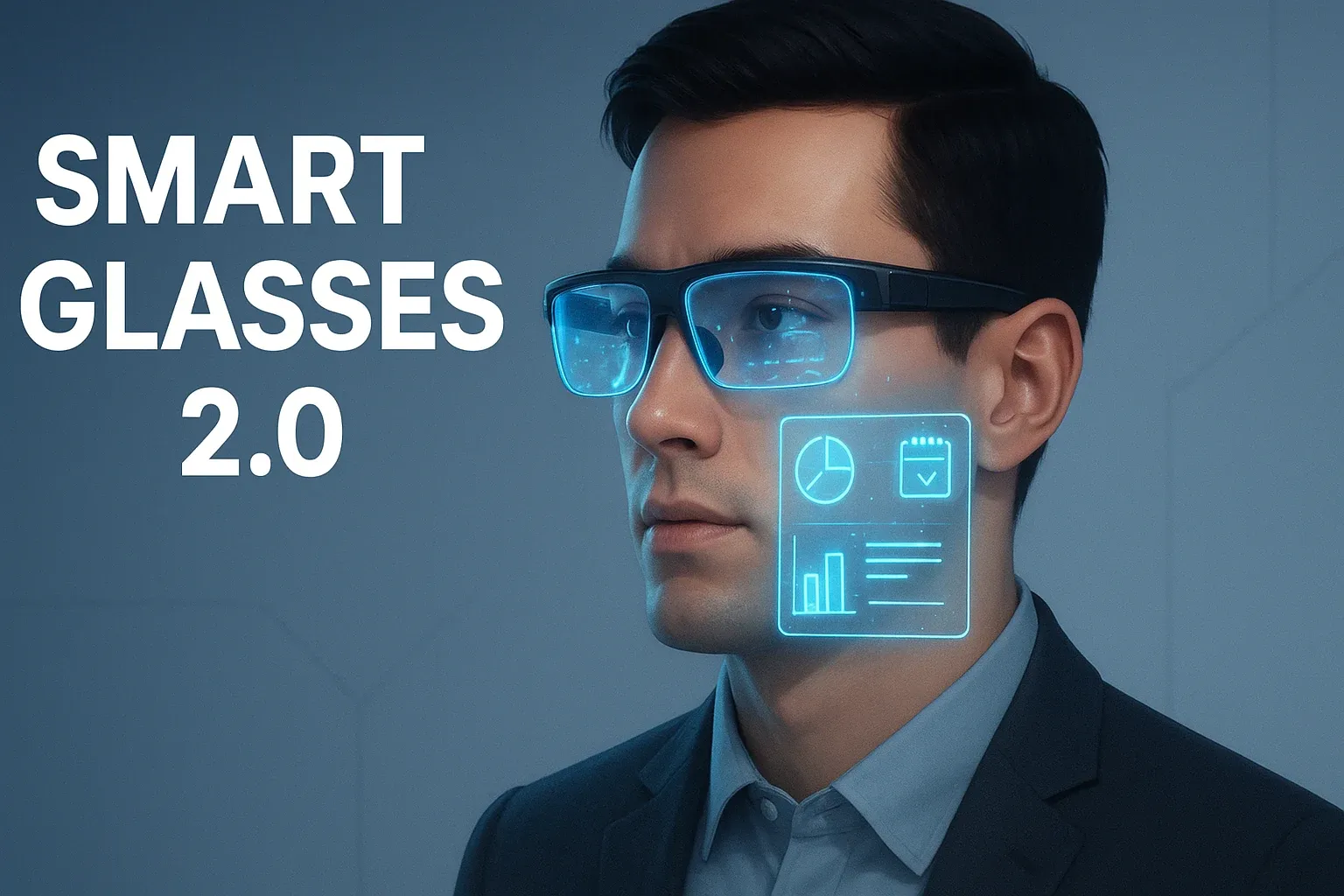
The world once viewed smart glasses as flashy gadgets designed for tech enthusiasts — more novelty than necessity. Remember Google Glass? Its early promise of augmented reality (AR) fizzled out due to privacy concerns, limited functionality, and, frankly, a lack of purpose beyond looking futuristic.
Fast forward to today, and the story is completely different. Smart Glasses 2.0 have arrived — and this time, they’re not just for AR selfies or digital overlays. They’re becoming powerful productivity tools, transforming how we communicate, learn, and work in real time.
Welcome to the era where eyewear meets intelligence — and smart glasses become as essential as your smartphone.
The Evolution of Smart Glasses: From Hype to Utility
When smart glasses first entered the consumer market, they were marketed as revolutionary wearable tech that would blend digital information with the real world.
But the first generation — including early attempts like Google Glass, Snap Spectacles, and Epson Moverio — faced limitations:
- Short battery life
- Clunky design
- Poor privacy perception
- Minimal use beyond recording or displaying notifications
Still, those early experiments laid the groundwork.
Now, Smart Glasses 2.0 are lighter, more stylish, and far more capable — thanks to massive leaps in AI integration, microdisplays, spatial computing, and edge processing.
They’re no longer just about “seeing” data. They’re about doing more — hands-free, intelligently, and seamlessly.
What Makes Smart Glasses 2.0 Different?
The new generation of smart glasses represents a fundamental shift from novelty to necessity.
Let’s break down what makes this wave of wearables stand out:
1. AI-Powered Assistance
Smart glasses are now integrated with AI assistants capable of understanding context and providing real-time information.Imagine walking through a city and having your glasses translate signs instantly, identify landmarks, or summarize emails read aloud to you.
AI gives these glasses the power to see, interpret, and assist — not just display.
2. Voice and Gesture Controls
Gone are the days of awkward touchpads.The latest models feature voice commands, eye tracking, and gesture controls — enabling users to navigate interfaces naturally and intuitively.
No more tapping or swiping on frames — you can interact with digital elements simply by looking, speaking, or moving.
3. Real-Time Data Visualization
From surgeons overlaying patient vitals to engineers visualizing schematics, AR-enabled smart glasses now deliver meaningful real-time data for professionals.
These tools aren’t just augmenting reality; they’re enhancing performance across industries.
4. Lightweight Design and Style
One major barrier for earlier models was aesthetics.Today’s smart glasses look like designer eyewear — thin frames, minimal sensors, and polarized lenses — with embedded tech almost invisible to the naked eye.
Companies like Meta, Apple, and Xreal are proving that powerful doesn’t have to mean bulky.
5. Battery and Connectivity Improvements
Smarter chips and energy-efficient displays allow for longer battery life and constant cloud connectivity.This means users can now stream, record, and interact all day — not just for 15 minutes at a time.
Beyond AR Filters: Turning Smart Glasses Into Productivity Powerhouses
In the early days, AR filters defined how most people viewed smart glasses — fun but superficial.Today, Smart Glasses 2.0 have matured into genuine productivity tools capable of transforming workflows.
Here’s how:
1. Hands-Free Workflows
For field workers, technicians, and surgeons, hands-free visual access is a game-changer.Smart glasses can project schematics, safety alerts, or checklists directly into view — no need to stop, scroll, or check devices.
Imagine a mechanic viewing 3D engine diagrams or a doctor referencing patient scans mid-procedure.That’s hands-free intelligence in action.
2. Seamless Communication
AI-powered transcription and translation mean users can communicate across languages instantly.Your glasses can listen to a conversation, display subtitles, or summarize key points — bridging global communication barriers.
3. Remote Collaboration
With integrated cameras and AR projection, users can share live visuals with remote colleagues or supervisors.This turns smart glasses into real-time collaboration tools, especially valuable in manufacturing, design, and healthcare.
4. Instant Access to Knowledge
Smart glasses with AI integration can pull up relevant data or instructions based on context.For example, if you’re fixing a machine, the glasses can recognize the model and display the repair manual.
Knowledge is no longer behind a screen — it’s right in your line of sight.
5. Personal Productivity Boost
For professionals, Smart Glasses 2.0 can manage notifications, summarize emails, track meetings, and even integrate with productivity suites like Google Workspace or Microsoft 365.
The idea isn’t to overload users — it’s to simplify and enhance focus.
The Technologies Powering Smart Glasses 2.0
The leap from gimmicky AR overlays to true productivity stems from several core innovations working together:
1. Edge AI Processing
On-device AI chips now allow glasses to process data locally instead of relying solely on the cloud.This ensures faster responses, offline functionality, and enhanced privacy.
2. Computer Vision
Smart glasses use computer vision to identify objects, people, and environments in real-time.This enables contextual AR overlays — from recognizing a product to translating a street sign.
3. Microdisplay Advances
Modern micro OLED and waveguide displays are compact, bright, and energy-efficient, enabling clear visuals even under direct sunlight.
4. Spatial Audio
Directional audio enhances immersion and awareness, letting users hear notifications or voice prompts without blocking ambient sound — critical for safety.
5. Neural Interfaces (Emerging Trend)
Future models are exploring brain-computer interfaces (BCIs), allowing subtle thought-based control — a step toward frictionless human-AI interaction.
Key Players Shaping the Smart Glasses 2.0 Revolution
A wave of innovation from both tech giants and startups is driving the Smart Glasses renaissance. Here’s who’s leading the charge:
1. Meta (Ray-Ban Meta Smart Glasses)
Meta’s collaboration with Ray-Ban combines style with AI-driven utility. Their newest model supports hands-free video, voice commands, and AI assistant integration, turning eyewear into an always-on digital companion.
2. Xreal (formerly Nreal)
Xreal focuses on immersive AR for productivity and entertainment. Their Air 2 series connects seamlessly to laptops and phones, delivering a virtual workspace experience anywhere.
3. Apple (Vision Pro & Beyond)
While technically a headset, Apple’s Vision Pro paves the path for mixed-reality computing that could influence future lightweight glasses. Expect Apple’s ecosystem-driven smart eyewear soon.
4. Lenovo and Microsoft
Both companies are developing enterprise-grade AR glasses for industries like logistics, defense, and healthcare — emphasizing durability and integration with business systems.
5. Vuzix
A pioneer in industrial AR, Vuzix Blade and Ultralite models focus on enterprise productivity, offering AI-driven visual support and real-time collaboration tools.
Smart Glasses and AI: A Perfect Partnership
The real magic of Smart Glasses 2.0 lies in how AI enhances usability.
AI turns a passive display device into an active assistant that learns your habits, anticipates your needs, and streamlines daily tasks.
For example:
- AI can detect when you’re reading a document and summarize it.
- It can translate a foreign menu in real time.
- It can notify you of approaching deadlines or suggest focus breaks.
Over time, your smart glasses adapt — becoming personalized companions that blend seamlessly into your day.
Real-World Applications of Smart Glasses 2.0
1. Healthcare
Surgeons use AR overlays to view patient vitals and 3D models during operations. Nurses can access hands-free checklists and training modules in real-time.
2. Manufacturing and Engineering
Technicians can inspect machinery with digital guidance overlaid on equipment, reducing errors and training time.
3. Education and Training
Students can learn through immersive AR experiences, visualizing historical sites, molecules, or complex systems right before their eyes.
4. Remote Work
Professionals can attend virtual meetings, take notes, and view dashboards — all without touching a laptop or phone.
5. Retail and Logistics
Warehouse workers can locate products faster with digital wayfinding cues projected in their field of view.
The Challenges Ahead
Despite the massive progress, smart glasses still face hurdles before reaching mass adoption:
- Battery limitations for full-day use
- Privacy and surveillance concerns
- Software ecosystem fragmentation
- High production costs
- User adaptation curve
However, as with smartphones and wearables before them, these challenges are being rapidly solved through design innovation, better regulations, and public education.
The Future of Smart Glasses: From Vision to Reality
The next few years will define whether smart glasses become mainstream tools or remain niche gadgets.Given the momentum, it’s clear that Smart Glasses 2.0 have the potential to replace smartphones as the next computing interface.
Imagine:
- AI-powered vision assistants that understand what you’re looking at.
- Cloud-synced productivity environments that move with your gaze.
- Mixed-reality collaboration where physical and digital worlds blend effortlessly.
As hardware shrinks and AI grows smarter, the glasses on your face may soon be the most powerful computer you own.
Conclusion
Smart Glasses 2.0 mark a turning point in wearable technology.They’re evolving from flashy AR gadgets into intelligent productivity companions that merge seamlessly with everyday life.
Whether it’s enabling hands-free collaboration, enhancing accessibility, or unlocking new creative workflows, smart glasses are proving that the real revolution isn’t about seeing more — it’s about doing more.
As AI, AR, and design innovation converge, one thing is certain:The future of computing won’t fit in your pocket — it’ll rest on your face.
✅ Key Takeaways
- Smart Glasses 2.0 are evolving from AR toys to productivity tools.
- AI and AR integration make them context-aware and efficient.
- Real-world use spans healthcare, education, and enterprise.
- Style, comfort, and battery life are fueling mainstream adoption.
- The future is hands-free, intelligent, and always connected.