Search engine optimization is experiencing its most radical transformation since the launch of mobile-first indexing.
Traditional search engines used to return a list of ten blue links for every query. Today, artificial intelligence platforms like ChatGPT Search, Perplexity AI, and Google AI Overviews deliver synthesized, multi-paragraph answers directly on the screen placing cited web sources right alongside the text.If your content strategy relies exclusively on traditional keyword density and basic backlink acquisition, your brand risks becoming invisible to conversational search users.
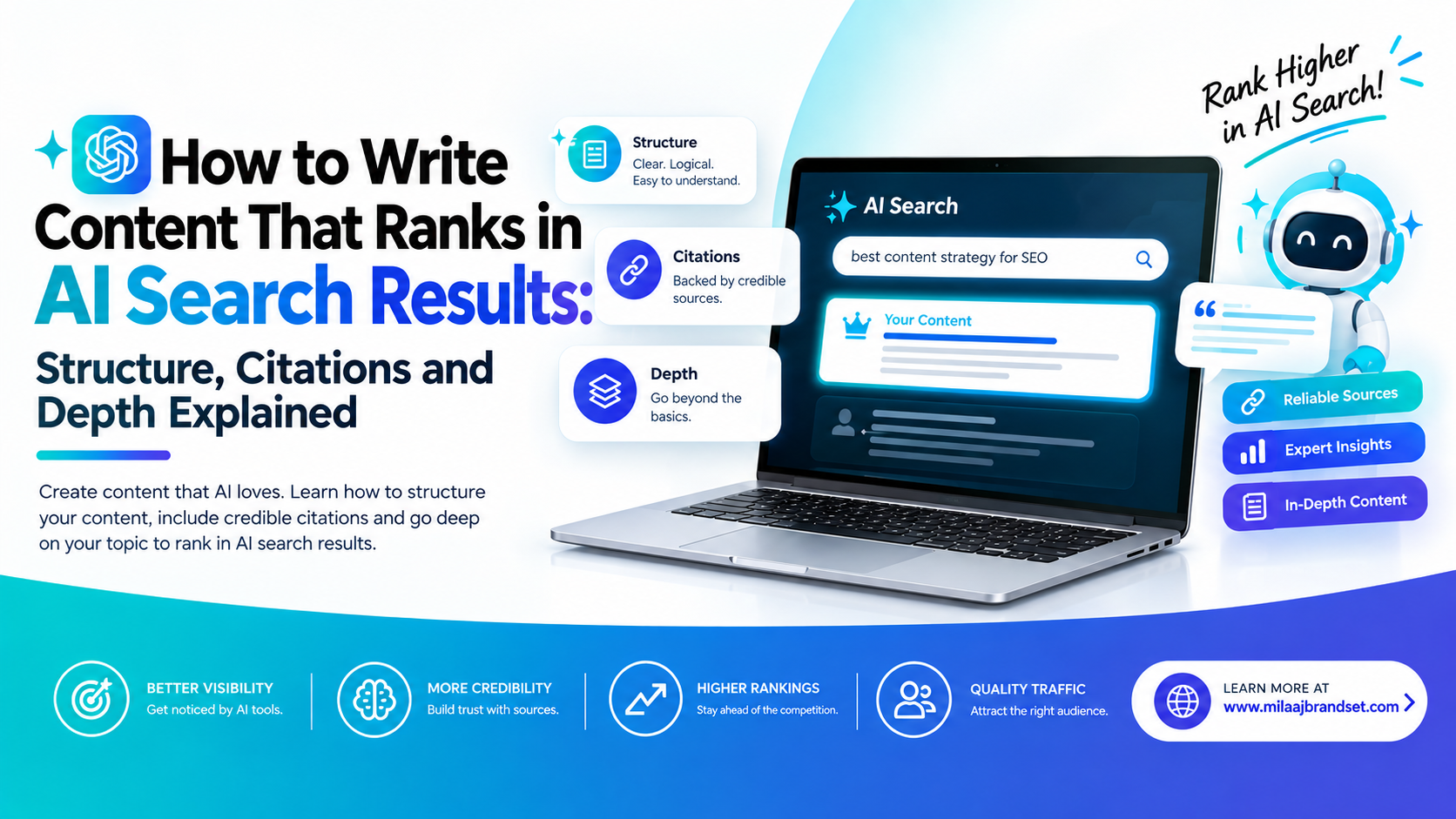
To win visibility today, you must master Generative Engine Optimisation (GEO). This comprehensive guide breaks down how to write content that ranks in AI search results, focusing on structural formatting, citation acquisition, and topical depth.
What Changes When You Optimize for AI Search Engines?
AI engines do not read web pages like traditional web crawlers. Instead of matching exact keyword phrases, Large Language Models (LLMs) parse content into semantic entities, factual claims, and structured summaries.
When an AI engine processes a query, it scans thousands of indexed documents to extract concise facts, compare data points, and credit authoritative sources.
To earn citations within AI-generated answers, your content must satisfy three core criteria:
- Information Extraction: Content must follow clear structural patterns so AI bots can read and process key points instantly.
- Factual Verification: Information must include verifiable data, original statistics, or clear expert consensus.
- Entity Authority: Your brand must display strong Experience, Expertise, Authoritativeness, and Trustworthiness (E-E-A-T) across your domain.
Pillar 1: Structure Content for Instant AI Extraction
AI models prioritize content layouts that minimize processing friction. If your main points are buried inside dense, unstructured paragraphs, AI crawlers will skip your page in favor of clearer sources.
Adopt an "Answer-First" Block Architecture
Place a self-contained 40-to-60-word direct summary immediately below your primary subheadings (H2 or H3). Expand on the topic afterward with detailed context, step-by-step instructions, and visual evidence.
❌ OUTDATED FLUFF INTRODUCTION: H2: What is Generative Engine Optimisation? [Paragraph 1]: In today's fast-paced digital universe, many business owners wonder about the evolution of online search engines and why digital marketing strategies change so quickly...✅ 2026 AI-READY STRUCTURE: H2: What is Generative Engine Optimisation? [45-Word Direct Answer]: Generative Engine Optimisation (GEO) is the practice of structuring digital content so AI search engines—such as ChatGPT, Perplexity, and Google AI Overviews—can extract facts, summarize passages, and cite your domain as an authoritative source in generated responses.
Use Structured Tables and Bulleted Lists
AI platforms favor structured formats when generating comparison charts or procedural steps for users.
[ Dense 4-Paragraph Copy ] ➔ Hard for AI to parse ➔ Excluded from Citations [ Markdown Data Tables & Lists ] ➔ Easy Machine Parsing ➔ Cited in AI Summaries
Replace long text blocks with Markdown tables whenever presenting specifications, pricing comparisons, or performance benchmarks.
Pillar 2: How to Build Authority and Secure AI Citations
Earning citations inside AI search engines requires establishing clear factual consensus and original insights across your website.
1. Publish Original Research and Primary Data
AI search engines love to quote original data points. When you publish unique survey results, proprietary industry metrics, or hands-on case studies, AI models reference your site as the primary data owner.
2. Implement Rich JSON-LD Schema Markup
Structured schema markup acts as a direct translation layer between your web content and search crawlers. Wrap your key questions and answers using valid FAQPage and Article schema code:
JSON
{ "@context": "https://schema.org", "@type": "FAQPage", "mainEntity": [{ "@type": "Question", "name": "How do you rank content in AI search results?", "acceptedAnswer": { "@type": "Answer", "text": "To rank content in AI search results, format your text with answer-first blocks, use Markdown data tables, add JSON-LD schema markup, and publish original primary data." } }]}
Developing real-world skills in search optimization, content strategy, and technical schema implementation requires structured training. Enrolling in a practical digital marketing course equips you with hands-on experience running multi-channel campaigns, executing technical audits, and optimizing content for modern search surfaces.
Pillar 3: Build Topic Depth with Semantic Entity Clusters
AI search engines do not evaluate web pages in isolation. They evaluate your domain's total topical authority across an entire subject area.
Map Semantic Entities, Not Just Keywords
Instead of repeating a single keyword throughout an article, cover the broader network of semantically related concepts (entities).
For example, an article about AI search optimization should naturally cover related entities like semantic search, Large Language Models, Perplexity AI, schema markup, vector embeddings, and E-E-A-T.
Build Interconnected Content Hubs
Create comprehensive topic clusters by linking detailed sub-topic posts back to a core pillar page using descriptive anchor text. This clear internal linking structure helps AI crawlers map your site's expertise across the entire subject.
To gain advanced skills in topical authority mapping, JSON-LD schema validation, and generative search algorithms, taking a specialized advanced SEO course provides practical frameworks to optimize websites for modern AI search engines.
2026 AI Search Optimization Matrix
Use this matrix to audit your content before publishing:
Content Element | Traditional SEO Approach | 2026 AI Search Standard |
Heading Layout | Keyword-stuffed subheadings | Clear question-based headings |
Introductory Text | 200-word background context | 40-to-60-word immediate answer block |
Data Formatting | Multi-paragraph text copy | Structured Markdown tables & bullet points |
Content Depth | Surface-level word counts | Semantic entity coverage & original data |
Technical Markup | Basic HTML tags | FAQPage & Article JSON-LD Schema |
Author Signals | Generic "Admin" bylines | Verified Author profiles with Person schema |
Frequently Asked Questions (FAQs)
What is the difference between traditional SEO and Generative Engine Optimisation (GEO)?
Traditional SEO focuses on earning top positions on search engine result pages to drive direct organic clicks. Generative Engine Optimisation (GEO) focuses on structuring content so AI search engines (like ChatGPT, Perplexity, and Google AI Overviews) extract and cite your data directly inside generated conversational answers.
Does AI search optimization mean ignoring traditional keyword research?
No. Keyword research remains essential for identifying real user pain points and search intent. However, instead of optimizing for exact keyword matches, group keywords into semantic topics and frame subheadings around natural questions users ask AI assistants.
How do I track whether AI search engines are citing my content?
Monitor your brand mentions and referral traffic sources in Google Analytics 4 (looking for traffic from domains like chatgpt.com or perplexity.ai). Additionally, run key industry prompts directly through AI search engines to see if your domain appears in the citation links.
Conclusion: Claim Your Spot in the Future of Search
Understanding how to write content that ranks in AI search results is essential for maintaining organic digital visibility. By organizing your pages with answer-first blocks, presenting complex data in structured Markdown tables, adding JSON-LD schema, and establishing topical depth, you turn your content into the authoritative source that AI engines rely on every day.
Audit your high-priority blog posts today, add direct summary blocks, and secure your place at the top of AI search results.