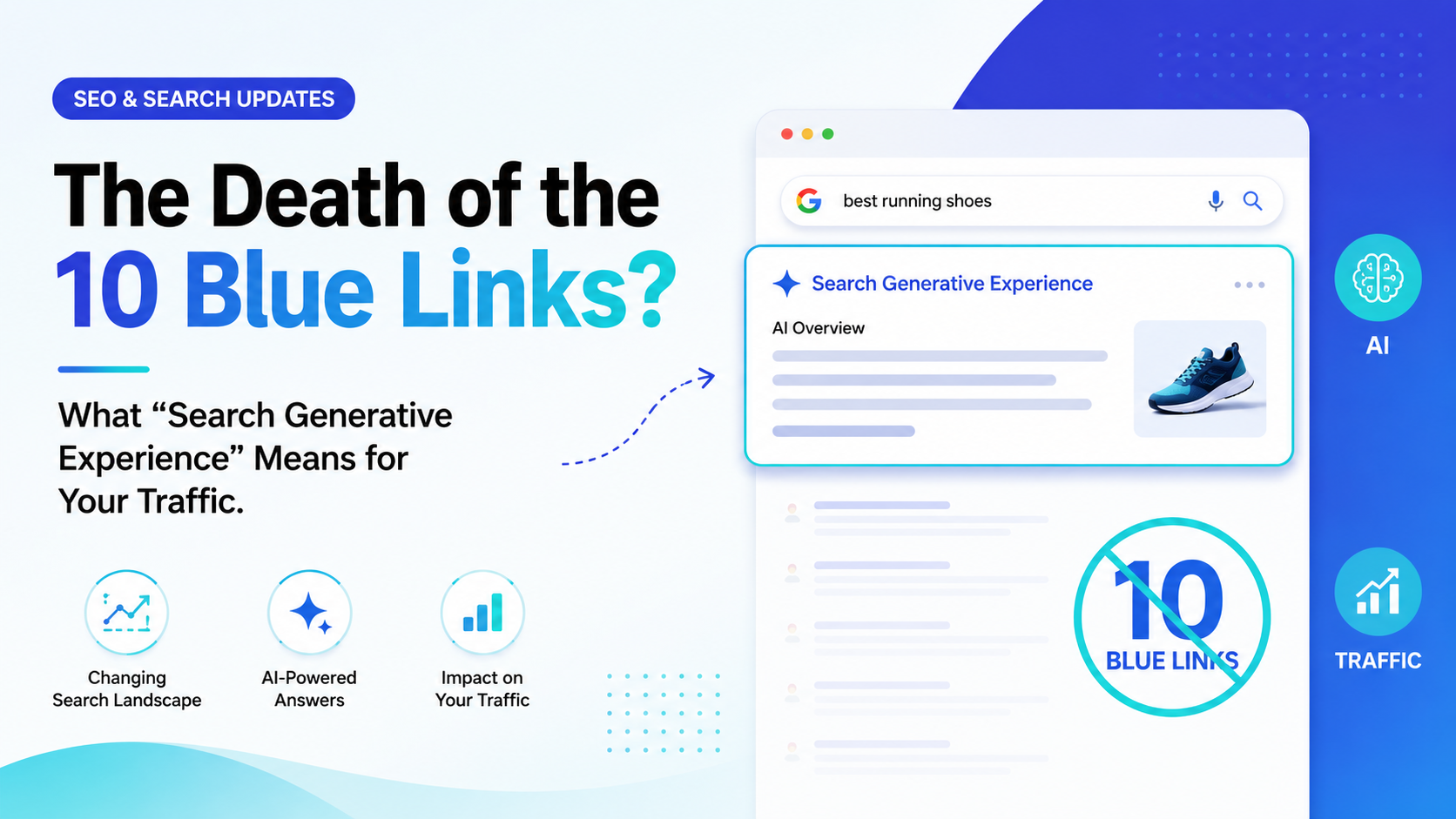
For nearly three decades, the foundational contract of the internet remained unchanged: users typed a fragmented phrase into a blank box, and Google returned a tidy list of 10 blue links. If you optimized your website correctly, you captured a predictable share of that audience click by click.
But as we navigate 2026, that classic contract has officially expired.
The widespread global rollout of Google’s Search Generative Experience (SGE) now permanently woven into the search landscape via AI Overviews has fundamentally transformed user behavior. Instead of acting as a mere digital directory that points users elsewhere, Google now operates as an answer engine that synthesizes information, answers multi-step questions, and displays complete solutions right on the results page.
Traditional Search Model: [User Query] ──> [10 Blue Links] ──> [Click to Website]Generative Search Model: [Conversational Query] ──> [AI Overview Snapshot] ──> [Zero-Click Resolution]
This structural evolution has triggered widespread panic in the marketing world. Is the classic era of organic web traffic truly over? Let's analyze the real Search Generative Experience traffic impact and explore the precise strategies your business must deploy to thrive in an AI-first search economy.
The Hard Truth: Analyzing the "Zero-Click" Reality in 2026
The transition away from traditional web indexing is no longer a future prediction—it is a measurable reality. The expansion of AI Overviews has drastically altered how users interact with text on a screen.
What the 2026 Data Reveals
Independent industry trackers highlight an undeniable trend toward user confinement within the search ecosystem:
- The Clickless Surge: In the first four months of 2026, roughly 68% of Google searches ended without a single click to an external website. This explosive growth in zero-click behavior stems directly from AI features satisfying search intent instantly.
- CTR Compression: When an AI Overview blankets the top of an informational query, traditional organic click-through rates (CTR) underneath the snapshot experience drop by up to 60%.
- Walled Garden Ecosystem: Google is increasingly incentivized to keep users within its interface, using generative models to aggregate data rather than sending shoppers and researchers away.
While these numbers sound intimidating, they do not signal the death of digital marketing. Instead, they indicate that the standard metric of success has fundamentally evolved. Winning in 2026 is no longer about chasing a top position in the 10 blue links; it is about establishing your brand as a cited, highly visible primary source within Google's generative summary block.
1. How Generative Search Processes Informational Queries
To build an effective optimization model, you must recognize that AI systems do not process language like legacy keyword indexes. Generative search engines rely on large language models (LLMs) to map complex concepts, extract data points, and identify semantic depth.
The Evolution of Conversational Queries
Users are changing how they type. Instead of entering choppy search terms like "digital marketing course duration," searchers routinely enter natural, multi-step questions like, "What topics are included in a modern AI-based digital marketing course and can I finish it within six months while working?".
Google's Gemini engine dynamically analyzes these queries by breaking down sentence fragments and extracting separate concepts. It then crawls highly authoritative domains, isolates matching structured passages, and compiles an automated answer complete with links back to its verified sources.
Structuring your digital frameworks to match this conversational reality requires deep training. At Milaaj Digital Academy, we actively prepare creators to bridge the gap between traditional web layouts and semantic AI architectures.
2. Shift from Keyword Optimization to "Source Worthiness"
The core strategy for driving traffic under the Search Generative Experience framework is source worthiness. Because AI Overviews cite their information sources directly, landing a featured citation card can boost your click-through rate by up to 80% compared to remaining an un-cited standard listing below the fold.
The Blueprint for Becoming an AI Source
To ensure an AI crawler chooses to extract and cite your data, your content must possess specific architectural traits:
- Implement "Atomic Answers": Do not hide critical insights deep inside an unorganized 3,000-word paragraph. Lead with your core answer immediately following your header. Write a concise, 40-to-60-word summary block that a machine model can pull effortlessly.
- Utilize Question-Based Subheadings: Structure your page hierarchy using H2 and H3 tags phrased as direct questions. This makes it incredibly easy for scrapers to map your content blocks directly to conversational user intent.
- Incorporate Verifiable Facts and Original Data: LLMs are trained to prioritize original analysis, proprietary case studies, and concrete statistics over generic, rephrased common knowledge.
3. Structural Foundations: Topic Clusters and Structured Data
AI crawlers evaluate your entire domain's topical authority on a subject rather than just scanning an isolated page. If your site features clear structural signals, models will trust your data points far more readily.
Building High-Density Topic Clusters
Avoid publishing random, disconnected articles. Organize your domain around centralized pillar pages that cover the full, comprehensive scope of a macro-topic. From there, branch out into highly detailed subpages addressing tightly defined niche questions, linking them systematically back to your main pillar asset. This clean network structure proves to search systems that your site leaves no topical gaps.
[Central Pillar Page] / | \ / | \ [Subpage: Q&A] <───> [Subpage: Data] <───> [Subpage: FAQ]
The Non-Negotiable Role of Schema Markup
Structured data is the primary translator for machine algorithms. While humans enjoy a clean visual layout, AI models rely heavily on backend code signals. Consistently apply JSON-LD code frameworks—specifically FAQ, Article, and Product schema to remove any margin of error when algorithms crawl your business entities.
To master these automated schemas and protect your site from structural invisibility, check out the specialized modules in our Advanced Digital Marketing Course, designed to teach modern generative engine tactics.
4. Elevating E-E-A-T to Counter Programmatic Fluff
The web is currently flooded with low-quality, automated content farms that churn out thin material solely to harvest pageviews. Google's response in 2026 is an aggressive, algorithmic preference for verified E-E-A-T (Experience, Expertise, Authoritativeness, Trustworthiness) signals.
Injecting Imperative Human Value
AI models can effortlessly replicate standard descriptions, but they cannot fabricate authentic human experiences. To insulate your brand from algorithm shifts, weave real-world perspectives into your publishing routine:
- First-Person Case Studies: Share exact operational journeys, using phrases like "In our testing, we found..." or "Here is the data from our recent project...".
- Verifiable Credentials: Back up every informational piece with transparent author bios, links to professional portfolios, and external brand mentions across trusted industry platforms.
- Real-Time Data Integration: Maintain absolute data accuracy. Outdated statistics or broken contextual facts will cause an AI engine to flag your site as a low-trust node.
Conclusion: Redefining Digital Success in the Generative Era
The traditional 10 blue links layout may be fading into the background, but the fundamental demand for high-quality, trusted online information is higher than ever. The Search Generative Experience traffic impact is undeniably compressing standard pageviews, yet it simultaneously creates a highly lucrative premium tier for brands that achieve source status.
By restructuring your content into modular answer blocks, leaning heavily into active voice, constructing interconnected topic clusters, and proving your authentic human expertise, you ensure your business remains a visible leader on the modern web.
Frequently Asked Questions (FAQ)
What exactly is Google's Search Generative Experience (SGE)?
SGE, now widely known as AI Overviews, is an updated search engine interface that uses generative artificial intelligence to synthesize information from multiple web sources. It presents a comprehensive text summary directly at the top of the search results page so users can get answers fast without clicking through to individual links.
How much traffic will my website lose because of AI Overviews?
Traffic impact depends heavily on your content type. General informational queries face standard click-through rate declines of up to 60% because the AI answers those questions directly. However, complex commercial queries, branded searches, and hyper-local business queries continue to drive highly qualified, high-intent traffic to deep-link resources.
What is an "Atomic Answer" in AI SEO optimization?
An Atomic Answer is a highly structured, clear paragraph of 40 to 60 words placed near the top of a webpage that answers a target question directly. This layout allows language model crawlers to easily extract and copy the sentence into an AI Overview snapshot box, securing a premium source citation card for your brand.
Can I block Google's AI from scraping my website content?
Yes, you can apply technical robots tags like to prevent your text from appearing inside generative answers. However, implementing this block also removes your site from traditional featured snippets and rich organic snippets across the standard index, which often leads to an immediate drop in overall visibility.
How does schema markup protect my site from zero-click losses?
Schema markup provides clear machine-readable code signals that define your business properties, products, and articles directly to AI crawlers. By eliminating text ambiguity, you make your site a highly reliable data source, significantly increasing your chances of being integrated directly into AI Shopping recommendations and conversational answer summaries.