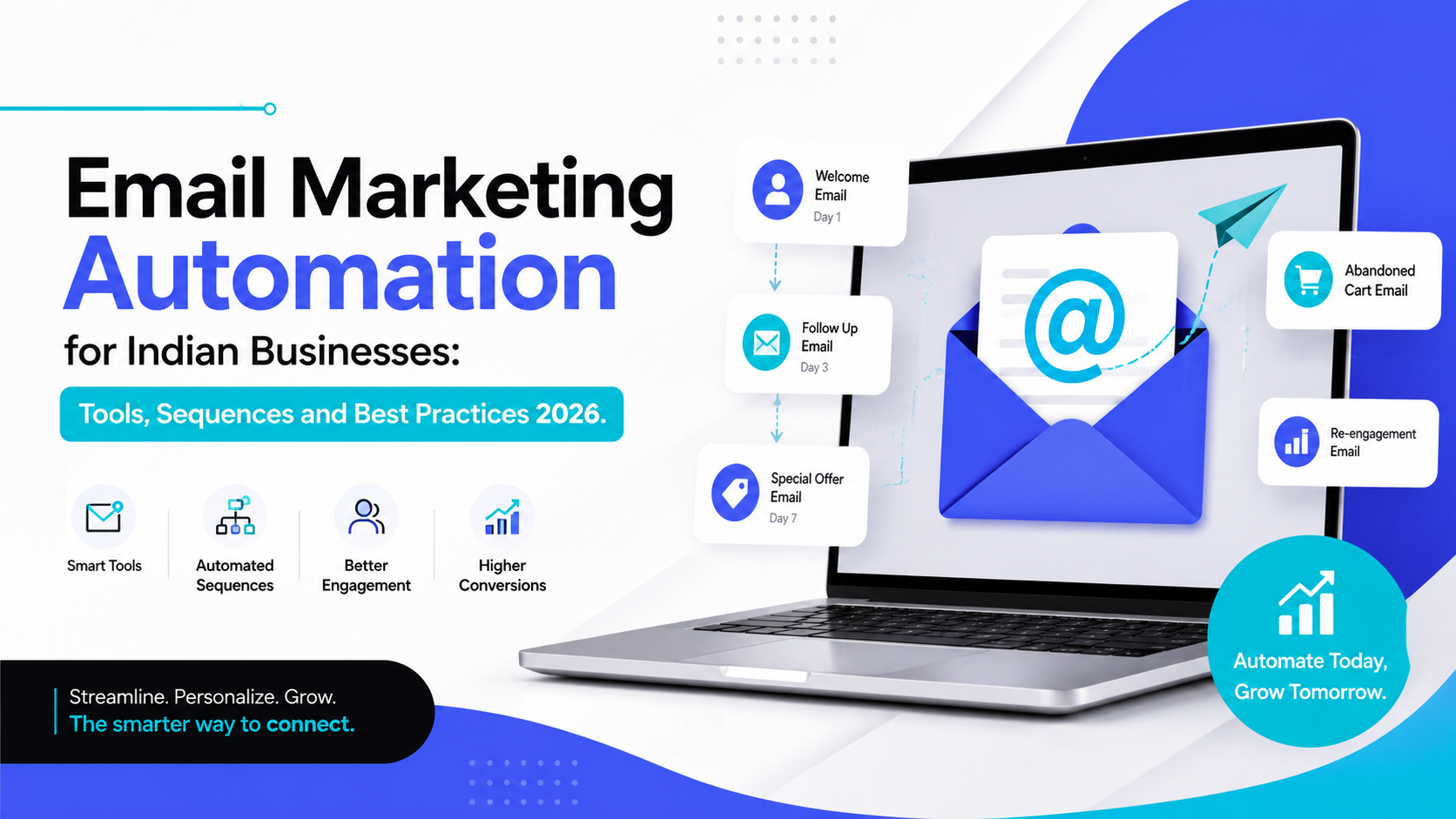
Indian businesses face a fierce battle for customer attention. Social media ad costs keep climbing, organic reach continues to dip, and local buyers demand instant, personalized communication across multiple digital channels.
While ad platforms rent you an audience, email marketing gives you an asset you own.
Email marketing automation for Indian businesses is no longer just about sending weekly newsletters. It is a smart engine that works in the background 24/7 to turn casual visitors into loyal repeat buyers. When you combine automated email workflows with India's unique multi-channel ecosystem like WhatsApp integrations and UPI checkout triggers—your business builds a reliable system for steady revenue growth.
Whether you run a D2C e-commerce brand, a B2B agency, a local service company, or an edtech startup, this actionable guide covers the tools, automated sequences, and localized best practices you need to succeed in 2026.
Why Email Marketing Automation Matters for Indian Businesses
Many small business owners assume email marketing is outdated compared to social media reels or chat apps. The data tells a very different story.
+-----------------------------------------------------------------------+| Traditional Mass Emailing Modern Marketing Automation || * One message to everyone * Segmented, behavior-based || * Low open rates (~10-12%) * High open rates (35-50%+) || * Manual sending, high effort * Set up once, runs 24/7 || * High risk of spam folder * High deliverability & ROI |+-----------------------------------------------------------------------+
Email marketing consistently delivers one of the highest returns on investment in digital marketing, yielding roughly ₹40 for every ₹1 spent. The secret lies in moving away from manual broadcast emails toward automated, trigger-based communication.
Key Benefits for Indian Companies:
- Lower Customer Acquisition Costs (CAC): Retaining existing leads through nurturing costs a fraction of running continuous paid ad campaigns on Meta or Google.
- Hyper-Personalization at Scale: Modern automation tools let you address customers by name, recommend products based on browse history, and send birthday discounts automatically.
- Seamless Multi-Channel Reach: In India, pairing email automation with SMS and WhatsApp notifications creates a reliable brand presence across every device.
- Higher Conversion Rates: Triggered emails sent right after a user takes an action (like downloading a guide or abandoning a cart) get up to 3x higher open rates than standard campaigns.
Top Email Marketing Automation Tools for the Indian Market
Choosing the right software depends on your business model, contact list size, and integration needs. Here is how the top email automation platforms stack up for Indian enterprises and SMBs in 2026.
[ Email Automation Tools Matrix ] High ^ | * HubSpot (Enterprise B2B) |F |E | * ActiveCampaign (Advanced CRM)A |T | * Brevo / MailerLite (SMB & Startup Friendly)U |R | * Klaviyo (eCommerce / D2C)E |S | * Zoho Campaigns (Best Indian Ecosystem) | Low +--------------------------------------------------> Low COST High
1. Zoho Campaigns & Zoho CRM (Best Local Ecosystem)
Zoho is built right here in India and offers seamless integration with its broader software suite. It offers local currency pricing (INR), domestic payment gateway support, and strict regional data compliance.
- Best For: Indian SMBs, service providers, and B2B firms using Zoho's ecosystem.
- Key Feature: Built-in GST-compliant billing, local support teams, and smooth syncing with Zoho CRM.
2. Brevo (Formerly Sendinblue)
Brevo offers a user-friendly platform with pay-per-email pricing instead of charging per contact subscriber. This makes it very cost-effective for growing businesses with large contact lists.
- Best For: Startups, local businesses, and budget-conscious marketers.
- Key Feature: Integrated SMS and WhatsApp messaging workflows alongside standard email.
3. Klaviyo
If you run a Shopify, WooCommerce, or custom D2C storefront in India, Klaviyo remains the gold standard for e-commerce automation.
- Best For: E-commerce and D2C brands.
- Key Feature: Predictive analytics, detailed purchase segmentation, and automated product recommendations.
4. ActiveCampaign
An advanced automation engine for companies that need deep lead scoring, branching conditional logic, and CRM tracking.
- Best For: B2B companies, agencies, and high-ticket service businesses.
- Key Feature: Visual drag-and-drop workflow builder with deep pipeline tracking.
5. MailerLite
An accessible, highly intuitive tool featuring clean templates, landing page builders, and affordable pricing tiers.
- Best For: Beginners, creators, and micro-enterprises.
- Key Feature: Drag-and-drop editor with high deliverability rates.
Master the Tools: Want to build automated funnels hands-on? Check out the practical Digital Marketing Course at Milaaj Digital Academy, where you will design live email workflows, set up CRM integrations, and run performance-driven campaigns.
4 High-Converting Automated Email Sequences You Must Set Up
An automated sequence is a series of pre-written emails triggered by specific user actions. Here are four foundational workflows every Indian business should implement.
1. WELCOME SEQUENCE [Lead Signup] ---> [Email 1: Warm Welcome + Lead Magnet] ---> [Email 2: Brand Story & Values] ---> [Email 3: Core Products / Offer]2. ECOMMERCE ABANDONED CART [Cart Abandoned] ---> [1 Hr: Friendly Reminder] ---> [24 Hrs: Social Proof / Reviews] ---> [48 Hrs: Incentive / UPI Discount]3. B2B LEAD NURTURING [Form Filled] ---> [Email 1: Value Asset Delivery] ---> [Email 2: Case Study / ROI] ---> [Email 3: Demo / Consultation Invite]4. CUSTOMER RE-ENGAGEMENT [60 Days Inactive] ---> [Email 1: "We Miss You"] ---> [Email 2: Exclusive Re-entry Discount] ---> [Email 3: Final List Clean-Up Alert]
1. The Onboarding & Welcome Sequence
First impressions shape your long-term customer relationships. When someone subscribes to your newsletter or creates an account, deliver immediate value.
- Trigger: Form submission or new account registration.
- Email 1 (Immediate): Warm welcome + Instant delivery of promised lead magnet (e.g., PDF guide, discount code).
- Email 2 (2 Days later): Your brand story, mission, and what makes your approach different.
- Email 3 (4 Days later): Introduction to your top products, services, or most popular content.
2. The E-commerce Abandoned Cart & Checkout Sequence
In India, online cart abandonment rates hover around 70–75%. An automated recovery sequence helps capture that lost revenue.
- Trigger: User adds an item to their cart but leaves without completing the purchase.
- Email 1 (1 Hour after abandonment): Quick reminder showing the exact items left behind.
- Email 2 (24 Hours later): Highlight customer reviews, ratings, or trust badges (e.g., Easy Returns, COD Options, Secure UPI Checkout).
- Email 3 (48 Hours later): A limited-time incentive (e.g., 5% off or free express shipping) to close the sale.
3. The B2B Lead Nurturing & Educational Sequence
B2B buying cycles in India often require building strong trust over weeks or months. Educational email sequences build your authority and keep your business top of mind.
- Trigger: Whitepaper download, webinar sign-up, or price quote request.
- Email 1 (Immediate): Asset delivery + A simple question to invite a direct reply.
- Email 2 (3 Days later): A detailed case study showing how you solved a similar problem for an Indian client.
- Email 3 (6 Days later): Breakdown of common industry mistakes and how to avoid them.
- Email 4 (10 Days later): Direct call-to-action inviting them to book a free discovery call.
4. The Re-Engagement Sequence (List Cleaning)
Inactive subscribers hurt your sender reputation and deliverability rates. Automatically filter out inactive contacts before they impact your overall campaign performance.
- Trigger: Subscriber has not opened an email in 60 to 90 days.
- Email 1: "Are we still on your radar?" — Ask if they still want to receive updates.
- Email 2: Present a special offer or point them to your absolute best content.
- Email 3: "Final Goodbye" — Inform them that they will be removed from the list in 48 hours unless they click a link to stay subscribed.
Best Practices for Email Automation in the Indian Context (2026)
Applying generic international tactics does not always work in the Indian market. Local buyer habits, technical standards, and mobile usage require a tailored approach.
[ Regional Email Optimization Pillars ] +---------------------+ +---------------------+ | Mobile-First Design| | WhatsApp & SMS Pairing| | Fast load, clean UI| | Multi-channel reach | +----------+----------+ +----------+----------+ | | +-------------+-------------+ | +----------+----------+ +----------+----------+ | 2026 Technical Auth| | Regional Nuance | | SPF, DKIM, DMARC | | Festival timing & UI| +---------------------+ +---------------------+
1. Optimize for Mobile & Slow Network Connections
Over 80% of emails in India are opened on smartphones often while browsing on cellular data networks.
- Keep image sizes lightweight (under 200 KB per image) to guarantee fast load times.
- Use clean single-column layouts that look clear on screen sizes ranging from budget phones to flagship devices.
- Make call-to-action (CTA) buttons prominent and easy to tap with a thumb.
2. Pair Email with WhatsApp Automation
While email is ideal for structured content, educational sequences, and receipts, combining it with WhatsApp creates a powerful duo for time-sensitive alerts in India.
- Send long-form content, pitch decks, and invoices over Email.
- Use WhatsApp API triggers for instant order confirmations, COD verification links, and delivery tracking alerts.
3. Master Technical Deliverability (SPF, DKIM, and DMARC)
Global inbox providers like Google and Yahoo strictly enforce technical authentication standards to block spam.
- SPF (Sender Policy Framework): Verifies which IP addresses are authorized to send emails on behalf of your domain.
- DKIM (DomainKeys Identified Mail): Attaches a cryptographic digital signature to every email you send.
- DMARC (Domain-based Message Authentication, Reporting, and Conformance): Instructs receiving servers on how to handle emails that fail SPF or DKIM checks.
Without proper SPF, DKIM, and DMARC authentication records set up on your domain, your automated emails risk dropping directly into recipient spam folders.
4. Respect Local Timing, Languages, and Cultural Nuances
- Timing: The ideal sending windows for Indian professionals are generally 8:30 AM – 10:00 AM (morning commute/desk setup) and 7:00 PM – 8:30 PM (evening review). Avoid sending non-urgent automated emails past 9:30 PM.
- Festive Campaigns: Adapt your automation calendars around major cultural moments like Diwali, Eid, Onam, New Year, and regional harvest festivals.
- Language: While corporate B2B automation runs primarily in English, consumer-facing D2C sequences increasingly benefit from regional language support (Hinglish, Tamil, Malayalam, Bengali) depending on your target demographic.
Deepen Your Technical Skillset: Looking to build technical marketing expertise? Explore the Advanced SEO & Analytics Program at Milaaj Digital Academy. You will master technical optimizations, semantic content frameworks, and advanced analytics setups to maximize search visibility and channel performance.
Key Metrics to Track Your Email Automation Success
To get the best return from your campaigns, monitor these five core metrics inside your automation analytics dashboard:
+-------------------------------------------------------------------------+| Metric | Ideal Benchmark | Action If Low |+-------------------+------------------+----------------------------------+| Open Rate | 25% – 40%+ | Test short, compelling subjects || Click-Through Rate| 3% – 8%+ | Add single, clear CTA buttons || Conversion Rate | 1.5% – 5%+ | Align landing page with email || Unsubscribe Rate | Under 0.5% | Improve list segmentation || Bounce Rate | Under 2% | Scrub inactive emails regularly |+-------------------------------------------------------------------------+
- Open Rate: Shows if your subject lines grab attention. Aim for 25% or higher on automated workflows.
- Click-Through Rate (CTR): Measures if your email copy and offers resonate with your audience.
- Conversion Rate: Tracks how many recipients complete your desired action (e.g., buying a product or scheduling a call).
- Bounce Rate: Keeps track of deliverability health. Keep hard bounces under 2% by regularly scrubbing invalid email addresses.
- Unsubscribe Rate: Helps measure content relevance. If this spikes over 1%, refine your customer segmentation.
Frequently Asked Questions (FAQs)
What is the best email marketing automation tool for small Indian businesses?
For small businesses and startups on a budget, Zoho Campaigns and Brevo offer excellent options. Zoho provides affordable INR pricing, local support, and smooth integration with domestic tools. Brevo provides pay-per-email models and integrated WhatsApp/SMS workflows.
Is email marketing still effective in India given WhatsApp's popularity?
Yes. While WhatsApp boasts higher instant open rates, email remains the preferred channel for professional communication, B2B deal-making, invoices, educational content, and high-trust transactions. Using both channels together delivers the best results.
How often should I send automated emails to my Indian subscribers?
For trigger-based sequences (like welcome emails or abandoned cart alerts), sending is dictated by user behavior. For routine lead nurturing and newsletters, 1 to 2 emails per week strike a healthy balance between maintaining engagement and avoiding subscriber fatigue.
How do I stop my automated marketing emails from going to Spam?
Ensure your domain has valid SPF, DKIM, and DMARC DNS records configured. Additionally, clean your email list regularly, avoid excessive use of ALL CAPS or spam-trigger words (like "100% FREE! CASH!"), and use double opt-in forms.
Final Thoughts: Building Your Automated Growth Engine
Email marketing automation gives Indian businesses a predictable, scalable channel for driving conversions and building long-term customer relationships. By pairing smart tools like Zoho, Brevo, or Klaviyo with strategic sequences and technical authentication, you create a marketing engine that works continuously to grow your brand.
Start small: build your core Welcome Sequence and an Abandoned Cart Workflow first. Analyze the performance data, refine your messaging based on user responses, and expand your automated funnels step by step.