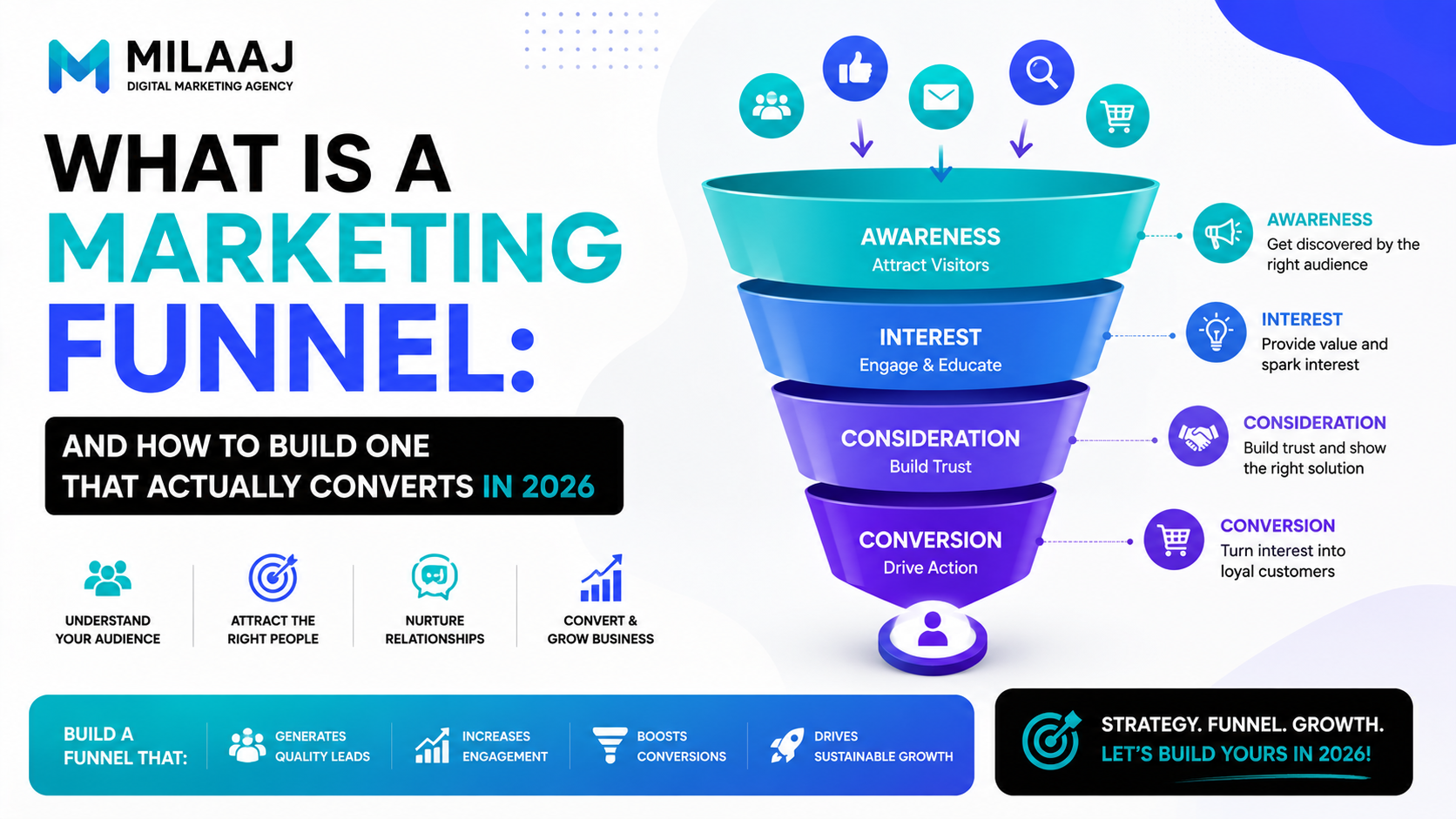
If you ask ten business owners how they land new clients online, half will tell you they rely on social media posts, while the rest might mention paid ads or organic search clicks. However, getting traffic to your website is only the first step. Without a structured engine to turn casual visitors into paying customers, most of those clicks simply bounce away forever.
That is where a modern sales framework comes into play. But what is a marketing funnel, and why is it even more critical today than it was a decade ago?
At its core, a marketing funnel is a step-by-step psychological framework that maps a prospect's complete journey from the moment they first discover your brand to the moment they make a purchase and become an advocate. In 2026, buyer behavior is nonlinear, heavily influenced by AI search engines, short-form video feeds, and personalized automated touchpoints.
If you want to build a predictable revenue engine, you must understand what is a marketing funnel in today's digital landscape and how to construct one that turns cold traffic into enthusiastic buyers.
Demystifying the Core Framework: The Modern TOFU, MOFU, and BOFU Stages
Understanding what is a marketing funnel begins with breaking down its three classic, interconnected stages. While consumers move fluidly back and forth between touchpoints today, these core stages organize your content and ad messaging around buyer intent.
[TOFU: Top of Funnel] ──► Build Brand Awareness & Answer Entry-Level Questions │[MOFU: Middle of Funnel] ──► Educate, Differentiate & Nurture Interested Leads │[BOFU: Bottom of Funnel] ──► Eliminate Buying Friction & Close High-Intent Deals
1. Top of the Funnel (TOFU): Building Brand Awareness
At the top of the funnel, your audience experiences a problem, but they might not know your brand or even your specific product category exists yet. The goal at this stage is purely educational. You want to answer broad questions, build topical authority, and capture attention.
- Primary Channels: Helpful blog posts, social media reels, podcasts, educational YouTube videos, and targeted discovery ads.
- The Buyer's Mindset: "Why is my website traffic dropping?" or "How can I improve my team's operational efficiency?"
2. Middle of the Funnel (MOFU): Nurturing and Evaluating Solutions
Once prospects recognize their pain points, they move into the middle stage. Here, they begin evaluating potential solutions, comparing vendor features, and looking for proof. This is where lead nurturing workflows turn casual readers into qualified contacts.
- Primary Channels: In-depth whitepapers, comparative buyer guides, interactive webinars, lead magnets, and targeted email nurture sequences.
- The Buyer's Mindset: "Which software platform offers the best feature set for my budget?"
3. Bottom of the Funnel (BOFU): Driving the Purchase Decision
At the bottom of the funnel, the prospect has narrowed down their options and is ready to make a purchasing decision. Your goal here is to remove all remaining buying friction, highlight social proof, and present a compelling call to action.
- Primary Channels: Free product trials, live software demos, detailed customer case studies, ROI calculators, and personalized retargeting campaigns.
- The Buyer's Mindset: "Why should I choose this specific company over their main competitor today?"
How Buyer Behavior Has Evolved
If you built your sales process several years ago, you might be relying on outdated linear assumptions. Historically, marketers assumed prospects entered at the top and moved smoothly down to the bottom.
Today, buyers move fluidly. A prospect might read a customer review on social media, ask an AI answer engine for top recommendations, skim a technical pricing page, leave for two weeks, and re-engage via a retargeting ad.
When answering what is a marketing funnel in 2026, it is helpful to view it not as a rigid pipe, but as a responsive ecosystem. Your job is to place value-rich touchpoints across every channel so prospects can move seamlessly toward a conversion, regardless of where they start their journey.
Step-by-Step Guide to Building a High-Converting Marketing Funnel
Creating a systematic engine that consistently converts visitors into customers does not require complex software. Follow this procedural blueprint to build your funnel from scratch:
1.Define Your Ideal Customer Profile (ICP) & Pain Points:Step 1.
Identify exactly who you are selling to. Map out their primary pain points, professional goals, key objections, and preferred communication channels. Knowing your ICP prevents you from creating generic content that fails to engage real buyers.
2.Create Intent-Driven TOFU Discovery Assets:Step 2.
Produce high-value educational content that directly answers your audience's entry-level questions. Focus on search engine optimization (SEO) and short-form video assets that establish your brand as a trusted industry authority.
3.Deploy Lead Magnets & Nurture Workflows:Step 3.
Capture prospect contact details by offering a high-value lead magnet such as a template, ebook, or checklist. Connect your opt-in forms to automated email sequences that deliver instant value and address common objections.
4.Optimize BOFU Conversion Points & Remove Friction:Step 4.
Ensure your pricing pages, booking calendars, and checkout forms are fast and simple. Include clear risk-reversal elements, such as customer testimonials, money-back guarantees, and live chat support, to help close deals faster.
Key Metrics: Measuring Your Funnel Efficiency
Building the structure is only half the battle. To maximize your return on ad spend (ROAS) and lower your customer acquisition cost (CAC), you must track conversion performance across every stage.
Funnel Stage | Primary Metric | What It Tells You | Optimization Focus |
TOFU (Top) | Click-Through Rate (CTR) & Impression Volume | How effectively your content attracts target prospects. | Test sharper headlines and visual hooks. |
MOFU (Middle) | Opt-In Rate & Lead Qualification Rate | How well your lead magnets convert casual readers into leads. | Refine lead magnet value & email subject lines. |
BOFU (Bottom) | Sales Conversion Rate & Customer Acquisition Cost | How efficiently your final offer turns leads into paying clients. | Add social proof & streamline checkout steps. |
If you want to master the art of setting up automated lead funnels, running high-ROI ad campaigns, and measuring conversions with precision, exploring our comprehensive Digital Marketing Master Program is an excellent next step. Gaining hands-on experience with live ad budgets and email automation builds the practical skills agencies and top brands look for.
3 Fatal Mistakes That Destroy Funnel Conversions
Even experienced marketers can suffer performance drop-offs by making avoidable structural errors. Watch out for these three common pitfalls:
1. Pushing the Sale Too Early
Pitching a high-ticket product or service to a first-time website visitor is like asking someone to marry you on a first date. If you skip the educational MOFU stage, your conversion rates will plummet because prospects haven't built trust with your brand yet.
2. Ignoring Search Intent Alignment
If your TOFU blog posts target broad informational keywords, do not send that traffic directly to a hard sales landing page. Ensure the promise made in your title matches the content on the page to prevent high bounce rates.
Understanding search mechanics and modern Generative Engine Optimization (GEO) allows you to capture high-intent organic traffic consistently. To build deeper expertise in organic search architecture, check out our industry-taught Advanced SEO & AI Search Course.
3. Failing to Follow Up
Studies show that over 70% of sales conversions happen after multiple brand interactions. If your funnel lacks automated email sequences or retargeting campaigns, you lose interested leads who simply weren't ready to buy on day one.
Frequently Asked Questions (FAQs)
What is a marketing funnel in simple terms?
A marketing funnel is the step-by-step path a customer takes from learning about your business to buying your product or service. It is called a "funnel" because it starts with a broad audience at the top and narrows down to qualified buyers at the bottom.
Is the classic marketing funnel dead in 2026?
No, the funnel concept is not dead, but it has evolved. While traditional models assumed a strict linear path, modern funnels account for nonlinear journeys, AI search research, and ongoing customer retention loops.
How long does it take to build a working marketing funnel?
You can launch a basic, effective funnel consisting of an ad, a landing page, a lead magnet, and a 3-part email sequence in less than a week. However, optimizing your funnel for maximum conversion rates requires ongoing testing and data analysis.
What is the difference between a sales funnel and a marketing funnel?
While the terms are often used interchangeably, a marketing funnel focuses on building awareness, capturing leads, and nurturing interest (TOFU/MOFU). A sales funnel takes over at the bottom stage (BOFU) to handle product demos, sales calls, and closing transactions.
Turn Your Traffic into Predictable Revenue
Understanding what is a marketing funnel gives you a clear, strategic framework for driving business growth. By aligning your messaging with what prospects need at each stage from discovery to final decision you build a system that converts visitors into long-term customers predictably.
Start by auditing your current customer journey. Identify where potential leads are dropping off, strengthen your educational content, and set up automated follow-ups. If you want expert guidance and hands-on training to build market-ready digital skills, visit Milaaj Digital Academy to explore our career programs today.