The "SEO grind" is changing. Gone are the days of spending ten hours manually mapping keywords to URLs or squinting at spreadsheets to find content gaps. We have entered the era of the AI-augmented marketer, where the most valuable asset in your toolkit isn't just your knowledge it’s your ability to build custom AI agents that execute your strategy at scale.
Custom GPTs allow you to bottle your specific SEO expertise into a repeatable, private tool. If you haven't built your own suite of "Digital SEO Assistants" yet, you are leaving hours of productivity on the table.
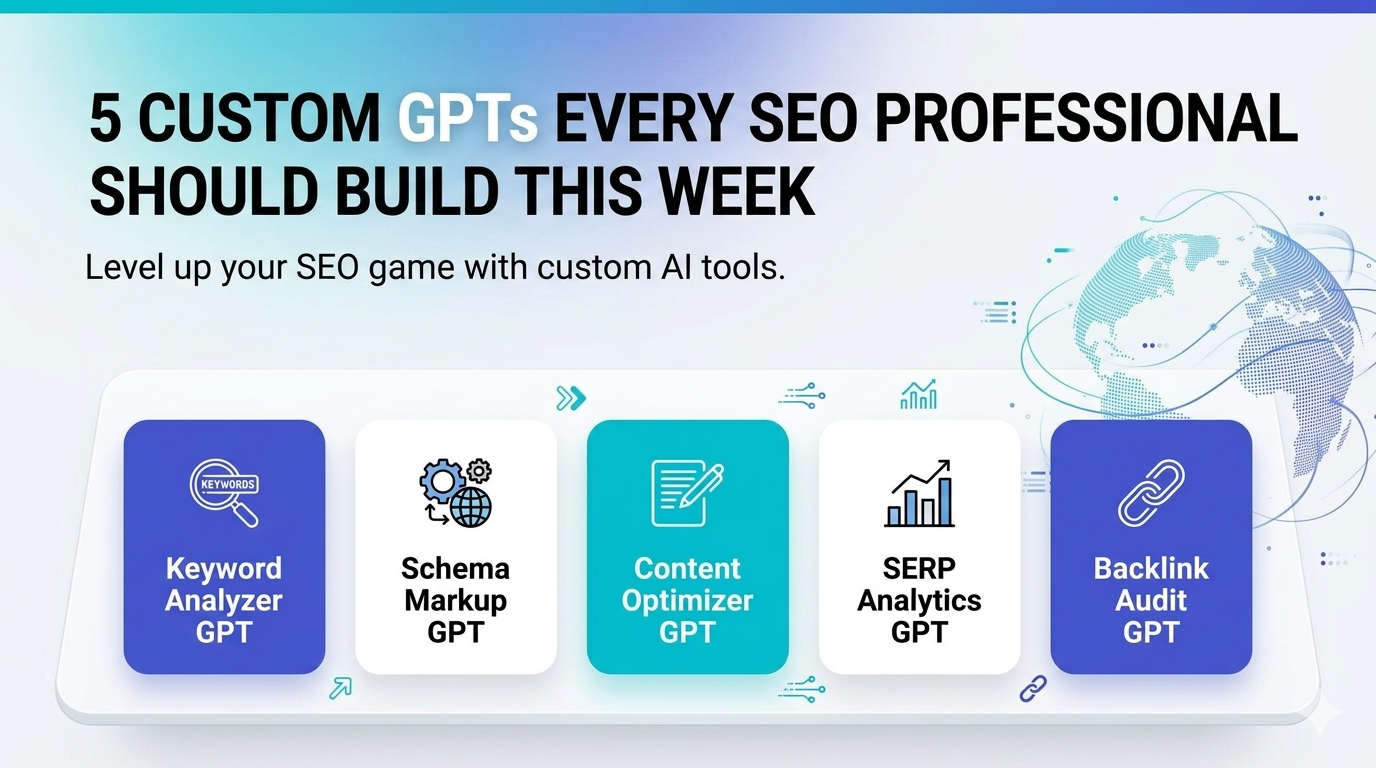
Here are the five Custom GPTs for SEO you should build this week to automate your workflow and dominate the SERPs.
1. The "Technical Audit Architect"
Technical SEO is often the most time-consuming part of any project. A Technical Audit GPT acts as a specialized consultant that understands your specific quality standards.
How it works:
You upload your favorite technical SEO checklist (or your agency’s proprietary audit framework) to the GPT’s knowledge base. When you paste a crawl report from tools like Screaming Frog or Arefs, the GPT analyzes the data against your standards.
Key Capabilities:
- Automated Prioritization: It separates "nice-to-fix" issues from "critical-blockers."
- Developer-Ready Tickets: It writes the Jira or Trello tickets for your dev team, explaining why a fix is needed in plain English.
- Schema Validation: Paste your code, and it checks for syntax errors or missing required fields.
2. The "Semantic Keyword Mapper"
Keyword research is no longer about finding high-volume strings; it’s about understanding topical authority and semantic relationships.
How it works:
This GPT is trained on Semantic SEO principles. Instead of just giving you a list of words, it clusters keywords into "Topic Hubs" and "Spoke Content."
Why you need it:
It identifies "Answer Engine Optimization" (AEO) opportunities. It looks for the specific questions users ask in your niche and maps them to the correct stage of the buyer's journey (Top of Funnel vs. Bottom of Funnel).
Pro Tip: To master the logic behind these clusters, check out our Advanced SEO Training where we dive deep into topic modeling and entity-based search.
3. The "E-E-A-T Content Guard"
Google’s Search Quality Rater Guidelines emphasize Experience, Expertise, Authoritativeness, and Trustworthiness. A "Content Guard" GPT ensures every piece of content you produce meets these high bars.
How it works:
Upload the official Google Search Quality Rater Guidelines as a PDF to the GPT’s knowledge base. Use it to "grade" your drafts before they go live.
Key Capabilities:
- Fact-Check Triggers: It flags claims that require a reputable external link.
- Tone Analysis: It ensures the voice sounds like an industry expert rather than a generic AI bot.
- Gap Identification: It tells you exactly what’s missing (e.g., "This article lacks a personal case study or unique data point").
4. The "Local SEO Citation & GMB Optimizer"
For businesses with physical locations, Local SEO is the lifeblood of lead generation. This GPT is designed specifically to manage Google Business Profiles (GBP) and local relevance.
How it works:
Feed it your business details: NAP (Name, Address, Phone), services, and specific neighborhood keywords.
Why it’s a game-changer:
- Review Response Generator: It drafts personalized, SEO-friendly responses to customer reviews that include your target keywords naturally.
- Local Post Creator: It generates "What’s New" posts for your GBP that are optimized for local search intent.
- Citation Audit: It helps you format your business information perfectly for directory submissions.
Staying ahead in local markets requires a blend of AI speed and local insight. At Milaaj Digital Academy, we teach you how to leverage these AI tools to win the "Local Map Pack" every time.
5. The "Internal Link Strategist"
Internal linking is one of the most powerful yet neglected SEO levers. This GPT helps you build a "web of relevance" across your site.
How it works:
You provide the GPT with a list of your existing URLs and their primary keywords. When you write a new blog post, you paste the draft into the GPT.
Key Capabilities:
- Anchor Text Suggestions: It finds the perfect spot in your new content to link back to your "Pillar Pages."
- Silo Maintenance: It ensures you aren't linking to irrelevant categories, keeping your topical silos clean and powerful for crawlers.
- Link Equity Distribution: It identifies old posts that need a link from the new post to boost their ranking.
How to Build Your First Custom GPT (Step-by-Step)
You don't need to be a developer to build these. Here is the simple framework:
- Define the Persona: Tell the GPT exactly who it is (e.g., "You are a Senior Technical SEO with 15 years of experience at a global agency").
- Upload Knowledge: This is the secret sauce. Upload your checklists, previous successful case studies, or brand voice guidelines.
- Set Constraints: Tell it what not to do (e.g., "Never use passive voice" or "Do not suggest black-hat techniques").
- Test and Refine: Give it a real task, see where it fails, and update the "Instructions" to fix the error.
Conclusion: Adapt or Be Left Behind
The future of SEO isn't just about knowing the algorithm; it's about building the systems that can dance with it. By building these five Custom GPTs for SEO, you aren't just saving time you are increasing the quality and consistency of your output.
Start small. Build one this week. Once you see the power of a "Digital SEO Assistant" that knows exactly how you think, you’ll never go back to manual workflows again.
FAQs
Do I need a ChatGPT Plus subscription to build Custom GPTs?
Yes, the ability to create and use Custom GPTs currently requires a ChatGPT Plus, Team, or Enterprise subscription.
Is my data safe when I upload it to a Custom GPT?
If you are using a personal "Plus" account, you can toggle off the setting that allows OpenAI to train on your data. For business use, the "Team" and "Enterprise" tiers offer even stricter data privacy, ensuring your proprietary SEO strategies stay private.
Can these GPTs replace an SEO professional?
No. These tools are augmentation devices. They require a human expert to set the strategy, verify the facts, and make final creative calls. They replace the tasks, not the person.
How often should I update my Custom GPTs?
SEO changes fast. You should update your GPT's "Instructions" or "Knowledge Base" whenever there is a major Google Core Update or if you refine your internal agency processes.
Can I share my Custom GPT with my team?
Yes. You can keep your GPT private, share it via a link with your colleagues, or publish it to the GPT Store for public use.