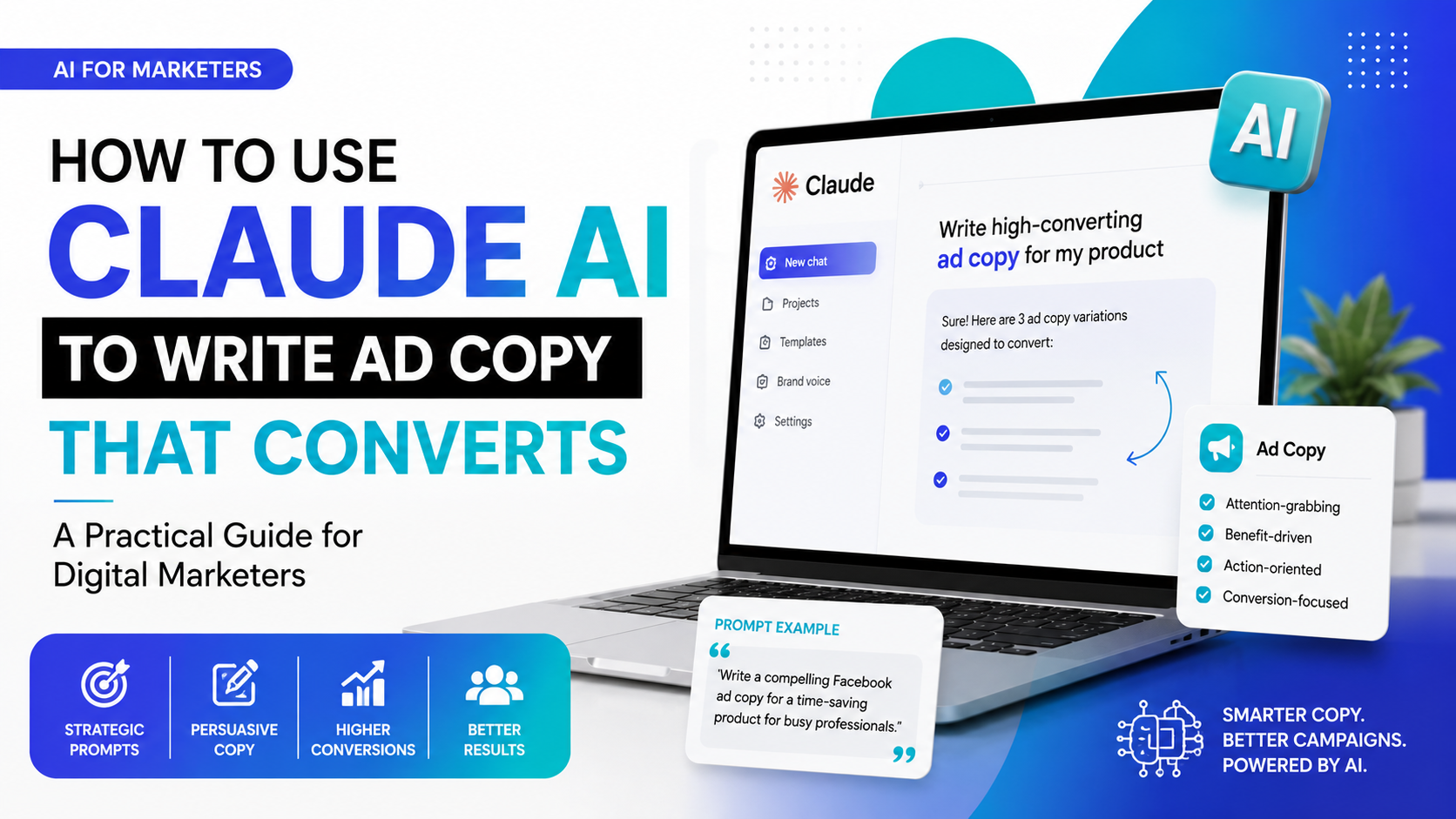
Most marketers who try generating ad copy with AI end up disappointed. They type a quick prompt like "write 5 Facebook ads for my online course," and the output reads like a generic textbook sales pitch. It lacks tension, misses the audience's deep emotional pain points, and gets scrolled past in less than half a second.
The problem is not the AI model—it is the input.
When you learn how to use Claude AI to write ad copy that converts, you unlock a systematic engine that builds high-performing ad variants in minutes. Anthropic's Claude AI stands out among large language models because it excels at following complex, multi-step instructions, adhering to strict character constraints, and matching nuanced brand tones.
This step-by-step practical guide shows digital marketers, agency owners, and media buyers how to build a repeatable Claude AI copywriting workflow that turns cold traffic into paying customers.
Why Claude AI Is a Game-Changer for Performance Marketers
Writing high-converting ad copy requires balancing psychological triggers, platform policies, and tight character limits. While ChatGPT generates punchy ideas, performance marketers rely on Claude AI for systematic campaign creation for several key reasons:
+-------------------------------------------------------------------------+| Claude AI vs. Standard AI Copy Generators |+-------------------------------------------------------------------------+| STANDARD PROMPTING | CLAUDE AI SYSTEMATIC WORKFLOW || * Generic benefit-stacking copy | * Nuanced brand voice & tone || * Frequent character count errors | * Strict character limit accuracy|| * Misses negative/prohibited constraints| * XML tag structured instructions|| * One-size-fits-all sales pitch | * Multi-framework variant testing|+-------------------------------------------------------------------------+
- Superior Constraint Adherence: Claude respects exact character limits (such as Google RSA's 30-character headline limit) far better than competitors.
- Context Window Depth: Claude processes massive documents—including landing page transcripts, customer reviews, and brand style guides—without losing track of details.
- Natural Human Flow: Claude avoids overusing robotic filler words (like "game-changer" or "revolutionize"). It generates natural, conversational copy that boosts ad strength metrics and engagement rates.
The 5-Step Framework to Prompt Claude AI for High-Converting Ad Copy
To generate ad copy that drives real sales, you must treat Claude AI like an elite copywriter who needs a thorough creative brief. Follow this five-step framework:
[1. Build Brand DNA] ──► [2. Structure with XML] ──► [3. Choose Copy Framework] │[5. Platform Adaptation] ◄── [4. Inject Performance Feedback] ◄─┘
Step 1: Feed Claude Your Brand DNA & Customer Insights
Never ask Claude to write copy in a vacuum. Start your session by pasting your Brand DNA:
- Ideal Customer Profile (ICP): Who are they? What keeps them awake at 2 AM?
- Pain Points vs. Desired Outcomes: What frustrates them about existing solutions?
- Brand Tone & Prohibited Words: What vocabulary should Claude use or avoid?
- Proof Points: Do you have verified customer reviews, metrics, or trust badges?
Step 2: Use XML Tags to Frame Your Prompts
Claude AI is optimized to recognize XML formatting tags. Wrapping your instructions in tags like <context>, <rules>, and <output_format> keeps the model focused and prevents instructions from bleeding together.
Step 3: Request Proven Copywriting Frameworks
Instead of asking for general copy, direct Claude to apply specific psychological frameworks:
- PAS (Problem - Agitate - Solution): Highlights pain before introducing relief.
- BAB (Before - After - Bridge): Shows the contrast between current struggles and future success.
- AIDA (Attention - Interest - Desire - Action): Guides prospects through a traditional sales funnel.
- Curiosity Gap: Reveals partial insights to compel the click.
Step 4: Inject Performance Feedback Loops
When you discover winning ad angles in Meta Ads Manager or Google Ads, feed those winning headlines back into Claude. Ask Claude to isolate the emotional driver (e.g., urgency, social proof, status, or savings) and generate 10 new variations using that exact angle.
Step 5: Adapt Copy for Platform Rules
A winning Facebook hook will fail as a Google Search ad. Instruct Claude to adapt the core message for each platform's unique format, character constraints, and user intent.
Upgrade Your Digital Marketing Career: Mastering AI-driven performance marketing requires practical, hands-on training. Explore the practical Digital Marketing Course at Milaaj Digital Academy to learn how to combine paid search, social media advertising, and automated content workflows.
Copy-Paste Claude AI Prompts for Digital Marketers
Here are three battle-tested prompt templates you can copy, customize, and use immediately in your campaigns.
1. Google Responsive Search Ads (RSA) Prompt
Google Search ads require high keyword relevance and tight character counts. Use this prompt to generate policy-compliant headlines and descriptions.
Markdown
<role>You are an expert PPC copywriter specializing in Google Responsive Search Ads (RSAs).</role><context>Product: [Insert Product/Service Name]Target Keyword: [Insert Primary Target Keyword]Target Audience: [Insert Audience Details]Main Value Proposition: [Insert Key Unique Selling Point]</context><rules>1. Generate 15 Headlines. Each headline MUST be 30 characters or fewer.2. Generate 4 Descriptions. Each description MUST be 90 characters or fewer.3. Include the primary keyword in at least 5 headlines.4. Do NOT use buzzwords like "best" or "#1" unless backed by third-party proof.5. Vary the emotional drivers: feature-led, urgency, social proof, and question-based.</rules><output_format>Table format with Columns: Type (Headline/Description), Character Count, Copy Angle, Draft Copy.</output_format>
2. Meta (Facebook & Instagram) High-Tension Hook Prompt
Meta feeds are visual and fast-paced. Your primary text needs a strong hook in the first line to stop the scroll.
Markdown
<role>You are a direct-response performance copywriter for Meta Ads.</role><context>Target Audience Pain Point: [Insert exact pain point, e.g., spending 15 hours/week manual reporting]Desired Outcome: [Insert goal, e.g., automated ROI reporting in 5 minutes]Offer: [Insert offer details, e.g., Free 14-day trial]</context><task>Write 3 distinct primary text variations using the Problem-Agitate-Solution (PAS) framework.- Hook 1: Contrarian statement- Hook 2: Relatable question- Hook 3: "Before vs After" transformationFor each variation, include a short 5-word headline for the ad button area.</task>
3. LinkedIn B2B Authority Positioning Prompt
B2B decision-makers respond to professional insight, industry data, and clear return on investment.
Markdown
<role>You are a B2B strategist crafting LinkedIn Sponsored Content.</role><context>Target Role: [e.g., Chief Marketing Officers / Growth Leads]Industry Challenge: [e.g., Rising customer acquisition costs in 2026]Data/Proof Point: [e.g., Reduced CAC by 34% across 50+ enterprise accounts]</context><instructions>Write 2 long-form LinkedIn ad copy options that use the Authority Positioning framework. Maintain a professional, insightful tone without sounding pushy. Focus on commercial impact and clear operational outcomes.</instructions>
Master Search Visibility & AI Optimization: Want to dominate search results across both search engines and AI answer engines? Learn how search algorithms evaluate content in our comprehensive SEO and AI Search Optimization Course at Milaaj Digital Academy.
4 Common Mistakes When Writing Ad Copy with Claude
Even advanced marketers make mistakes when integrating AI into their creative workflows. Avoid these four common traps:
+-------------------------------------------------------------------------+| Common Claude AI Copywriting Pitfalls |+-------------------------------------------------------------------------+| 1. Vague Prompts ──► Fix: Provide ICP details & pain points || 2. Over-reliance ──► Fix: Keep human review for policy compliance || 3. Ignoring Character Limits ──► Fix: Explicitly state strict limits || 4. Static Testing ──► Fix: Iterate weekly with performance data |+-------------------------------------------------------------------------+
- Accepting First-Draft Output Without Human Review: Always check generated copy against advertising policy guidelines (such as Google Ads or Meta Ads policies) before launching.
- Testing Too Many Variables At Once: When running A/B tests, test one element at a time—like the headline hook or the call-to-action—rather than swapping the entire ad creative.
- Skipping Character Count Constraints: Always state exact character limits in your prompt rules to prevent ad creation errors inside your ad accounts.
- Neglecting Brand Tone Rules: If your brand voice is casual, explicitly tell Claude to avoid formal language, jargon, or passive voice.
Frequently Asked Questions (FAQs)
Why is Claude AI better than other tools for writing ad copy?
Claude AI excels at understanding long context, adhering strictly to negative constraints (words or character limits to avoid), and producing natural language that feels human rather than overly promotional.
How do I ensure Claude AI ad copy matches my brand voice?
Supply Claude with a "Brand DNA" document containing examples of your best-performing past ads, key brand vocabulary, target audience pain points, and a list of prohibited words.
Can Claude AI help me pass Google Ads Quality Score checks?
Yes. By feeding Claude your target landing page copy and target keywords, you can ask it to generate search ad headlines that closely match landing page intent, boosting your keyword relevance and ad strength score.
How many ad variations should I generate with Claude per campaign?
A good practice is to generate 10 to 15 headline options and 3 to 4 body copy angles per campaign. This gives your ad network enough variety to run effective A/B tests.
Build Your AI-Powered Copywriting Engine Today
Understanding how to use Claude AI to write ad copy that converts transforms your digital marketing workflow from manual guesswork into a scalable system. By pairing structured XML prompts with strong customer insights and performance feedback, you can launch high-converting campaigns across search, social, and professional networks in a fraction of the time.
Start by testing a single Google RSA or Meta hook prompt today, analyze the performance data, and refine your prompt library to drive consistent growth for your brand.
Learn more about digital marketing strategies in this Learn Digital Marketing Master Course video, which outlines fundamental skills across SEO, paid ads, and content strategy.