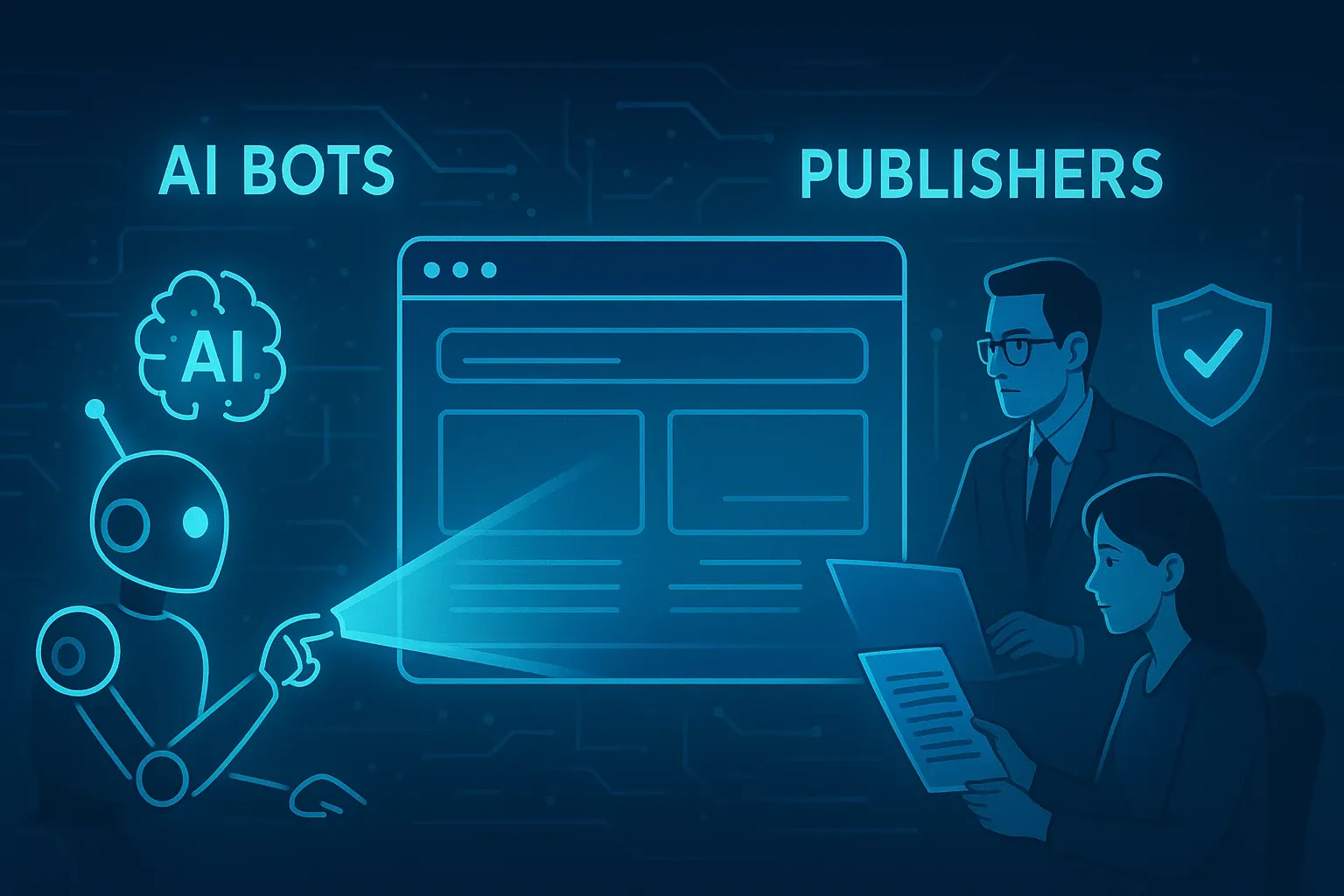
Artificial intelligence is reshaping the internet at lightning speed. AI bots and crawlers are scanning billions of web pages daily, training large language models (LLMs) that power chatbots, voice assistants, and generative AI platforms. While this fuels innovation, it also sparks an increasingly tense battle between publishers who create online content and AI companies that consume it.
At the center of this conflict lies a fundamental question: who controls online content in the age of AI? The fight over web standards and AI bots has become one of the most important debates in digital publishing and could redefine the relationship between creators, platforms, and readers.
What Are AI Bots and Why Do They Matter?
AI bots are automated systems designed to crawl the web, collect data, and feed it into machine learning systems. Unlike traditional search engine crawlers, these bots are not just indexing pages—they are extracting knowledge for training generative models.
- Search Bots: Collect data to improve search results.
- AI Crawlers: Ingest vast content libraries to train LLMs.
- Assistants: Power chatbots that can summarize, rewrite, or recreate original articles.
This shift has raised alarms among publishers, who argue that AI bots use their content without fair compensation or credit.
The Role of Web Standards in the Battle
Web standards are rules that govern how websites and digital platforms communicate. For decades, they ensured openness and interoperability. Now, they’re at the heart of the AI content struggle.
Key Standards Under Debate:
- Robots.txt: A file that tells bots which pages they can or cannot crawl.
- Meta Tags: Used to restrict indexing or AI training.
- Proposed AI-Specific Standards: New protocols aimed at controlling how generative AI systems access content.
The problem? Current standards were never designed for the AI era. While robots.txt can block crawlers, it’s voluntary—AI companies may choose to ignore it.
Publishers Push Back
Major publishers, news outlets, and creative platforms argue that AI companies profit from their work without sharing revenue. The risks include:
- Loss of Traffic: If AI answers users directly, fewer people click through to original sources.
- Content Scraping Without Credit: Articles are rephrased or summarized with no attribution.
- Revenue Decline: Ad-driven publishers lose monetization opportunities.
Some publishers have already taken action:
- Blocking AI Crawlers: Outlets like The New York Times and Reuters have restricted access to their sites.
- Legal Challenges: Lawsuits against AI companies for unauthorized use of copyrighted material.
- Licensing Deals: Some organizations strike agreements with AI firms for controlled data access.
AI Companies Defend Their Position
On the other side, AI companies argue that:
- Public Web Data Is Open: If it’s published online, it’s part of the open web.
- Fair Use: Training AI on existing content is legally permissible under certain interpretations.
- Innovation Benefits All: AI-generated insights help users, businesses, and even publishers indirectly.
- Traffic Redirection: Some AI platforms now experiment with citing sources, potentially driving clicks back to publishers.
Still, these arguments haven’t eased publisher concerns about value extraction vs fair compensation.
Risks of Unregulated AI Crawling
If this struggle remains unresolved, the risks extend beyond publishers:
- Content Dilution: The web could become flooded with low-quality AI-generated pages.
- Data Privacy Issues: AI bots might scrape sensitive or restricted data.
- Monopoly Power: A few AI giants could dominate knowledge distribution.
- Erosion of Trust: Readers may struggle to identify what’s human-authored vs AI-generated.
The absence of clear AI-specific web standards leaves the internet vulnerable to confusion and exploitation.
Potential Solutions Emerging
The debate has spurred innovation in potential frameworks to balance control and access.
1. AI-Specific Robots Directives
New extensions of robots.txt designed to give publishers finer control over how their content is used in AI training.
2. Licensing Agreements
Publishers may adopt standardized contracts that allow AI companies to pay for training rights.
3. Digital Watermarking
Embedding invisible signals in content to detect unauthorized AI usage.
4. Policy & Regulation
Governments and international bodies may step in, creating rules on data scraping, copyright, and AI transparency.
5. Revenue-Sharing Models
Similar to how music streaming pays royalties, AI companies could distribute profits to content creators.
Case Study: News Media vs AI Bots
In 2024–2025, the news industry became the front line of this struggle. Outlets that rely on advertising saw AI platforms summarizing their stories—often without links. Traffic dropped, fueling calls for compensation and stricter rules.
Meanwhile, some organizations chose collaboration: striking deals with AI companies to provide exclusive feeds for training, with guaranteed attribution. This highlighted a growing split between “AI-friendly” and “AI-resistant” publishers.
The Ethical Dilemma
Beyond legal battles, the rise of AI bots raises ethical questions:
- Should creators be forced to give their work to AI systems?
- Do users deserve transparency about where AI answers come from?
- Can innovation flourish without undermining original creators?
Striking a balance between open knowledge and fair ownership will define the future of digital publishing.
The Future of Content Control
The struggle over AI bots and web standards is far from over. What’s likely:
- New Technical Standards: Updated versions of robots.txt built specifically for AI.
- Global Legal Frameworks: International regulations on AI data use.
- Hybrid Ecosystems: Some publishers block AI completely, while others license content for new revenue streams.
- Greater Transparency: Users may demand clearer labels on AI-generated content.
Ultimately, the future of online content may rest on a single principle: shared value between creators and AI platforms.
Conclusion
The rise of AI bots has triggered one of the most important digital battles of our time. On one side are publishers fighting to protect their rights and revenue; on the other are AI companies pushing for open access in the name of innovation.
Web standards, once a quiet corner of the internet, have become the frontline of this struggle. The outcome will determine not just the future of publishing, but also the integrity and fairness of the internet itself.
The question remains: will the future of online content be shaped by cooperation—or conflict?