The year 2026 has brought us to a strange crossroads. On one hand, generative AI can produce a month’s worth of social media content in the time it takes to brew a cup of coffee. On the other hand, the internet is becoming a "sea of sameness" a landscape filled with generic, robotic, and emotionally hollow content.
For the modern AI-augmented marketer, the challenge is no longer about efficiency; it is about AI brand voice ethics. How do you leverage the sheer power of Large Language Models (LLMs) without sacrificing the unique "soul" that makes your brand recognizable? How do you stay ethical in a world where "fake" is easier than "real"?
Maintaining authenticity in an automated world isn't just a creative choice it is a business necessity. If your audience can’t tell you apart from a bot, they have no reason to stay loyal to your brand.
The Ethical Dilemma: Efficiency vs. Authenticity
In 2026, transparency is the new currency. The ethical use of AI doesn't mean avoiding these tools; it means using them as a "creative skeleton" rather than a "finished body."
The dilemma arises when brands rely solely on AI for the final output. This leads to several ethical and strategic risks:
- AI Hallucinations: Presenting false information as fact, damaging your brand's authority.
- Plagiarism & Copyright: Using tools that might have been trained on data without proper attribution.
- Erosion of Trust: Customers feel "cheated" when they realize they are interacting with a machine pretending to be a human.
1. Defining Your "Human-Centric" AI Strategy
To use AI brand voice ethics as a competitive advantage, you must first define what your brand sounds like when it isn't using a machine.
The Anchor Point
Before you open ChatGPT, Claude, or Gemini, you must have a brand style guide. This guide should include your tone (witty, professional, rebellious), your preferred vocabulary, and the "no-go" zones.
When you use AI, you aren't asking it to "be creative." You are asking it to "follow the rules."
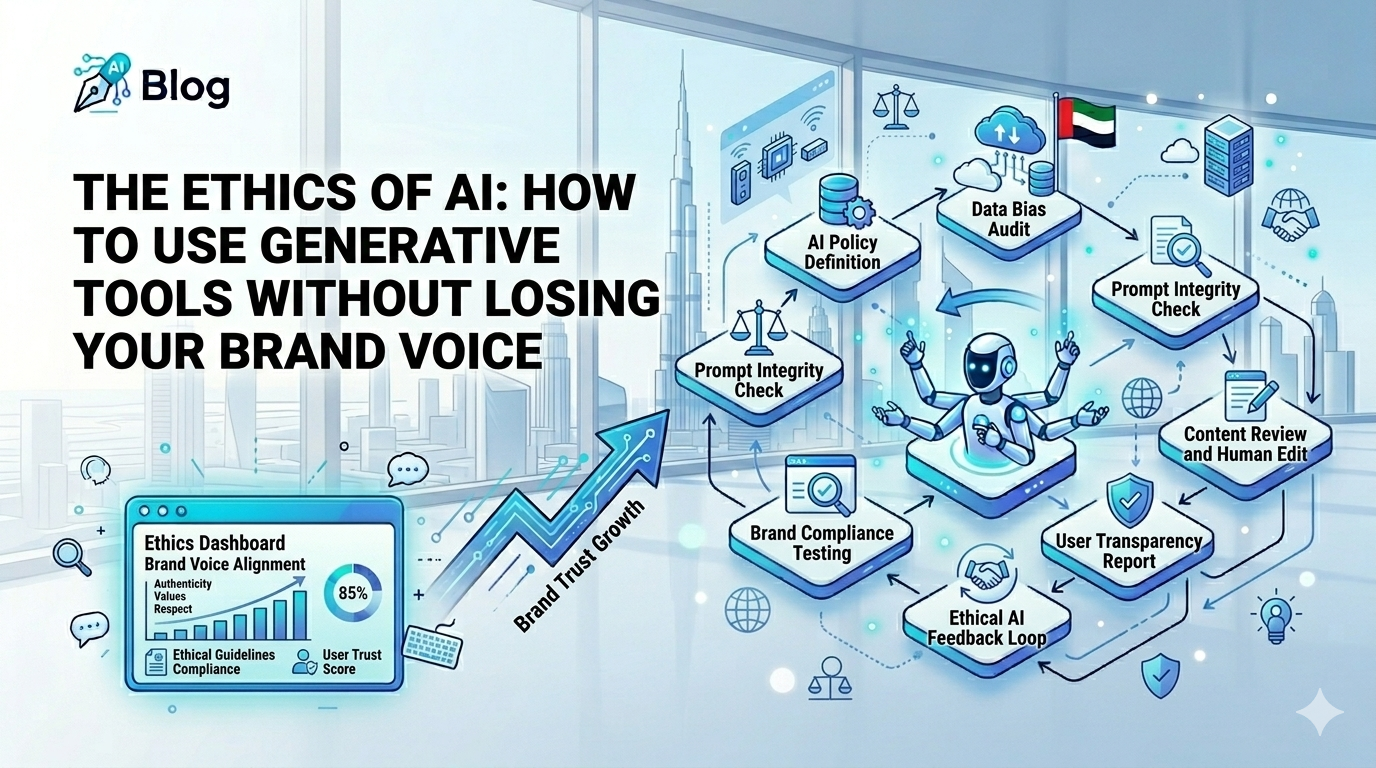
- Human-in-the-loop (HITL): This is the gold standard for 2026. No AI-generated content should ever reach the "Publish" button without a human editor checking for nuance, bias, and brand alignment.
- Internal Link: At Milaaj Digital Academy, we teach students how to build these ethical frameworks in our Digital Marketing and AI Strategy courses, ensuring technology enhances, rather than replaces, human creativity.
2. Using "Prompt Engineering" to Protect Brand Voice
The secret to keeping your voice alive lies in how you talk to the AI. Generic prompts yield generic results. Ethical AI usage requires "contextual priming."
The "Identity-First" Prompting Method
Instead of saying "Write a blog post about SEO," an ethical marketer provides a "Brand DNA" prompt:
By setting these boundaries, you prevent the AI from defaulting to its "average" training data, which often sounds like a corporate brochure.
3. The Ethics of AI Disclosure: To Tell or Not to Tell?
One of the hottest debates in AI brand voice ethics is disclosure. In 2026, many global regulations require brands to label AI-generated images and videos. But what about text?
The "Value-First" Rule
The ethical consensus is shifting toward "Value-Based Disclosure."
- Deep AI Content: If a tool generated 90% of the piece, a small disclaimer (e.g., "Drafted with the assistance of AI") builds trust.
- Augmented Content: If a human researched, structured, and polished an AI-assisted draft, disclosure is less critical because the "creative ownership" remains human.
Transparency doesn't hurt your brand it humanizes it. It shows your audience that you are using technology responsibly to serve them better, not to cut corners.
4. Avoiding the "Bot-Neck": Fighting Content Decay
When every competitor is using the same LLMs, everyone starts to rank for the same keywords with nearly identical advice. This is "Content Decay."
How to Stay Unique:
- Use Proprietary Data: Feed the AI your own case studies, customer surveys, and local insights. This is the customer intelligence that AI cannot find on the open web.
- Inject Personal Experience: AI cannot say, "When we opened our repair shop in Al Barsha, we noticed..." Only you can.
- Focus on E-E-A-T: Google's 2026 algorithms are hyper-focused on "Experience." If your content lacks a unique human perspective, it will sink in the SERPs, regardless of how many keywords you use.
For those looking to master technical search strategies, our SEO and Development modules cover how to build sites that prioritize human experience over robotic patterns.
5. Guarding Against Bias and Misinformation
AI is a mirror of the internet it reflects both the good and the bad. An ethical brand must be a "truth filter."
The Verification Loop
- Fact-Checking: AI-generated statistics are notoriously unreliable. Every claim must be verified against primary sources.
- Cultural Sensitivity: In diverse markets like the UAE or Kerala, AI might miss cultural nuances or use idioms that don't translate well.
- Inclusivity: Regularly audit your AI tools to ensure they aren't perpetuating stereotypes in the images or text they generate.
Conclusion: The Machine is the Brush, You are the Artist
The Ethics of AI isn't about setting limits on what technology can do; it's about setting standards for what humans will allow. As we move deeper into the age of the AI-augmented marketer, the brands that win will be the ones that use generative tools to amplify their humanity, not hide it.
By maintaining a rigorous "Human-in-the-loop" process, investing in prompt engineering, and staying transparent, you can harness the speed of AI while keeping the brand voice that your customers have grown to love and trust.
FAQs
Can AI-generated content really sound like a human?
Yes, but only with high-quality prompting and heavy human editing. AI is excellent at mimicry, but it lacks the "emotional context" of real-world experiences. To sound human, you must add your own stories and specific brand nuances.
Is it unethical to use AI for SEO?
No, it is not unethical to use AI for research, clustering, or drafting. However, it is unethical to publish unverified, thin, or deceptive content that wastes a user's time or provides false information.
How do I protect my brand's "Secret Sauce" when using AI?
Most professional AI tiers (like Claude Team or ChatGPT Enterprise) do not use your data to train their models. Always ensure you are using a "Privacy-First" tier when inputting proprietary business strategies or customer data.
Will Google penalize me for using AI content in 2026?
Google penalizes low-value content, not AI content. If your AI-generated post solves a user's problem and demonstrates E-E-A-T (Experience, Expertise, Authoritativeness, Trust), it will rank. If it's generic fluff, it will fail.
How can I learn to use AI ethically in my business?
The best way is through structured learning. Joining a community or academy that focuses on the intersection of technology and ethics, like Milaaj Digital Academy, ensures you stay compliant while remaining competitive.