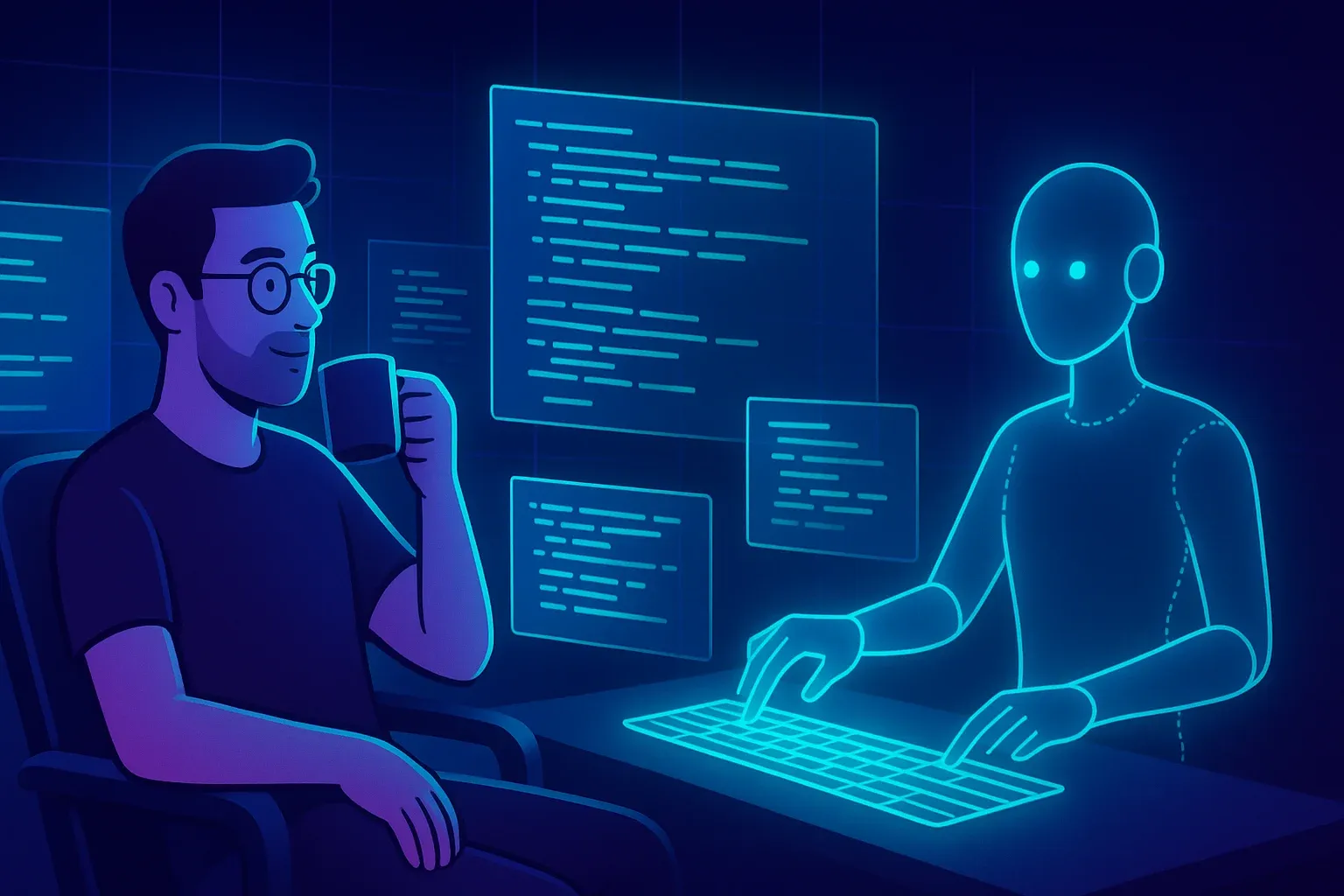
In tech circles today, a new phrase is stirring up debate: vibe coding. Coined recently by Alexandr Wang and popularized by software engineers like Andrej Karpathy, vibe coding refers to a programming workflow where developers lean heavily on AI tools to write code, and do less detailed legacy-style review. Rather than scrutinizing every line, devs describe what they want, let the AI generate boilerplate or scaffolding, and iterate based on execution results rather than code purity.
It’s part of a broader shift: as AI gets better at handling syntax, repetitive tasks, and even catching certain classes of bugs, programmers are reimagining which parts of coding require human time—and which can be delegated. But what are the benefits? The risks? And is this “review-less” style sustainable, or just a shortcut with hidden costs?
What Exactly Is Vibe Coding
- Definition: Vibe coding is essentially an intuitive, experimental coding style where AI tools are asked to generate large chunks of code (boilerplate, modules, prototypes) with minimal initial human review. Developers test, see if it works, then ask for fixes rather than deeply inspect every line.
- Origins & Popularization: The term and concept have gained traction via public discussions: Karpathy defined vibe coding in early 2025; media and forums have since picked it up. It appeals especially to young programmers or those learning, because it lowers barriers to starting projects.
Why It’s Gaining Popularity
- Speed and PrototypingWith AI generating skeletons, devs can get working prototypes faster; what used to take days can take hours. Boilerplate, scaffolding, and templates are handled by AI; the human spends more time refining, integrating, or designing.
- Lower Barrier to EntryVibe coding lets less-experienced devs experiment more freely. If you can describe what you want, AI can produce something workable, helping you learn by iteration rather than steep upfront design.
- Focus on Higher-Level WorkDevelopers using vibe coding often say they can spend less time on style, syntax, or infrastructure setup, and more on architecture, logic, UX, or product decisions.
- Better Integration of AI ToolsMore tools and agents now assist in code generation, code review, auto-fixes, etc. AI code review tools are becoming standard in many development workflows.
Real-World Use Cases & Success Stories
- A report (DeputyDev) on enterprise use showed AI-powered review tools reduced pull request review times significantly, with many devs adopting it after trial phases.
- Companies using AI agents (e.g. Walmart, etc.) are automating review, tests, and bug detection in parts, enabling speed gains in development.
- Forums and developer communities report mixed experiences: devs say AI handles minor bugs, syntax, boilerplate; human oversight is still needed for design, architecture, and critical logic.
Risks, Challenges & Trade-offs
Even fans of vibe coding admit there are downsides:
- Security VulnerabilitiesAI-generated code often contains flaws. A study by Veracode found ~45% of AI-generated code had security vulnerabilities. Relying too much on AI without review increases risk.
- Loss of Deep Knowledge / Skills DecayIf devs stop reviewing code deeply, they may lose the skills to understand architecture, debugging, or nuanced logic. Some report feeling less satisfaction from solving problems themselves.
- Inconsistency & Context BlindnessAI tools frequently miss project-specific conventions, domain logic, or contextual constraints. They may not understand why code is structured a certain way and may suggest “improvements” that break things.
- Technical DebtQuick fixes and boilerplate can accumulate into messy codebases. If AI-generated code isn’t refactored and maintained, long-term maintenance costs rise.
- Ethical & Quality ConcernsCopying or reusing AI’s training data may raise licensing or originality issues; blindly trusting AI could propagate biased patterns.
Best Practices & Guidelines for Using Vibe Coding Responsibly
To get the best of vibe coding while minimizing risks, organizations/developers should consider:
- Always pair AI generation with at least light human oversight—especially for security, logic, and architecture.
- Use AI tools that support context: access to entire code base, prior commits, style guidelines, domain logic, etc.
- Define boundaries: which parts of code are auto-generated (boilerplate, scaffolding), and which require human writing or review.
- Integrate automated tests and security scans in the workflow so that issues are caught early.
- Maintain style, code health metrics, version control discipline.
- Training/development: junior devs should learn fundamentals, not just rely on AI generation.
The Future Outlook
- Wider adoption of feel-first or vibe workflows especially in startups or experimental projects.
- Improved tools: AI agents with better context, code quality estimation, security awareness, and feedback loops.
- Hybrid workflows: part AI, part human; humans in supervisory or review roles rather than line-by-line writing.
- New roles: AI “prompt engineers,” reviewers of AI outputs, maintainers of AI-generated code can become more prominent.
- Quality metrics & standards: Tools or industry norms for evaluating AI-generated code, error rates, etc.
Conclusion
Vibe coding isn’t a fad—it reflects a shift in how developers view work: less about writing every single line, more about guiding AI, experimenting, iterating, and shipping faster. The benefits are compelling: speed, prototyping, freeing human effort for higher-value thinking. But risks are real too: security, maintainability, skills erosion.
In 2025, the winning approach seems to be balance: use AI aggressively, but never abdicate human responsibility. Vibe coding should be about expanding what developers can do—not replacing their critical judgment.