For decades, the path to a lucrative career in software engineering was straightforward: pick a programming language, master its syntax, and become the go-to specialist for that specific stack. If you could write clean code faster than anyone else, your job security was practically guaranteed.
But as we navigate 2026, that traditional career playbook has been completely rewritten.
The explosive maturation of generative AI tools, automated coding agents, and the rise of "vibe coding" where AI models generate, suggest, and refactor codebases in real time has fundamentally commoditized raw syntax generation. Typing boilerplate code, fixing basic syntax bugs, and memorizing framework APIs are tasks now handled instantly by cognitive AI ecosystems.
Legacy Developer Mindset: [Problem] ──> [Manual Syntax Typing] ──> [Functional Code]Modern Developer Mindset: [Problem] ──> [System Design & Prompting] ──> [AI Synthesis & Review]
In this transformed landscape, pure technical specialization is no longer a sustainable moat. The industry no longer values developers who only understand their narrow slice of a system. Instead, the modern tech economy demands a T-shaped developer skill profile.
Let’s explore what it truly means to possess a T-shaped skill architecture, why it has become the ultimate defense against AI obsolescence, and how you can transform your skillset to thrive in an automated software economy.
Deconstructing the "T": Depth vs. Breadth in the AI Era
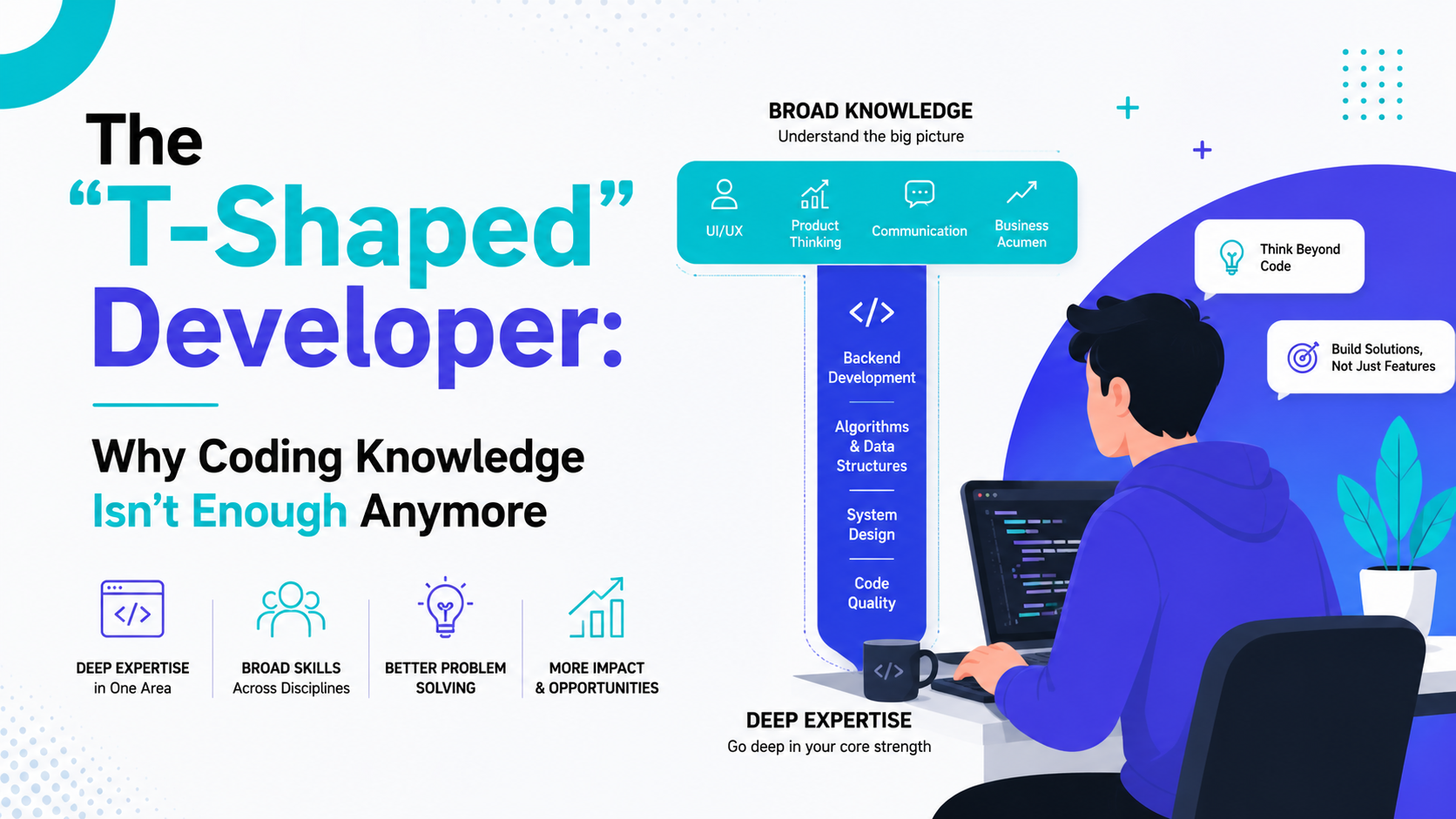
The concept of a T-shaped professional isn't entirely new, but its application to modern engineering has accelerated dramatically. The profile consists of two distinct components that work together to create an unstoppable professional:
1. The Vertical Bar: Deep Core Expertise
The vertical line of the "T" represents your deep, specialized mastery in a single technical domain. This is your anchor. Whether you are an expert in backend architecture, native iOS systems, cloud infrastructure engineering, or machine learning pipelines, this depth provides your professional credibility. It ensures you understand advanced architectural foundations and complex failure modes that surface-level AI tools frequently miss.
2. The Horizontal Bar: Cross-Functional Breadth
The horizontal top bar represents your broad, high-level understanding of adjacent disciplines. It means a backend engineer knows enough about UI/UX principles to spot a flawed frontend element, understands DevOps pipelines to debug a broken deployment, and grasps business metrics well enough to map feature requests to actual company growth goals.
Developing this comprehensive technical balance is exactly what separates senior technical leaders from entry-level programmers. At Milaaj Digital Academy, we specifically design our interactive ecosystems to help technical professionals build wide-ranging digital skillsets.
Why the AI Explosion Mandates a T-Shaped Skill Profile
The rapid adoption of AI coding agents has completely flipped the economics of software development. Because AI raises the lower threshold of engineering by automating routine coding tasks, the true bottleneck in software production is no longer writing code it is problem decomposition, system integration, and architectural judgment.
The Trap of Narrow Specialism
If your entire value proposition relies on writing React components or configuring standard database schemas, you are competing directly with tools that operate at a fraction of your cost. Single-stack specialists are finding themselves vulnerable because they cannot operate outside their designated silos. When an unexpected integration bug surfaces across the infrastructure layer, they stall.
The T-Shaped Advantage
Conversely, a developer with a diverse T-shaped developer skill profile views AI tools as a massive cognitive exoskeleton. They use generative coding models to write boilerplate fragments at lightning speed across unfamiliar languages, freeing up their mental energy to orchestrate complex, distributed systems. They become composers rather than manual scripters, safely guiding AI agents to solve intricate business problems end-to-end.
Structural Steps to Build Your T-Shaped Engineering Core
Transitioning into a versatile, T-shaped engineer requires a deliberate, step-by-step strategy. You cannot simply read a handful of superficial tutorials and claim cross-functional mastery. You must actively expand your skill horizons through practical experimentation.
Step 1: Fortify Your Computer Science Foundations
As development tools evolve, foundational computer science principles remain completely unchanged. Double down on data structures, system design patterns, algorithm optimization, and secure memory management. This deep architectural knowledge gives you the analytical framework to review AI code outputs critically, catch hidden vulnerabilities, and design highly scalable architectures.
Step 2: Acquire Adjacent Technical Horizons
Intentionally dedicate time each month to learning skills just outside your immediate comfort zone.
- If you are primarily a frontend developer, spend time exploring RESTful API design, database querying, and server-side logic.
- If you work deep in the backend, practice building basic user interfaces or deploying containerized apps via modern CI/CD systems.
Your goal isn’t to become a world-class expert in every single discipline, but rather to build enough functional fluency to collaborate seamlessly across complex, cross-functional teams.
[Your Broad Horizontal Skills] (UI/UX Fundamentals ── DevOps ── Product Strategy ── AI Systems) │ ▼ [Your Deep Vertical Focus] (e.g., Advanced Backend Dev)
Step 3: Hone Your Product and Communication Soft Skills
The absolute edge of the T-shaped profile lies in non-technical capabilities. You must learn to translate complex engineering challenges into clear, plain language that business stakeholders can easily understand. Practice clean documentation, study the core metrics that drive user engagement, and actively participate in product design reviews.
Bridging the gap between raw code capability and strategic business execution is exactly what drives long-term career growth. Discover our specialized masterclasses on our Full-Stack AI Architect, where we train professionals to lead modern, tech-driven business ecosystems.
Conclusion: The Era of the Code Composer has Arrived
The traditional era of the pure, single-language keyboard programmer is quickly winding down. AI has permanently altered how software is conceived, built, and maintained. Far from making human engineers obsolete, this tech shift has actually created an incredible era of opportunity for flexible, broadly skilled software builders.
By building a highly robust T-shaped developer skill profile, you elevate your role from a basic line-by-line script writer to an elite technical system architect. You ensure your expertise remains incredibly valuable, highly adaptive, and immune to the waves of digital automation.
Frequently Asked Questions (FAQ)
What exactly is a T-shaped developer skill profile?
A T-shaped developer profile refers to an engineering professional who possesses deep, highly specialized expertise in a single core domain (the vertical bar of the T), alongside a broad, practical understanding of adjacent technical fields and soft skills (the horizontal crossbar).
Is AI going to replace traditional software developers?
AI tools are not replacing human developers; rather, they are replacing routine, repetitive syntax generation and manual boilerplate writing. Human engineers who adapt by focusing on system design, prompt architecture, and end-to-end integration are finding themselves more productive and valuable than ever before.
How can a junior developer build a T-shaped skill set starting out?
Junior developers should first focus on mastering their core vertical skill to build solid professional credibility. Once they have a firm grip on their primary stack, they should gradually pick up 2 to 3 supporting skills each year by building small, multi-discipline side projects and actively participating in cross-functional design reviews.
Why are soft skills considered a vital part of a T-shaped profile?
Soft skills like clear technical documentation, effective stakeholder communication, and basic product strategy form a critical part of the horizontal bar of the T. They allow an engineer to understand the broader business context behind a software project, enabling them to design better systems that create real commercial value.
What is the difference between a generalist and a T-shaped engineer?
A pure generalist knows a little bit about everything but lacks the deep, authoritative mastery required to solve highly complex, specialized technical challenges. A T-shaped engineer represents the perfect balance, combining the broad collaboration skills of a generalist with the rigorous technical authority of a seasoned specialist.
For a deeper look into how the tech landscape is rapidly evolving with automation, you can check out this insightful discussion on How T-Shaped Devs Beat AI. This video breaks down how combining depth in one craft with broad systems knowledge makes you completely irreplaceable in an AI-driven economy.