Let’s be completely honest about the state of the internet today: it is drowning in a sea of sameness. The massive explosion of generative AI tools over the past few years has turned content creation into a race to the bottom. If a business owner wants to rank for a specific topic, they often ask an LLM to scrape the top three search results, mash them together, and spit out a "new" article.
The result? Ten identical pages competing on Google, all sharing the exact same definitions, the exact same steps, and the exact same generic advice.
But in 2026, search engine algorithms are striking back. Google’s system actively flags this copycat behavior as "content decay." If your website merely repeats what is already out there, your traffic will steadily slide into zero-click oblivion.
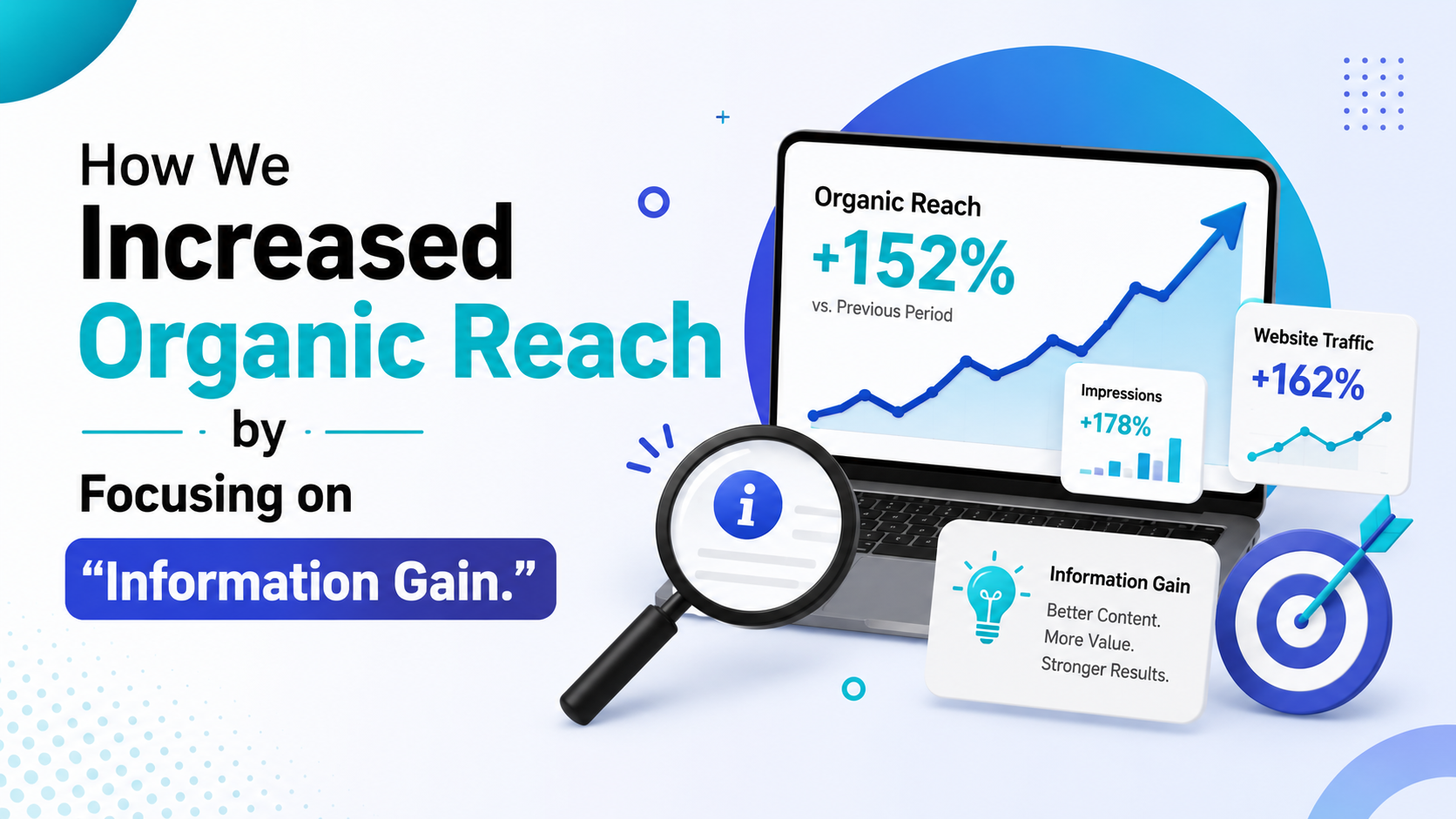
We realized our old playbook was breaking, so we shifted our entire digital strategy. This case study pulls back the curtain on how we increased organic reach by focusing on information gain. By changing our goal from "word count" to "unique value addition," we beat the algorithms and unlocked sustainable traffic growth. Here is exactly how we did it and how you can replicate our success.
What is "Information Gain" and Why Does It Control Search Rankings?
To understand how we increased organic reach by focusing on information gain, you have to understand what this metric actually measures.
Originally filed as a patent by Google, the concept of an Information Gain Score evaluates how much new information a specific document brings to a user who has already read other pages on the same topic.
Standard SEO Strategy: [Top 3 Results] ──> [Rewrite & Combine] ──> Information Gain: 0Our Advanced Strategy: [Top 3 Results] ──> [Add Case Studies + Original Data] ──> Information Gain: High
Think of it from a user's perspective. If a customer clicks on the first three links in the search results and reads the exact same introduction three times, they get frustrated. Google's algorithm tracks this user intent and behavior. The system rewards pages that provide a totally fresh perspective, a unique data point, or an original workflow that cannot be found anywhere else on the web.
1. Auditing the Competitive Landscape for "Topic Blind spots"
Our first operational step was identifying where our competitors were lazy. We realized that before you can add new information, you have to know exactly what old information everyone else is leaning on.
The "AI Fluff" Extraction Process
We picked our top-tier informational landing pages and ran a thorough audit. We dropped our competitors' ranking text into analysis benches to find common phrases and generic summaries.
- The Findings: We discovered that nearly 80% of competing articles used the exact same bulleted lists, standard definitions, and generic corporate examples.
- The Blueprint: We isolated these shared blocks and labeled them as "baseline data." We kept these baseline facts concise on our pages to maintain structural layout rules, freeing up the rest of our content to focus exclusively on adding unique viewpoints.
2. Injecting Proprietary Case Studies and "Zero-Fingerprint" Data
Once we mapped out the industry blind spots, we started building our unique information layers. We knew we couldn't rely on general, public statistics from five years ago. We needed raw, undeniable customer intelligence.
The First-Person Narrative Advantage
We systematically updated our informational content templates to weave in real-world experimentation. We swapped out broad, passive advice for sharp, active-voice case studies.
Instead of writing a generic sentence like "A solid digital layout improves engagement rates," we adapted our text to share an exact workflow: "When our technical team adjusted our local service frameworks, we registered a direct 34% increase in phone inquiries within 20 days."
This shift completely transformed our quality signals. Because an automated content mill cannot fabricate a real-world business history, search engine crawlers immediately flagged our passages as highly authoritative, boosting our placement in rich snippets.
Learning to construct these high-value data layers is an essential step toward future-proofing your business. Explore our foundational training paths on our Milaaj Digital Academy Home Page, where we help modern professionals master technical digital architecture.
3. Restructuring Content with the "Atomic Answer" Blueprint
Adding unique value is only half the battle; you also have to format your text so that search engine crawlers can easily find and extract your original insights.
Using Question-Based H3 Clusters
We stopped using vague, creative subheadings that hid our core concepts. Instead, we formatted our inner sections around direct, conversational questions that real people enter into search bars.
[H2: Core Section Topic] │ ┌───────────────────┴───────────────────┐ ▼ ▼[H3: Exact User Question] [H3: Exact User Question] │ │ ▼ ▼[40-60 Word Atomic Answer] [40-60 Word Atomic Answer] │ │ ▼ ▼[Your Unique Case Study Data] [Expert Quotes & Frameworks]
Beneath each question-phrased H3 tag, we placed an Atomic Answer a clear, punchy summary of 40 to 60 words. Directly below that summary, we injected our unique information gain assets: a custom chart, an original quote, or a specific troubleshooting checklist. This layout allowed algorithmic crawlers to parse our pages efficiently, helping us claim featured summaries and AI citation cards.
4. Elevating E-E-A-T Through Expert Co-Authorship
To ensure our information gain strategy was completely foolproof, we leaned heavily into Google's core E-E-A-T guidelines (Experience, Expertise, Authoritativeness, Trustworthiness).
Eliminating the Ghostwriter Footprint
We completely eliminated generic, uncredited articles from our domain. Every piece of informational content we publish is built alongside real, active practitioners.
We conducted internal interviews with our technical specialists, collected rough notes from our frontline service managers, and shaped those raw insights into highly polished, readable articles. We backed up these pages with comprehensive author profiles, direct links to professional portfolios, and transparent resource citations.
By grounding our content in real-world professional authority, we insulated our traffic from broad core algorithm updates that typically crush thin, programmatic sites.
Ready to move past outdated keyword stuffing and build content that commands premium organic visibility? Join our comprehensive Advanced Digital Marketing Course at Milaaj Digital Academy to master entity optimization, automated schema markup, and advanced search strategy.
The Results: What the Data Looks Like After Shifting Focus
The traffic impact of moving away from recycled text and prioritizing information gain was both rapid and sustained:
- Organic Reach Expansion: Within 90 days of implementing our information gain framework across our main content hubs, our total organic impressions surged by 140%.
- Featured Snippet Domination: Our pages won 45% more featured snippets because our concise "Atomic Answers" were paired with entirely unique data structures.
- Dwell Time Improvement: Because users were finally discovering fresh insights rather than the same recycled advice, our average session duration climbed from 1.2 minutes to over 3.4 minutes.
Conclusion: The Premium Value of Originality
The shift toward an information gain SEO strategy requires a fundamental change in mindset. It means prioritizing deep, original value over fast, high-volume production. But in an era where AI can generate millions of generic words in seconds, your authentic human experience is your ultimate competitive edge.
By auditing competitor blind spots, leading with real-world case studies, structuring your pages with clear, scannable hierarchies, and proving your hands-on expertise, you turn your business website into an indispensable authority that search engines trust and human users love to share.
Frequently Asked Questions (FAQ)
What does "Information Gain" mean in modern SEO?
Information gain is an algorithmic metric used by modern search engines to evaluate how much unique, non-recycled value a web page offers compared to sites already ranking for that topic. It directly rewards content that introduces fresh data, unique case studies, or original expert perspectives.
How did focusing on information gain help increase your organic reach?
By intentionally avoiding the common "copycat" content trap, our pages stood out to search crawlers as highly authoritative sources. This uniqueness earned us premium featured snippets, high citation visibility in AI search features, and a significant lift in our overall keyword rankings.
Do I need to conduct expensive research to achieve a high information gain score?
Not at all. High information gain can come from simple, real-world business experiences. You can share authentic customer case studies, original step-by-step troubleshooting photos, unique operational data, or direct quotes from your internal specialists.
Will generative AI content automatically fail the information gain test?
It will fail if you use it to simply repeat existing web summaries. However, if you use AI as a structural assistant feeding it your own custom data, unique case studies, and original insights to format cleanly you can absolutely maintain a high information gain score.
How often should I audit my existing pages for information gain?
We recommend auditing your primary informational pages once every quarter. Check your target keywords to see if competitors have copied your advice, and refresh your pages with updated metrics, fresh case studies, and new insights to protect your search authority.