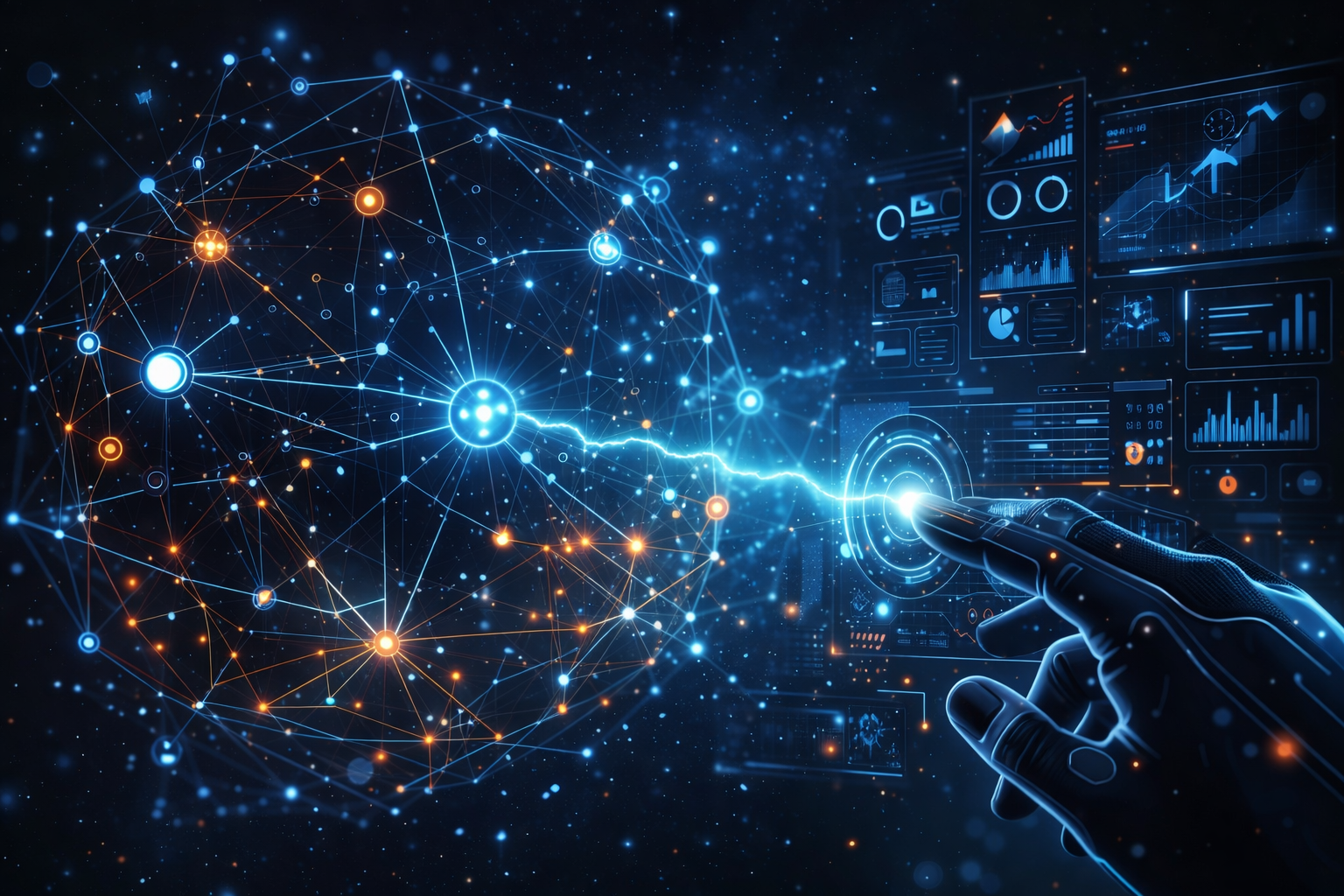
Data is no longer something businesses can store and check later.User behavior changes instantly. Security threats evolve minute by minute.Modern platforms need information that adapts at the same pace.
Real time knowledge graphs solve this problem by updating themselves as soon as new interactions happen.Instead of relying on nightly batch jobs or human refreshes, the graph shifts continuously based on real events.
This means decisions, experiences and predictions always stay relevant.
What Is a Real Time Knowledge Graph
A knowledge graph connects data in a way that shows both the entities and their relationships.Users, products, devices, systems and actions all become nodes in a web of connections.
Traditional knowledge graphs only update on a schedule, which means they fall out of date quickly.
A real time knowledge graph updates automatically the moment something happens.Every click, API call, purchase, login or message strengthens, reshapes or removes links between data points.
The result is a living structure that reflects reality instead of history.
Why Older Data Systems Cannot Keep Up
Legacy systems assume data moves slowly.Organizations run weekly exports or nightly syncs and base decisions on static snapshots.
But modern digital ecosystems no longer allow that delay.
Customers switch preferences quickly.Threat actors adapt in seconds.Market signals spike or disappear without warning.
Static systems fail because:
- Context changes faster than reporting windows
- User intent is fluid, not fixed
- Decisions based on stale information harm the business
- Modern applications demand awareness, not archives
Real time graphs provide the flexibility needed to match the pace of real user behavior.
How Real Time Knowledge Graphs Actually Work
These systems rely on constant streams of events.Instead of loading large chunks of data at once, they ingest tiny updates continuously.
Event sources include:
- Logins or session starts
- Clicks, searches and navigation paths
- File access or content views
- Transactions or add to cart activity
- Chat messages or support interactions
- IoT device signals and sensor updates
The graph does not store these as isolated facts.It connects them to form a context rich map of user actions and system activity.
The more events the graph receives, the clearer its understanding becomes.
Why Real Time Graphs Provide Big Advantage
Organizations using real time graphs start seeing benefits immediately.
Personalization That Matches the Moment
Platforms can adapt content, product suggestions or pricing based on live actions, not old averages.
Security Awareness Before Damage Happens
If suspicious patterns emerge, alerts trigger fast and stop incidents earlier.
Better Business Decisions
Teams access current context instead of outdated dashboards.
Cleaner Data Over Time
Old or inactive relationships naturally fade, reducing clutter and confusion.
Competitive advantage comes from responding to what users are doing now, not what they did days ago.
Industries Already Using Real Time Knowledge Graphs
This technology is spreading fast across sectors where timing matters.
Financial Services
- Spot suspicious transaction patterns in motion
- Track money movement across multiple accounts
- Predict fraud before funds disappear
Ecommerce and Retail
- Update recommendations based on active browsing
- Detect cart abandonment in real time
- Forecast demand directly from behavior
Cybersecurity
- Recognize lateral movement inside networks
- Notice compromised accounts acting differently
Healthcare and Education
- Adapt treatment or learning paths to progress signals
- Identify disengagement or risk faster
IoT, Smart Cities and Logistics
- Track devices and sensors continuously
- Reroute deliveries or resources instantly
Anywhere data shifts rapidly, real time graphs outperform static models.
Technology Making It Possible
This transformation is powered by modern software infrastructure.
Critical components include:
- Event streaming systems such as Kafka, Pulsar or Kinesis
- High speed graph databases like Neo4j Aura, TigerGraph or RedisGraph
- AI models that predict links or spot anomalies
- Edge computing that updates graphs locally
- Distributed compute layers that eliminate bottlenecks
Together they turn systems into real time networks instead of delayed data warehouses.
What Challenges Teams Must Address
Moving to real time graphs delivers huge value, but requires preparation.
Key challenges include:
- Handling constant high volume data flows at scale
- Avoiding graph noise or useless relationships
- Protecting user privacy and data governance
- Managing uncertainty in AI driven link decisions
- Training analysts and teams to read graph outcomes
- Balancing automated actions with control and rules
Organizations that handle these barriers well jump ahead faster.
Where Real Time Knowledge Graphs Are Heading
Today, graphs are used mostly for insight and intelligence.The next phase is automated action.
Expect rapid growth in:
- AI agents that query the graph before deciding what to do next
- Interfaces that adjust themselves based on a user’s last steps
- Shared graph models across companies with permission controls
- Knowledge systems that self correct bad links or broken assumptions
- Products that transform as their relationships evolve
Users may never see the graph directly.They will simply feel that systems know what they want next.
FAQ Section
What makes a knowledge graph real timeIt updates continuously as events stream in, instead of waiting for scheduled uploads.
Does it require AINot always. AI makes graphs smarter, but real time updating works without machine learning.
Do graphs replace relational databasesNo. Graphs complement structured databases by storing dynamic data relationships.
Is privacy at riskModern systems use anonymization, access control and retention rules to avoid personal tracking.
Is scaling difficultDistributed engines and in memory computation now support millions of changes per second.