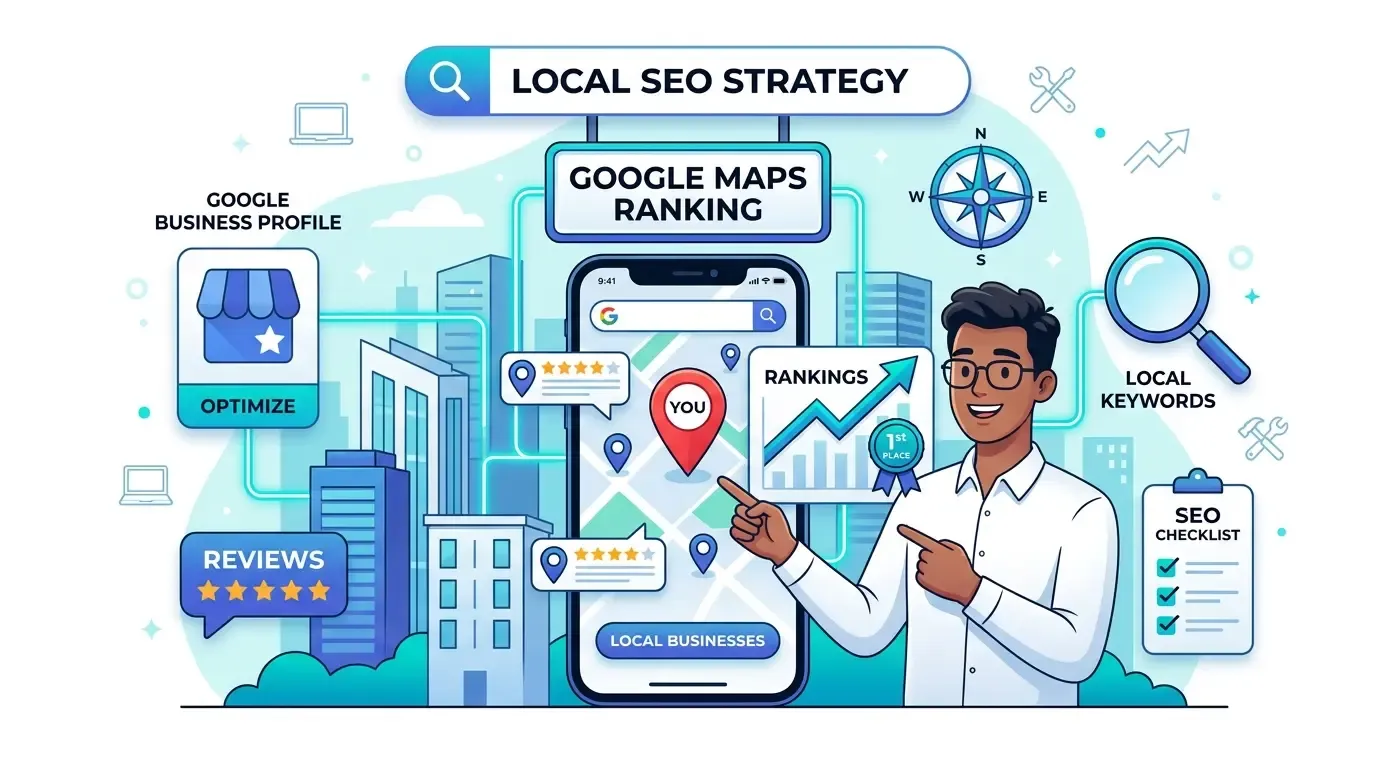
If you’ve ever searched for something like “repair shop near me” or “best cafe in Calicut,” you’ve already seen how powerful Google Maps results can be.
Those top 3 listings that show up with reviews, directions, and contact details get most of the attention.
And most of the clicks.
For local businesses, ranking on Google Maps isn’t just helpful. It can directly impact calls, visits, and revenue.
The good news is that you don’t need a huge budget to rank. You just need the right local SEO strategy.
Let’s walk through it step by step.
What Is Google Maps SEO and Why It Matters
Google Maps SEO, often called local SEO, is the process of optimizing your business to appear in local search results on Google Maps and Google Search.
When someone searches for a service nearby, Google shows a “local pack” with map listings.
Ranking here depends on three main factors:
- Relevance – how well your business matches the search
- Distance – how close you are to the user
- Prominence – how well-known and trusted your business is
Understanding these factors helps you focus on what actually improves rankings.
Step 1: Set Up and Optimize Your Google Business Profile
Your Google Business Profile is the foundation of local SEO.
If this is not optimized properly, ranking becomes difficult.
Key optimization steps:
- use your exact business name (no keyword stuffing)
- choose the most relevant primary category
- add accurate address and service areas
- include phone number and website
- write a clear, keyword-rich business description
- upload high-quality images regularly
Consistency and completeness matter more than tricks.
Step 2: Use Local Keywords Naturally
Local keyword optimization helps Google understand where you operate.
Instead of just targeting “SEO services,” use variations like:
- SEO services in Calicut
- digital marketing agency near me
- local SEO expert in Kerala
Place these keywords naturally in:
- business description
- website content
- service pages
- blog content
Avoid overusing keywords. Keep it natural and readable.
Step 3: Get More Reviews and Respond to Them
Reviews are one of the strongest ranking factors.
They influence both rankings and user trust.
How to get more reviews:
- ask satisfied customers directly
- share your review link
- follow up after service
- make the process simple
Why responses matter:
- shows engagement
- builds trust with potential customers
- signals activity to Google
Always respond politely, even to negative reviews.
Step 4: Build Local Citations and NAP Consistency
Citations are mentions of your business on other websites.
They usually include:
- Name
- Address
- Phone number (NAP)
Consistency across platforms is important.
List your business on:
- local directories
- business listing sites
- industry-specific platforms
Even small inconsistencies can affect rankings.
Step 5: Optimize Your Website for Local SEO
Your website supports your Google Maps ranking.
Make sure it includes:
- location-specific landing pages
- local keywords in titles and headings
- embedded Google Map
- clear contact details
- mobile-friendly design
Google looks at your website to verify your business information.
Step 6: Build Local Backlinks
Backlinks increase your business authority.
For local SEO, focus on:
- local blogs and websites
- business directories
- partnerships with local businesses
- event sponsorships
Quality matters more than quantity.
Step 7: Post Regular Updates on Your Profile
Your Google Business Profile allows you to post updates.
You can share:
- offers and promotions
- business updates
- new services
- blog content
Regular activity signals that your business is active and relevant.
Step 8: Use Photos and Videos to Improve Engagement
Visual content plays a big role in local SEO.
Businesses with more photos often get more clicks.
Upload:
- storefront images
- interior photos
- team pictures
- service demonstrations
This helps build trust and improve engagement.
Step 9: Track Performance and Improve
Use tools like Google Business Profile Insights to track:
- how customers find your business
- search queries used
- clicks, calls, and direction requests
This helps you understand what’s working and what needs improvement.
Common Mistakes That Hurt Google Maps Rankings
Many businesses struggle because of avoidable mistakes.
Avoid:
- incomplete business profiles
- inconsistent NAP details
- fake or spammy reviews
- keyword stuffing in business name
- ignoring customer reviews
- inactive profiles
Fixing these alone can improve your ranking significantly.
How Long Does It Take to Rank on Google Maps
Local SEO takes time, but it’s usually faster than traditional SEO.
You may start seeing improvements within:
- a few weeks for profile optimization
- a few months for stronger rankings
Consistency is key.
How Google Maps SEO Fits into Your Overall Strategy
Local SEO works best when combined with other strategies:
- SEO for organic rankings
- content marketing
- social media engagement
- paid local ads
Together, they create a complete digital presence.
If you want to understand how SEO connects with broader digital marketing strategies, this beginner-friendly SEO guide explains it clearly.
Final Thoughts
Ranking on Google Maps is not about shortcuts.
It’s about building trust, consistency, and relevance.
Focus on:
- optimizing your business profile
- getting genuine reviews
- maintaining accurate information
- staying active and engaged
Over time, these efforts add up.
And that’s what helps you stand out in local search results.
If you’re looking to apply these strategies in real-world scenarios, Milaaj Digital Academy focuses on practical learning that helps connect ideas with execution.
That’s where real growth begins.
FAQs
How do I rank higher on Google Maps
Optimize your Google Business Profile, get reviews, and maintain consistent business information.
Are reviews important for local SEO
Yes, reviews directly impact rankings and user trust.
What is NAP consistency
It means keeping your name, address, and phone number the same across all platforms.
How long does local SEO take
It can take a few weeks to a few months depending on competition.
Can I rank without a website
Yes, but having a website improves your chances significantly.