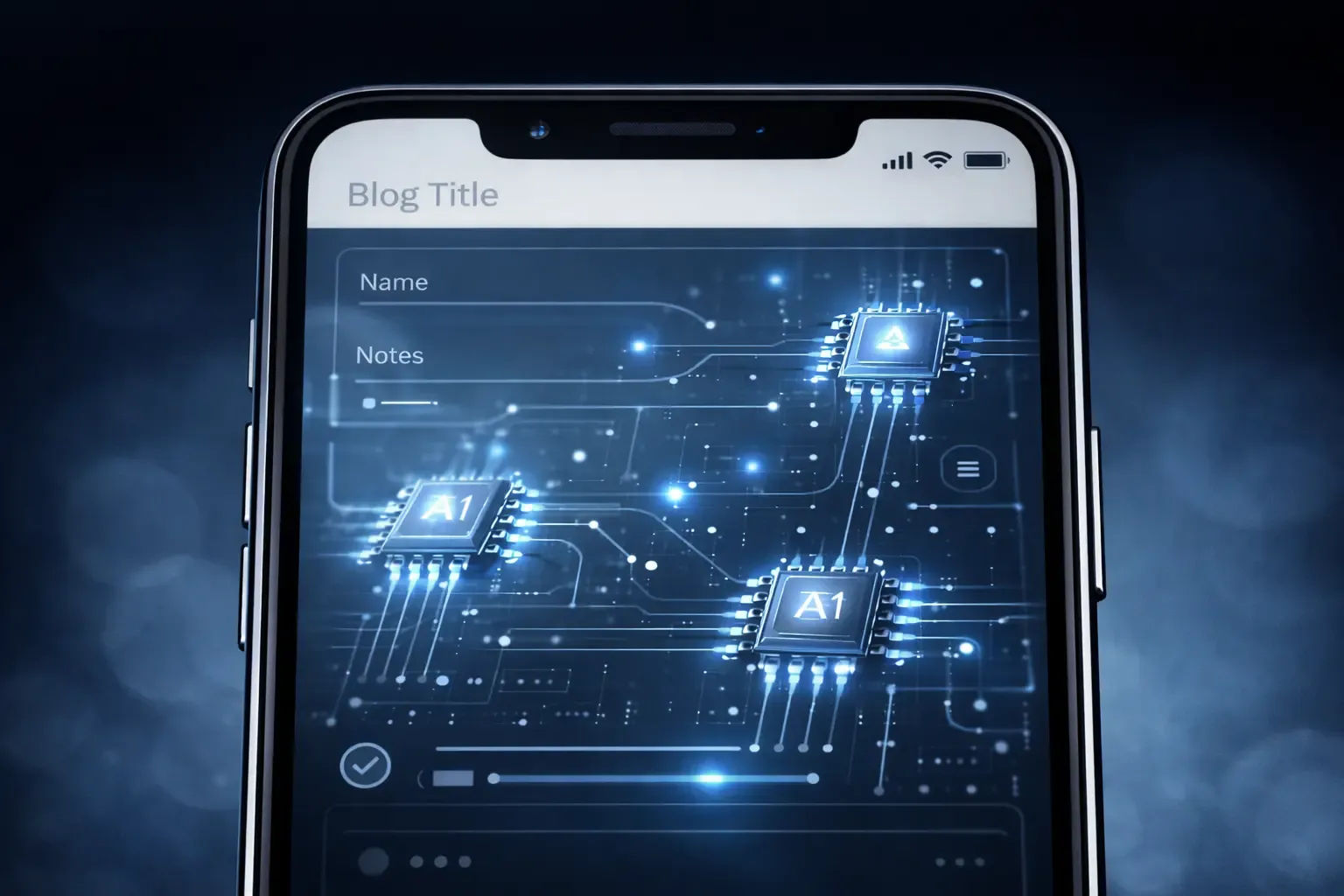
Artificial intelligence used to require powerful servers, GPU clusters, and cloud connectivity.Today, something new is happening. AI models are shrinking in size while increasing in usefulness.
This shift has given rise to a new category of technology known as on device micro AI.These are tiny yet capable models that run directly on a phone, laptop, wearable, or edge device, without sending data back to a remote server.
For UX designers, product builders, and customer facing brands, micro AI is not just a convenience.It is a new way to shape digital experiences in real time.
This blog explores what on device micro AI means, why it matters now, and how instant UX feedback is changing the future of interaction.
What On Device Micro AI Really Means
Micro AI models are designed to be small enough to run locally.They consume low power, require minimal memory, and execute tasks without relying on the internet.
They typically specialize in one function.Instead of being general purpose, they are highly targeted. For example:
• Detect gesture patterns• Monitor navigation confusion• Predict user hesitation• Flag accessibility barriers• Respond to context changes, like lighting or speed
The best part is that they work silently in the background, adjusting and learning patterns without compromising performance.
Why UX Benefits From Micro AI Running On Device
The biggest UX barrier has always been delay.A user hesitates, clicks back, or abandons a form, but the system reacts too late.
With micro AI running right on the device, the loop closes immediately.No waiting for the cloud. No round trips to a server.
This enables the interface to feel more alive, more responsive, and more aware.
Here are the core benefits that directly improve experience.
Instant Feedback Means Higher Completion Rates
Every click, scroll, and hover tells the system something useful.Micro AI models can:
• Nudge a user when input looks incorrect• Suggest autofill before frustration sets in• Highlight required fields before an error happens• Resurface help content based on user behavior
Instead of punishing mistakes, interfaces now assist in moments of uncertainty.
Studies consistently show that faster feedback leads to more completed flows, which directly increases conversions.
Privacy Gets Stronger When Data Stays Local
Traditional analytics and UX insights depend on the cloud.Even anonymous data has to travel, get processed, and be stored somewhere.
Micro AI changes that equation.Since the computation happens on the device:
• No behavior tracking leaves the phone• No user profiles are built in the cloud• Companies reduce regulatory pressure• Trust becomes easier to earn
Local inference is becoming one of the strongest selling points for privacy conscious users and markets that face data compliance challenges.
Adaptive Interfaces Become Reality
Most apps today behave the same way for every user.Micro AI allows each interface to evolve based on what someone is actually doing.
Imagine:
• Navigation menus rearranging automatically based on usage patterns• Interfaces switching to simpler layouts if confusion is detected• Products that get smarter every time you use them
This moves apps from fixed design into dynamic experience.
The UI stops being a static shell and becomes a runway that responds to how people behave.
Offline First User Experience Takes the Lead
Whenever AI depends on the cloud, experience degrades in poor connectivity.On device models remove that limitation.
This is a breakthrough for:
• Travelers• Field workers• Rural customers• Developing markets• Anyone who relies on mobile devices in unpredictable environments
Offline first AI enables stable reliability even when the network hiccups.
Lower Latency Creates Emotional Smoothness
Speed is not just a performance metric.It is something users feel.
Micro AI eliminates:
• Spinning loaders• Flicker delays• Waiting for pages to update• Lag between action and response
Users form opinions faster than they articulate them. A snappy interface communicates quality and professionalism, often subconsciously.
This is why Apple, Samsung, and automotive UI systems are investing heavily in on device inference.
Developers Also Win From Micro AI
Engineers benefit from using tiny models because:
• They reduce operational cost• They avoid expensive GPU cloud scaling• They simplify architecture• They are easier to maintain and upgrade• They typically require less data
Instead of deploying hundreds of cloud instances, developers distribute intelligence to the edge.
This shifts the workload outward, making systems more resilient and scalable.
Micro AI in Real Products Today
This trend is not theoretical. It is already inside:
• Smartphones predicting touch and gesture intent• Wearables monitoring wellness signals• VR headsets adjusting rendering based on gaze• Apps offering assistive text before typing finishes• Cars adjusting displays based on driver stress patterns
Even with micro footprints, these models have meaningful impact.
How Teams Can Start Using Micro AI Now
You do not need a research lab or proprietary hardware.Small teams can begin with:
• Lightweight open source models optimized for mobile• On device frameworks like CoreML, TensorFlow Lite, ONNX Runtime• Micro inference engines built for wearables and IoT• User session signals that feed back locally
Start small.Choose one task where predictive or corrective intelligence matters most.
The Future: Micro Models Everywhere
Over the next few years, expect micro AI to become the new normal.
• Local inference at the edge• Context aware decision engines• Personalized interfaces without personal profiles• Adaptive layouts and navigation• Real time feedback loops across all devices
UX will cease to be one size fits all and become something continuously shaped by the person using it.
FAQ Section for AEO
What is micro AI?Micro AI refers to small, efficient machine learning models that run directly on devices rather than relying on servers or cloud processing.
Why is on device AI better for UX?It provides immediate responses without internet delays, which reduces friction, increases completion rates, and creates more natural interaction patterns.
Does micro AI protect user privacy?Yes. Since data never leaves the device, there is far less exposure to data collection, storage risks, or regulatory compliance challenges.
Can micro AI work offline?Micro AI models are designed to operate fully offline, which makes them ideal for mobile apps, wearables, and field environments.
Will micro AI replace cloud AI?Not entirely. Cloud systems still handle heavy training and aggregation. Micro models are the execution layer that delivers intelligence at the edge.
How can a business start using micro AI?Use lightweight, open source model frameworks and focus first on a single use case that improves customer experience.