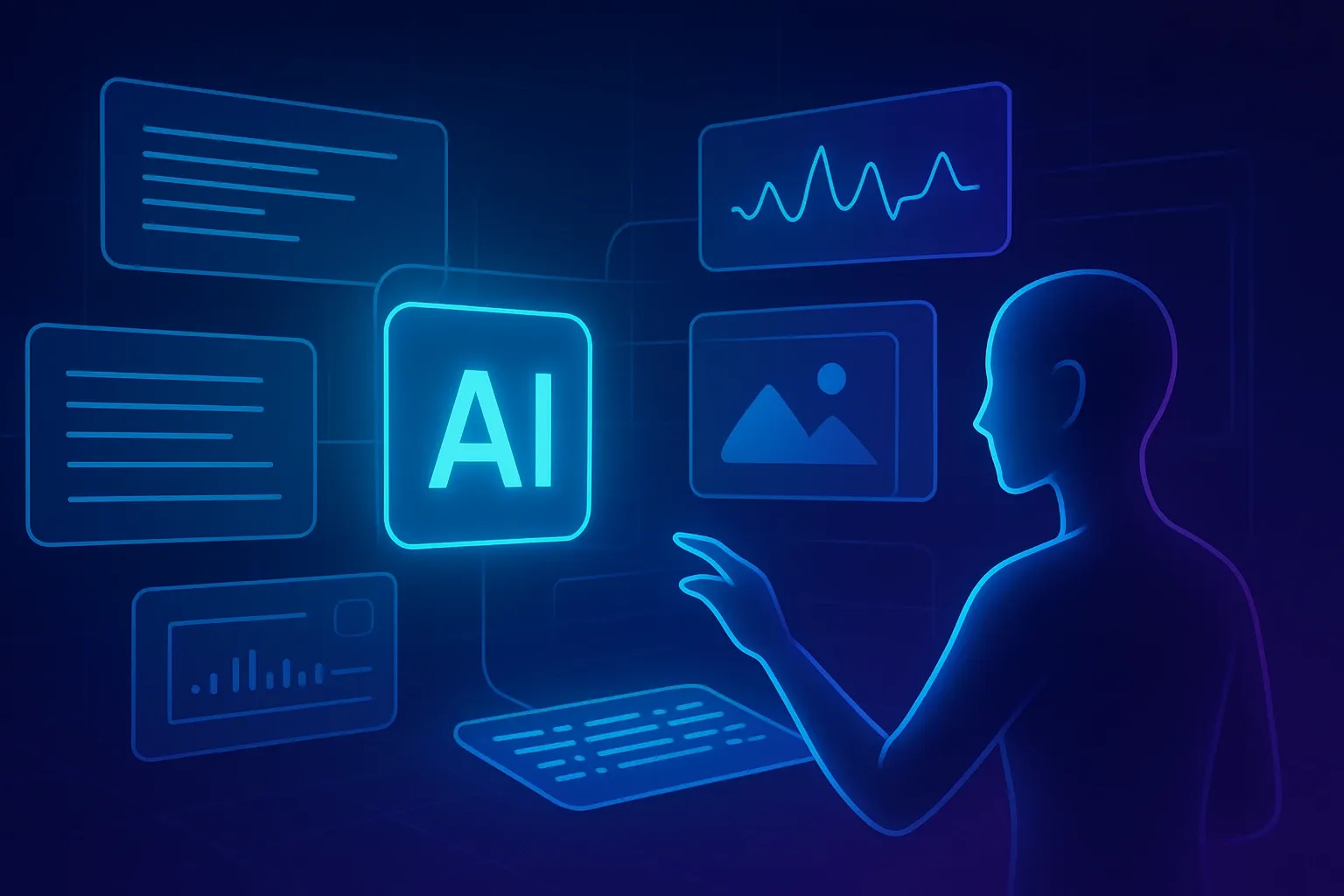
In 2025, the era of single-mode AI—where models handled only text or voice—is officially behind us. We’re now entering the age of multimodal AI, where artificial intelligence can understand and respond to multiple types of input: text, voice, image, and even video, all at once.
This evolution marks a monumental step toward a more natural, human-like interaction between people and machines. Whether you’re chatting with a voice assistant that understands tone and emotion, or using an app that can “see” and “describe” what’s in front of your camera, multimodal AI is quietly reshaping how we experience technology.
As tech giants, startups, and researchers converge on this field, the question is no longer if multimodal AI will dominate—but how fast it will become the new standard for smarter user experiences (UX).
What Exactly Is Multimodal AI?
Multimodal AI refers to artificial intelligence systems capable of processing and combining multiple types of data—such as text, speech, images, and video—to make decisions, generate outputs, or understand context.
Unlike traditional models that specialized in one input type (like GPT for text or DALL·E for images), multimodal systems integrate these capabilities seamlessly. For example, you could show a multimodal AI a picture of your broken laptop, explain the issue verbally, and receive both a visual diagnostic and spoken solution—all from the same interface.
This integrated understanding is closer to how humans perceive the world. We don’t think in text or sound alone—we combine sensory inputs continuously. Multimodal AI is now doing the same.
The Evolution: From Unimodal to Multimodal Intelligence
In the early 2020s, AI breakthroughs like OpenAI’s GPT models, Google’s Gemini, and Anthropic’s Claude demonstrated remarkable progress in language and reasoning. But their scope was limited—they were “unimodal,” focusing on text-based tasks.
The next leap came when researchers began linking different sensory models together. The fusion of language models with vision and audio models unlocked new dimensions of capability:
- Chatbots that understand visual cues.
- Voice assistants that respond with contextual awareness.
- Image tools that comprehend emotion or narrative, not just pixels.
By 2025, the fusion of modalities has matured. AI systems like GPT-5, Gemini 2, and Meta’s Emu can simultaneously process and generate across text, image, audio, and video channels. It’s not just multitasking—it’s cross-modal reasoning.
Why Multimodal AI Is Transforming UX
The core of great user experience is contextual understanding. Traditional AI struggled here—it could interpret words but not tone, or see an image but not grasp its emotional meaning. Multimodal AI closes this gap.
- Natural InteractionUsers can now talk, show, and gesture instead of typing commands. It makes AI feel more intuitive and conversational.
- Accessibility & InclusivityPeople with disabilities benefit from AI that adapts to various inputs—like combining voice and image to help the visually impaired understand their surroundings.
- Speed & PrecisionBy combining data streams, multimodal AI provides more accurate and faster results. For example, healthcare AIs can analyze patient images, medical histories, and notes simultaneously.
- Emotional IntelligenceVoice tone, facial expressions, and text sentiment together give AI a better sense of emotional nuance—leading to more empathetic responses in virtual assistants or therapy bots.
Real-World Applications of Multimodal AI
1. Smarter Voice Assistants
Assistants like Gemini-powered Siri, ChatGPT Voice, and Alexa Next now combine speech recognition with visual understanding. Imagine saying, “Hey Siri, what’s this?” while pointing your phone camera at a device—and receiving a verbal and visual explanation instantly.
2. Healthcare Diagnostics
AI tools can now read MRI scans, analyze doctors’ notes, and even interpret patient speech or tone during consultations to assess stress levels or early symptoms.
3. Education and Training
Learning apps use text, speech, and video to create adaptive learning experiences—where AI tutors respond to both what a student says and how engaged they look.
4. Creative Media
Designers and filmmakers are using multimodal tools that can take prompts like: “Make this scene feel calmer”—and the AI adjusts the lighting, sound, and visuals in harmony.
5. Retail and Customer Support
AI chatbots now “see” what customers upload, “hear” their tone, and respond with empathy—bridging the gap between automation and human touch.
Behind the Scenes: The Tech Driving Multimodality
Multimodal AI relies on fusion models that bring together distinct neural networks—each trained for a different type of data.These systems use shared embeddings or representations that convert all data types into a unified format, enabling cross-modal understanding.
For instance, when you upload a photo and describe it in text, the AI maps both the image and the text to the same vector space, aligning them conceptually. This allows it to reason: “The picture shows a cracked screen” and “the user mentioned it’s a phone problem”—and merge those insights.
Some leading technologies enabling this include:
- Vision Transformers (ViTs) – For visual pattern recognition.
- Large Language Models (LLMs) – For reasoning and contextual understanding.
- Audio Encoders (Whisper, Deepgram) – For tone and speech comprehension.
- Cross-Attention Layers – The “bridge” that lets these modalities talk to each other.
Together, they form an ecosystem capable of interpreting, reasoning, and generating across all sensory channels.
Challenges in Building Multimodal Systems
Despite the progress, integrating modalities is not without hurdles:
- Data Alignment: Synchronizing visual, textual, and audio data is technically complex and resource-intensive.
- Bias & Interpretation: Different modalities can introduce conflicting signals. An image might appear “happy,” but the text says otherwise.
- Computational Load: Multimodal models are enormous, requiring distributed training on advanced GPUs or TPUs.
- Ethical Concerns: Voice and image data introduce privacy challenges—especially when tied to emotion detection or facial recognition.
The industry is working on privacy-preserving AI and federated multimodal learning to reduce data exposure while maintaining performance.
How Multimodal AI Will Redefine Design and UX
The relationship between users and digital interfaces is evolving rapidly. Instead of designing buttons and menus, UX designers will now design experiences that blend senses.
- Voice-Led Design: Interfaces that rely on tone and verbal feedback instead of clicks.
- Visual-Textual Harmony: Content will adapt based on what users see and say.
- Gesture Interaction: Motion tracking will merge with voice commands for more immersive experiences.
- Context-Aware AI: Apps that understand lighting, location, and sound to adjust dynamically.
In the future, you won’t just interact with AI—you’ll collaborate with it through multiple senses.
The Business Impact
For companies, multimodal AI is both a challenge and an opportunity. Integrating multimodal capabilities enhances customer engagement and retention while streamlining operations.
- In marketing, AI can analyze how audiences see, hear, and respond to ads, creating personalized experiences in real time.
- In customer service, chatbots can detect frustration or satisfaction through voice tone and adapt accordingly.
- In e-commerce, visual search combined with conversational AI will redefine product discovery.
Businesses that adopt multimodal strategies early will stand out with deeper personalization and context-rich automation.
Ethics and Responsibility in a Multimodal World
The power of multimodal AI also comes with responsibility.Combining images, speech, and emotion recognition risks privacy intrusion or misinterpretation. Developers must prioritize ethical transparency—ensuring users know when AI is analyzing multiple inputs and how that data is stored or used.
Building trust will be central to adoption. Transparency reports, user consent prompts, and on-device processing will become standard practices for trustworthy multimodal systems.
What’s Next for Multimodal AI
The next phase of multimodal evolution will involve:
- Emotionally aware systems that understand empathy and mood.
- Context-persistent assistants that remember and adapt over time.
- Collaborative creativity, where AI and humans co-create across text, visuals, and sound.
- Hardware integration, with AR glasses, smart speakers, and wearable sensors feeding real-time multimodal data into AI systems.
Ultimately, the future of AI interaction will be fluid, adaptive, and sensory-rich—less about commands and more about understanding.
Conclusion
Multimodal AI represents the most human-like evolution of artificial intelligence yet. By merging text, voice, image, and video, it enables communication that feels natural, intuitive, and deeply connected.
In the coming years, as devices, apps, and cloud systems align around multimodal frameworks, the line between human and machine interaction will blur—not in a dystopian way, but in a way that makes technology feel more alive, responsive, and personal.
The age of typing prompts and clicking buttons is fading fast.The future is multimodal—and it listens, sees, speaks, and understands you better than ever before.