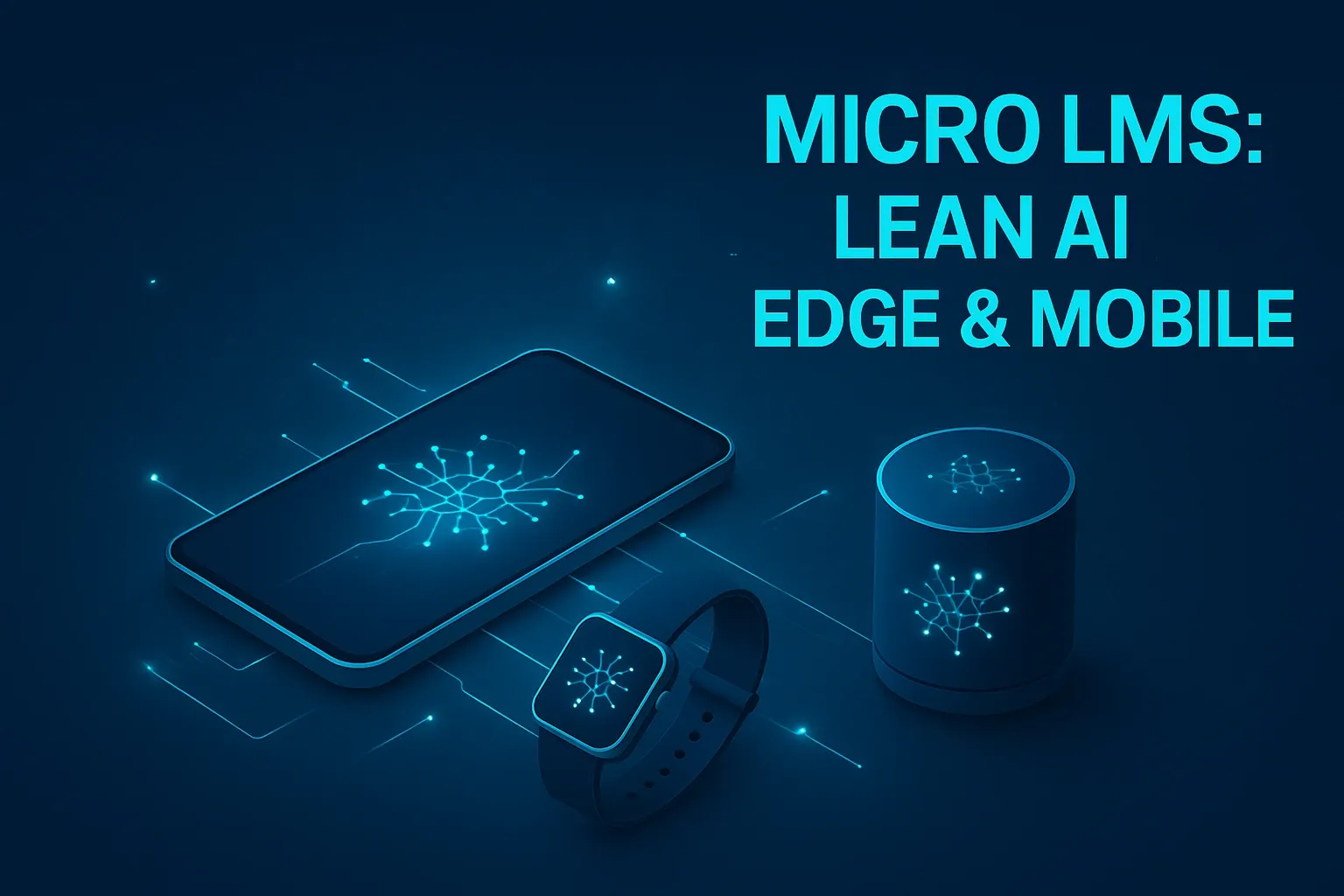
Large Language Models (LLMs) like GPT-4 and GPT-5 have taken the AI world by storm, powering everything from chatbots to advanced productivity tools. But as these models grow in size, they require massive computational resources—making them harder to run on everyday devices. Enter Micro LLMs: leaner, more efficient versions of language models designed for edge computing and mobile environments.
In this blog, we’ll explore what Micro LLMs are, why they matter, and how they’re shaping the future of AI for smartphones, IoT devices, and real-time applications.
What Are Micro LLMs?
Micro LLMs are compact language models that retain many of the powerful capabilities of large-scale models but are optimized to run on limited hardware. Instead of requiring massive cloud infrastructure, they can function on:
- Smartphones
- Tablets
- IoT devices
- Wearables
- Low-power edge servers
This allows AI to be more accessible, private, and energy efficient while still delivering meaningful performance.
Why Micro LLMs Are Becoming Essential
The rise of Micro LLMs is driven by several key trends:
- On-Device AI DemandUsers increasingly want AI features like voice assistants, translation, and summarization to work offline and in real time. Micro LLMs make this possible.
- Privacy ConcernsRunning AI locally reduces dependency on the cloud, ensuring greater data privacy and security for sensitive information.
- Lower LatencyWithout constant reliance on servers, Micro LLMs provide instant responses—a must for applications like AR, VR, and autonomous vehicles.
- Energy EfficiencySmaller models consume less energy, making them ideal for sustainable AI adoption across mobile and IoT ecosystems.
Real-World Applications of Micro LLMs
1. Mobile Assistants
Imagine a phone assistant that understands context, translates speech instantly, and summarizes text—all without an internet connection. Micro LLMs enable this kind of local intelligence.
2. Healthcare Devices
Wearables powered by Micro LLMs could provide real-time health monitoring, natural language interaction, and predictive analytics without risking patient data leaks.
3. Smart Appliances
From refrigerators to cars, on-device language understanding makes interactions smoother, faster, and less dependent on connectivity.
4. Industrial IoT
Factories and logistics can benefit from AI that processes data on-site for faster decision-making and reduced reliance on cloud networks.
Challenges of Micro LLMs
While promising, Micro LLMs also face challenges:
- Performance Trade-Offs: Smaller models may struggle with complex reasoning compared to full-scale LLMs.
- Hardware Limitations: Even optimized models require specialized chips (like NPUs or TPUs) for smooth operation.
- Constant Updating: Keeping Micro LLMs accurate and up to date requires frequent retraining or distillation techniques.
Future of Micro LLMs
The next few years will likely see Micro LLMs integrated into nearly every device we use. Tech companies are already working on:
- Model Distillation: Breaking down larger LLMs into smaller, efficient models while retaining accuracy.
- Hardware Optimization: New processors built specifically for AI workloads at the edge.
- Hybrid Systems: Devices that combine local Micro LLMs for quick tasks with cloud-based LLMs for heavy lifting.
This hybrid future will give users the best of both worlds—speed, privacy, and efficiency without sacrificing intelligence.
Conclusion
The emergence of Micro LLMs marks a turning point in the AI revolution. By making language models smaller, smarter, and more efficient, tech companies are paving the way for AI-powered devices that are faster, more private, and more sustainable.
As edge computing grows, expect Micro LLMs to become as common as mobile processors—driving a future where AI is everywhere, yet invisible, working quietly in the background to make life easier.
FAQs
Q1: What is a Micro LLM?A Micro LLM is a compact version of a large language model optimized to run on devices with limited resources like smartphones and IoT devices.
Q2: How are Micro LLMs different from traditional LLMs?Unlike massive LLMs that require cloud servers, Micro LLMs are designed for on-device efficiency, privacy, and low-latency performance.
Q3: Can Micro LLMs work offline?Yes. Many Micro LLMs are capable of functioning offline, making them ideal for real-time translation, summarization, and voice interaction.
Q4: What industries will benefit from Micro LLMs?Healthcare, mobile, IoT, automotive, and consumer electronics are expected to see the most impact.
Q5: Are Micro LLMs as powerful as large models?Not entirely—Micro LLMs trade some performance for efficiency. However, advances in distillation and optimization are closing the gap.