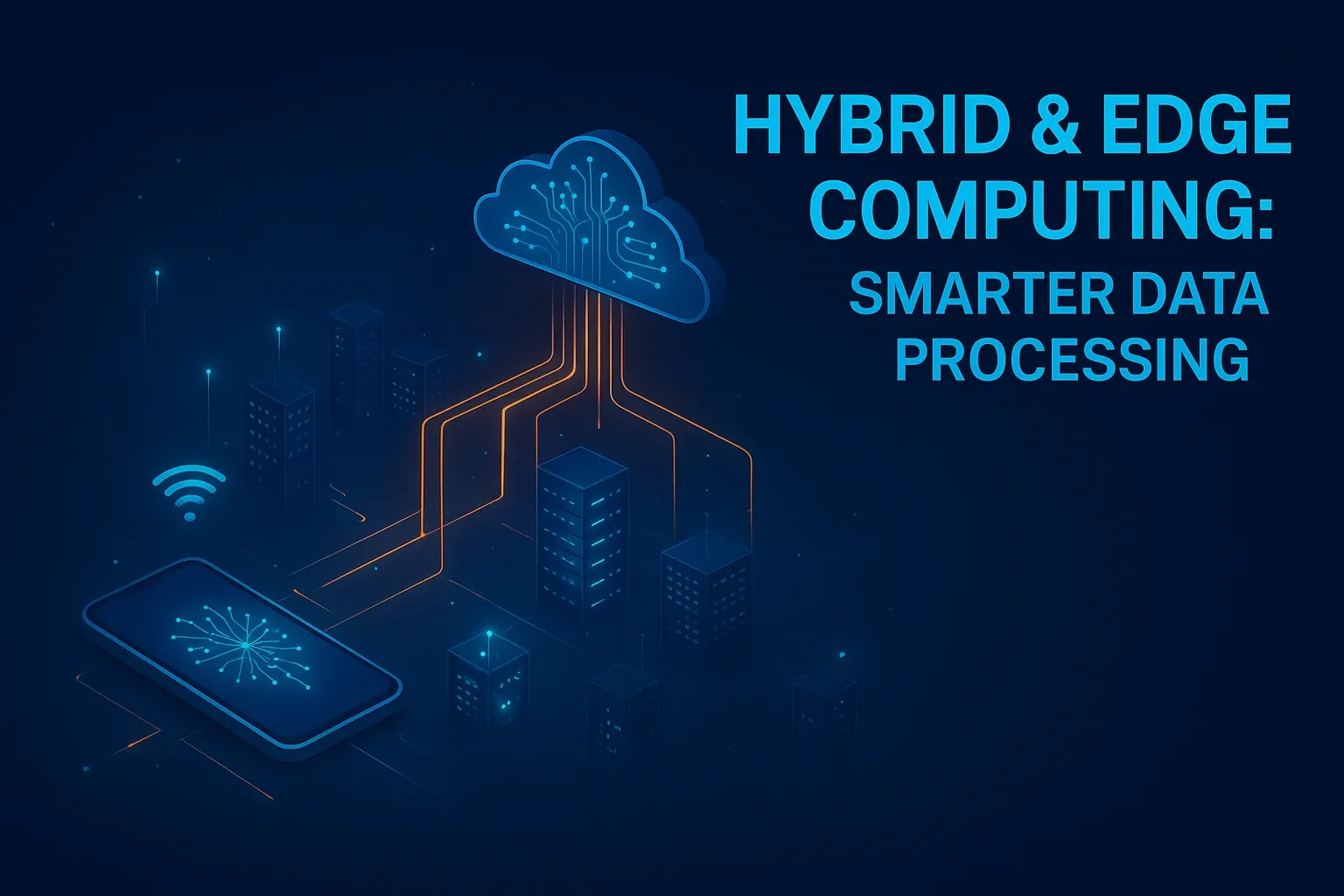
As the world generates more data than ever before, traditional cloud computing is starting to show its limitations. High latency, privacy concerns, and bandwidth costs are pushing businesses to explore new computing architectures. Enter Hybrid and Edge Computing—two approaches that bring data processing closer to users, enabling faster, smarter, and more efficient digital experiences.
In this blog, we’ll dive into what Hybrid and Edge Computing are, how they complement each other, and why they’re becoming essential for the future of AI, IoT, and real-time applications.
What Is Edge Computing?
Edge computing refers to processing data at or near the source, rather than sending it all the way to centralized cloud servers.
Examples of edge devices include:
- Smartphones and tablets
- IoT sensors and cameras
- Routers and gateways
- Autonomous vehicles
By handling tasks locally, edge computing reduces the need to constantly rely on cloud infrastructure, resulting in faster response times and improved privacy.
What Is Hybrid Computing?
Hybrid computing combines the best of both worlds: local edge processing and the scalability of the cloud.
- Edge handles real-time, latency-sensitive tasks
- Cloud manages heavy workloads, analytics, and storage
This hybrid approach ensures users benefit from instant responsiveness while still having access to the power of large-scale cloud processing when needed.
Why Hybrid & Edge Computing Are Becoming Essential
1. Ultra-Low Latency
Applications like autonomous vehicles, AR/VR, and smart factories demand real-time processing. Edge computing delivers results instantly, while the hybrid model offloads non-urgent tasks to the cloud.
2. Data Privacy & Security
With growing concerns over personal data, local processing ensures sensitive information stays on-device, reducing risks of exposure.
3. Bandwidth Efficiency
Instead of sending massive amounts of raw data to the cloud, only relevant insights are transmitted, saving both bandwidth and costs.
4. Scalability & Flexibility
Hybrid systems adapt to workloads, balancing local efficiency with cloud power. Businesses can scale seamlessly without overwhelming one system.
Real-World Applications of Hybrid & Edge Computing
Smart Cities
Traffic lights, surveillance systems, and environmental sensors powered by edge computing can react instantly, while the cloud manages large-scale analytics for long-term planning.
Healthcare
Wearable devices and hospital equipment can process patient data locally for real-time monitoring, while the cloud stores records and aids in deeper medical research.
Retail
Smart checkout systems and inventory sensors rely on local edge AI for instant decisions, with the cloud providing predictive analytics for supply chain optimization.
Industrial IoT
Factories and logistics networks depend on hybrid systems for real-time machine monitoring at the edge and predictive maintenance in the cloud.
Challenges in Hybrid & Edge Computing
While promising, these technologies face challenges:
- Infrastructure Costs: Setting up edge nodes and hybrid systems requires investment.
- Standardization: Lack of universal protocols makes integration harder.
- Security Risks: More distributed systems mean more potential entry points for cyberattacks.
However, advancements in 5G, AI accelerators, and standardized frameworks are steadily overcoming these hurdles.
The Future of Hybrid & Edge Computing
The convergence of hybrid and edge computing will redefine how devices interact with data. We’re moving toward a world where:
- AI runs locally on devices, but syncs with the cloud for big-picture intelligence.
- Smartphones and IoT devices act as mini data centers.
- 5G networks provide the backbone for ultra-fast, distributed computing.
This future will empower industries, cities, and consumers with smarter, faster, and safer technology experiences.
Conclusion
Hybrid and Edge Computing are more than just tech buzzwords—they represent a shift in the way we process and interact with data. By bringing computation closer to the user while still leveraging the cloud, businesses can achieve the best balance of speed, privacy, scalability, and efficiency.
As AI, IoT, and connected devices continue to grow, Hybrid & Edge Computing will become the invisible infrastructure powering the digital world around us.
FAQs
Q1: What’s the difference between edge computing and cloud computing?Edge computing processes data locally, while cloud computing handles data in remote servers. Hybrid systems combine both approaches.
Q2: Why is edge computing important for AI?AI often requires instant decision-making, and edge processing reduces latency by keeping tasks local.
Q3: Which industries benefit most from hybrid computing?Healthcare, retail, smart cities, manufacturing, and logistics gain huge advantages from combining local processing with cloud analytics.
Q4: Does edge computing improve privacy?Yes, because sensitive data can be processed locally, minimizing exposure to external networks.
Q5: How does 5G support edge computing?5G enables ultra-fast connectivity, making edge devices more effective at handling real-time workloads.