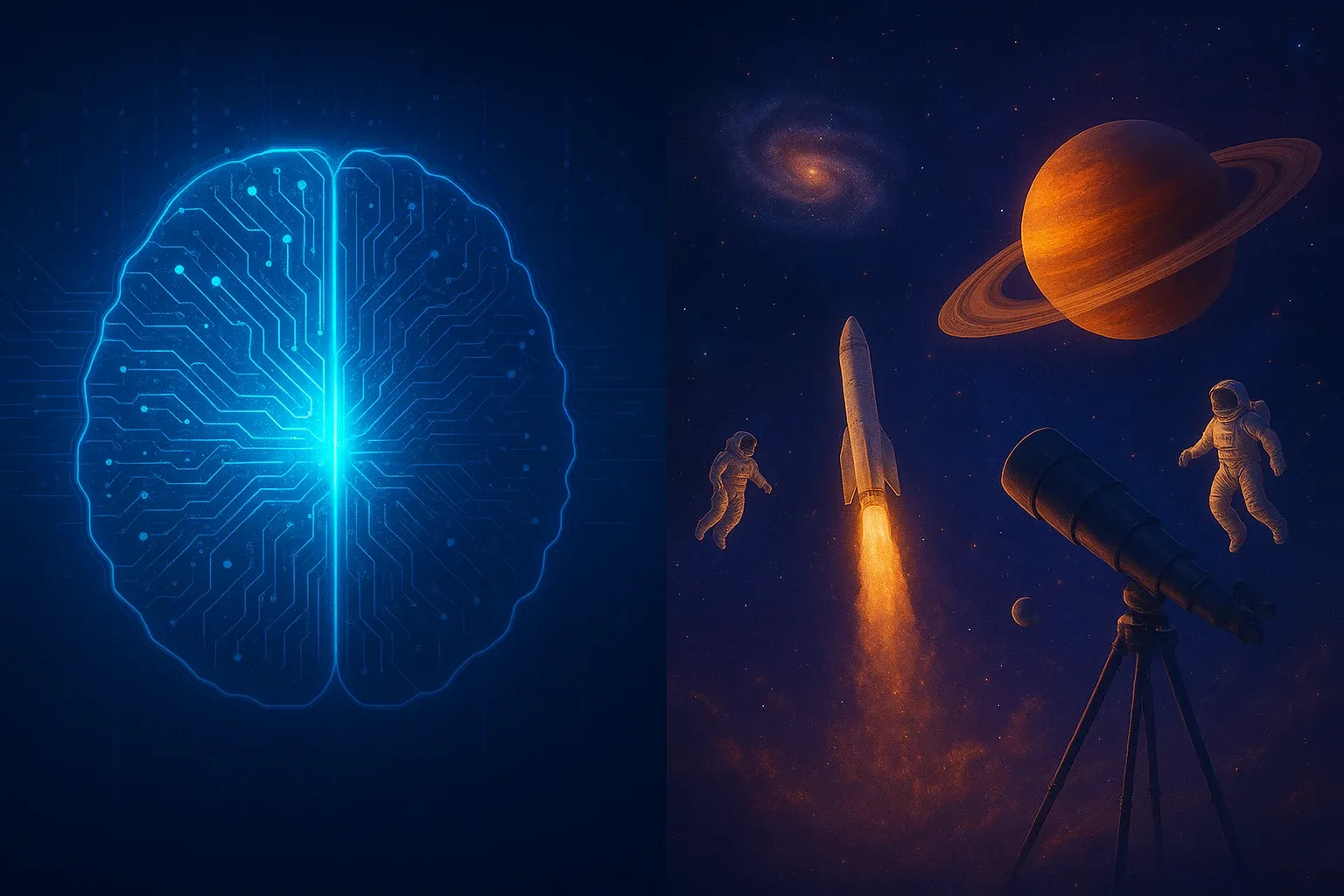
Humanity is living in a remarkable era where artificial intelligence and space exploration are advancing at lightning speed. With the launch of GPT-5, the next generation of artificial intelligence, and NASA’s groundbreaking space discoveries, we’re witnessing technologies that challenge the limits of human imagination. From decoding cosmic mysteries to rethinking how we interact with machines, these breakthroughs redefine what it means to push human boundaries.
This article explores GPT-5’s potential, NASA’s latest findings, and the technologies shaping the future of science and humanity.
GPT-5 Launch: Redefining Artificial Intelligence
The unveiling of GPT-5 represents one of the most significant milestones in AI. Building upon the foundations of GPT-4, this version promises faster reasoning, deeper understanding, and multimodal capabilities that combine text, images, audio, and even video.
- Smarter Conversations – GPT-5 is designed to hold more natural, human-like discussions while maintaining accuracy.
- Scientific Applications – Researchers can use GPT-5 to analyze massive datasets, detect anomalies, and assist in making predictions about climate, medicine, and space.
- Creative Power – From composing music to generating 3D designs, GPT-5 bridges the gap between human creativity and machine intelligence.
But its greatest impact may lie in scientific discovery, where AI becomes an indispensable partner to human curiosity.
NASA’s Latest Discoveries
While AI is transforming Earth-bound industries, NASA is uncovering the universe’s deepest secrets. Recent breakthroughs include:
- Exoplanet Discoveries – NASA’s latest telescopes have identified planets in the “Goldilocks zone,” potentially habitable worlds that raise new questions about life beyond Earth.
- Water on Distant Moons – Evidence of subsurface oceans on moons like Europa and Enceladus strengthens the possibility of extraterrestrial microbial life.
- Deep Space Imagery – NASA’s upgraded imaging technology has revealed never-before-seen details of black holes, star nurseries, and cosmic radiation.
These discoveries expand our understanding of the cosmos, but also depend heavily on AI for data processing and pattern recognition.
When AI Meets Space Science
The fusion of AI like GPT-5 and space science is transforming exploration:
- Data Analysis – NASA collects petabytes of information from satellites and telescopes. GPT-5 and other AI systems help filter meaningful insights from overwhelming data.
- Autonomous Navigation – AI is key in enabling rovers and spacecraft to make independent decisions on distant planets, where communication delays make real-time control impossible.
- Predictive Modeling – AI predicts solar flares, meteor trajectories, and other cosmic events, protecting astronauts and spacecraft.
- Robotics in Space – AI-driven robots assist with maintenance on the International Space Station and will play a vital role in Mars colonization missions.
Together, AI and space science form a partnership that accelerates human progress toward interplanetary exploration.
Tech That Pushes Human Limits
The latest technologies not only explore the cosmos but also extend human endurance and potential:
- Wearable Space Tech – Advanced suits monitor astronaut vitals, regulate body temperature, and adapt to harsh environments.
- Brain-Computer Interfaces (BCIs) – These interfaces allow direct communication between human thought and machines, potentially helping astronauts control devices in high-stress scenarios.
- Propulsion Breakthroughs – From ion thrusters to nuclear propulsion, these technologies aim to cut travel time to Mars and beyond.
- Earth Applications – Many space innovations, from GPS to medical imaging, find their way into everyday life, improving healthcare, communications, and safety on Earth.
By pushing human limits in space, we also push the boundaries of life on Earth.
Challenges and Ethical Considerations
Every leap forward raises questions:
- AI Risks – With GPT-5’s immense intelligence, concerns about misuse, misinformation, and dependency grow.
- Space Colonization Ethics – Debates continue on the moral implications of colonizing other planets and the environmental impact of space mining.
- Resource Allocation – Should humanity prioritize funding AI and space exploration while challenges like climate change and poverty persist?
Balancing ambition with responsibility is crucial as we navigate this new frontier.
The Road Ahead: Humanity’s Next Leap
By 2030 and beyond, experts predict deeper synergy between AI and space science:
- GPT-5 and future models could serve as co-pilots for astronauts, offering real-time translations, calculations, and mission-critical decision support.
- NASA and private companies like SpaceX may use AI to plan and execute Mars colonization missions.
- Breakthroughs in quantum computing and AI could unlock simulations of the universe itself.
The convergence of artificial intelligence, space exploration, and emerging tech signals a future where humanity may not only explore the stars—but thrive among them.
Conclusion
The launch of GPT-5, combined with NASA’s remarkable discoveries, symbolizes humanity’s relentless drive to explore and innovate. Technology is no longer just a tool—it’s a partner in our journey to understand the universe and ourselves.
As AI and space science continue to merge, the next frontier won’t just be about reaching Mars or building smarter machines. It will be about pushing human limits further than ever imagined.
FAQs
1. What is new in GPT-5 compared to GPT-4?GPT-5 offers faster reasoning, multimodal capabilities, and greater accuracy across tasks.
2. How is NASA using AI for space exploration?NASA uses AI to analyze massive datasets, guide autonomous rovers, and predict cosmic events.
3. What new discoveries has NASA made in 2025?Recent discoveries include habitable exoplanets, subsurface oceans on moons, and new cosmic imaging.
4. How does technology push human limits in space?From smart suits to brain-computer interfaces, new tech enhances astronaut safety and mission success.
5. Will AI like GPT-5 be used in future Mars missions?Yes, AI will assist astronauts with navigation, data analysis, and real-time problem solving on Mars.