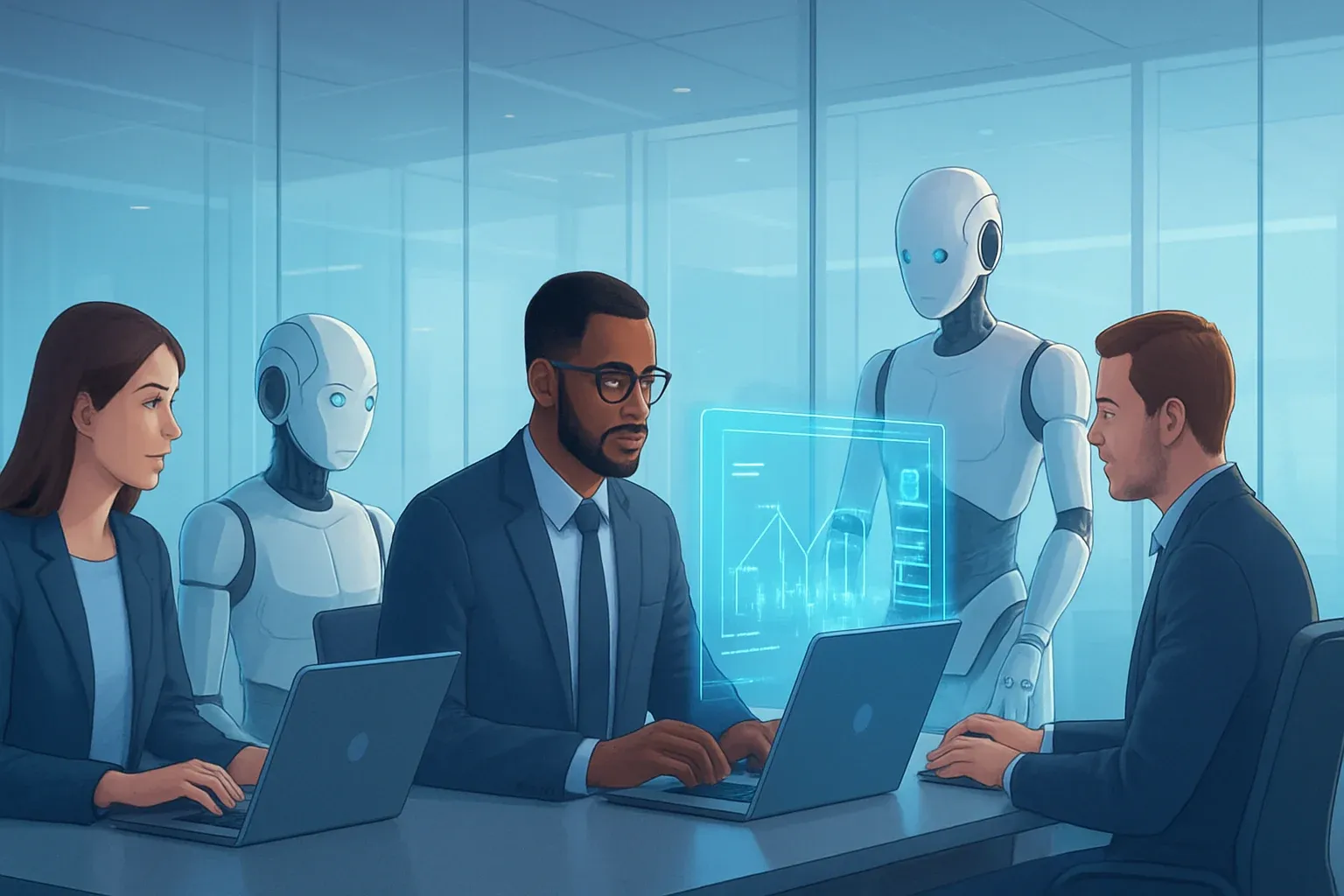
For years, the idea of sharing a workspace with artificial intelligence seemed futuristic — something out of science fiction. But today, generative agents and AI co-workers are stepping into real offices, bringing new forms of collaboration, creativity, and productivity.
From managing meetings to drafting proposals, these digital teammates are transforming how we work. The modern office is evolving fast — and at its center are AI co-workers who don’t need coffee breaks, sleep, or sick days.
What Are Generative Agents?
Generative agents are AI-powered digital workers capable of reasoning, learning, and generating new ideas or outputs autonomously. Unlike traditional software, they don’t just follow commands — they analyze, adapt, and respond like human collaborators.
These agents use large language models (LLMs), reinforcement learning, and contextual memory to simulate intelligent behavior. In simpler terms, they can plan, write, organize, and even hold conversations that feel human.
Instead of replacing jobs, generative agents enhance teams by handling repetitive or analytical tasks while people focus on creativity and strategic decision-making.
The Rise of AI Co-Workers
The journey toward AI in the workplace started with digital assistants like Siri, Alexa, and chatbots. Over time, these systems became smarter and more autonomous.
When ChatGPT and similar LLMs emerged, businesses realized that AI could do more than answer questions — it could generate reports, compose emails, analyze data, and even brainstorm ideas.
Now, AI co-workers can:
- Coordinate projects and timelines
- Generate content and creative ideas
- Conduct research and summarize findings
- Track progress and identify workflow bottlenecks
- Support real-time decision-making
Generative agents aren’t just tools; they’re digital collaborators integrated into the daily rhythm of modern work.
How Generative Agents Function Inside Offices
Generative agents operate on several key principles that allow them to act like real co-workers.
1. Language Understanding
They can read, write, and interpret natural language, meaning they understand the intent behind human communication — not just the literal words.
2. Contextual Memory
Modern AI agents can remember previous interactions, maintain context across conversations, and apply lessons learned from past behavior.
3. Role-Based Behavior
An agent can take on different “roles” — such as a marketing strategist, HR assistant, or analyst. It adjusts tone, language, and approach based on its assigned function.
4. Integration with Work Tools
Through APIs and automation platforms, these agents connect with tools like Slack, Trello, Asana, or Notion. They manage workflows seamlessly, almost as if they were an actual team member.
5. Continuous Learning
The more a generative agent interacts, the better it becomes. It learns from outcomes, feedback, and team communication — improving its accuracy and usefulness over time.
From Automation to Collaboration
Traditional automation focused on replacing repetitive human effort. Generative agents go further — they collaborate.
In older systems, AI followed fixed rules and performed predictable tasks. Generative agents, however, are goal-oriented and adaptive. They can switch contexts, improvise solutions, and make recommendations based on changing information.
In short, automation executed commands; generative agents understand intent.
Where AI Co-Workers Are Already Making an Impact
AI-driven co-workers are finding their place in a variety of industries and departments.
1. Marketing and Creative Teams
Generative agents can write ad copy, brainstorm campaign ideas, schedule social media content, and analyze audience behavior.Marketers are discovering that collaborating with AI sparks creativity rather than stifling it.
2. Human Resources
AI co-workers help HR teams by scanning resumes, conducting pre-screen interviews, and summarizing candidate profiles. They reduce hiring time and improve consistency.
3. Data Analysis
Generative agents turn complex data into clear insights. They can summarize financial reports, track KPIs, and even create dashboards that update in real time.
4. Customer Support
AI-powered agents handle first-line inquiries, provide instant responses, and escalate only complex issues to humans. This blend improves service quality and response time.
5. Product Development
In engineering and design, AI can suggest new product features, run simulations, and test user experiences virtually — reducing time from concept to prototype.
Changing Team Dynamics
Introducing generative agents into the office changes how people collaborate. Teams are learning to treat AI not as a tool but as a co-worker — one that enhances performance and efficiency.
1. Collaboration Over Competition
AI isn’t stealing jobs; it’s handling tasks that humans don’t enjoy or can’t do efficiently. This allows teams to focus on creativity, innovation, and relationship-building.
2. New Job Roles
Employees are becoming AI managers, prompt designers, and workflow architects — guiding how generative agents work within organizations.
3. Faster Decision-Making
AI co-workers analyze large datasets and provide instant insights. This helps leaders make better decisions quickly and confidently.
4. Boosted Creativity
Brainstorming sessions are changing. Humans bring empathy and vision, while AI brings data and endless idea generation — together, they drive innovation.
Ethical and Practical Considerations
As AI co-workers become more common, businesses face new questions about ethics and responsibility.
1. Privacy and Security
Generative agents process sensitive company data. Protecting that data through encryption, limited access, and compliance with privacy laws is essential.
2. Bias and Fairness
If an AI model is trained on biased data, its outputs can also be biased. Companies must audit AI systems regularly to maintain fairness and inclusivity.
3. Accountability
When an AI makes a decision or a mistake, who’s responsible — the algorithm or the team managing it? Clear accountability structures are critical.
4. Workforce Anxiety
Some employees fear being replaced by AI. Transparent communication and upskilling programs help reduce uncertainty and foster collaboration.
Why Businesses Are Embracing Generative Agents
The benefits of integrating generative AI into office workflows are too significant to ignore.
- Efficiency: Routine tasks get done faster, freeing employees for higher-value work.
- Consistency: AI reduces human error and ensures standardization.
- Scalability: Agents can handle multiple tasks simultaneously without burnout.
- Cost-effectiveness: Lower operational costs without compromising output quality.
- Innovation: AI encourages experimentation and faster iteration cycles.
Companies are finding that the ROI on generative AI isn’t just in productivity — it’s in creativity and agility.
Real-World Examples of AI Co-Workers
Several organizations are already integrating AI co-workers successfully.
- Salesforce Einstein GPT delivers personalized insights to sales teams, helping them predict customer needs.
- Microsoft Copilot enhances productivity by summarizing emails, drafting reports, and automating meeting notes.
- Humane AI Pin acts as a wearable generative agent that provides information contextually without screens.
- Replika for Business creates emotionally intelligent digital assistants that communicate naturally with customers.
Each example proves that AI co-workers are not a futuristic concept — they’re here, embedded in the workflows of innovative companies.
Preparing Your Workplace for Generative Agents
Integrating AI into daily operations isn’t just about software — it’s about mindset and strategy.
1. Upskill the Workforce
Employees need to understand how to work with AI, not against it. Training in AI literacy and prompt engineering should become standard.
2. Define Clear Boundaries
Determine which tasks AI should handle and which require human oversight. Clarity prevents confusion and builds trust.
3. Start Small
Pilot programs in HR, marketing, or data analysis can demonstrate value before scaling across departments.
4. Create Ethical Guidelines
Transparency, fairness, and privacy should guide every AI adoption. Define rules for data usage and accountability early on.
5. Encourage Collaboration
Make AI co-workers part of team discussions. When employees see AI as a collaborator, adoption becomes smoother and more effective.
The Future of Generative Agents
The next evolution of generative agents will go beyond intelligence — toward emotional understanding.
Soon, AI co-workers will interpret tone, emotion, and team sentiment. Imagine an AI that detects burnout signs and suggests schedule adjustments, or one that senses tension in communication and recommends mediation techniques.
In the near future, generative agents may:
- Act as real-time mediators in meetings
- Create digital project twins that track progress autonomously
- Manage entire workflows from concept to completion
- Develop “personalities” aligned with company culture
As their capabilities expand, so will their role in shaping organizational identity and productivity.
Challenges Still Ahead
Despite rapid progress, there are hurdles before generative agents become mainstream in every workplace.
- Battery and hardware limitations for wearable AI
- Regulatory uncertainty surrounding AI-driven decisions
- Employee trust issues and fear of surveillance
- Integration complexity across legacy systems
These challenges will require careful design, communication, and governance — but none are insurmountable.
Conclusion: The New Definition of a Team
The modern workplace is evolving from a “workforce” to a work-force — a synergy between humans and generative agents.
These AI co-workers aren’t replacing people; they’re redefining what teams can achieve together. By handling repetitive tasks, offering insights, and collaborating creatively, generative agents are becoming catalysts for innovation.
The future of work won’t be about humans versus AI — it’ll be about how both can thrive side by side.
Tomorrow’s best employees won’t just be skilled humans — they’ll be hybrid teams of minds and machines, learning, adapting, and creating together.