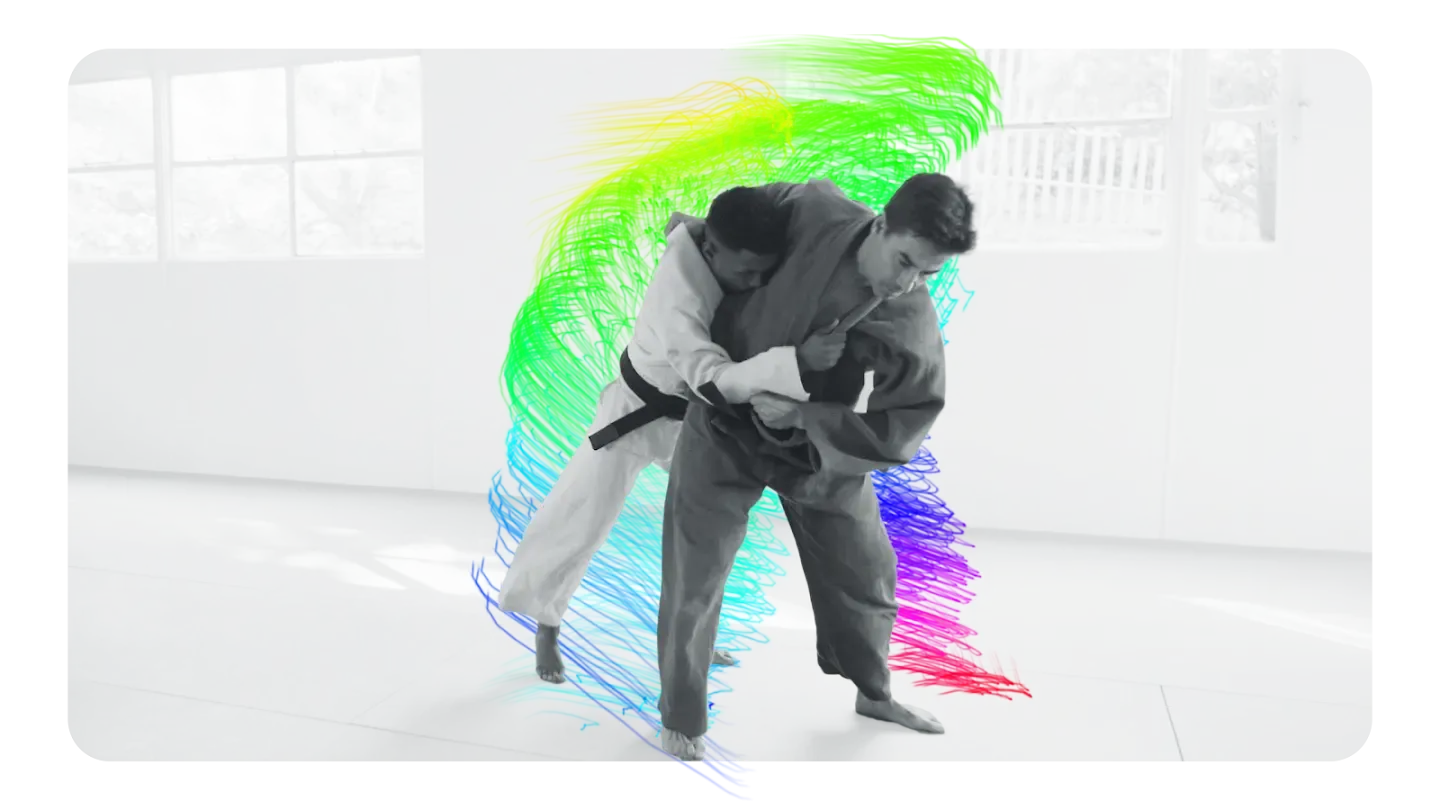
Artificial intelligence has excelled at interpreting static 3D environments, but the real world is constantly in motion. To truly understand scenes as humans do, AI must not only perceive space but also how that space changes over time. That is the goal behind D4RT, a new unified AI model introduced by Google DeepMind that enables machines to interpret dynamic scenes in four dimensions — three of space and one of time.
This breakthrough framework dramatically improves how AI understands motion, reconstructs geometry, and tracks objects evolving through time, all within a single efficient model. In this article, we explain what D4RT is, how it works, why it matters, and what future capabilities it may unlock.
What Is D4RT and Why It Matters
D4RT (Dynamic 4D Reconstruction and Tracking) is designed to give machines a four‑dimensional perception of the world — combining depth, geometry, movement, and time from ordinary video input. Traditional systems required separate models for depth estimation, motion tracking, and camera pose estimation. In contrast, D4RT unifies these tasks in one flexible architecture, enabling comprehensive scene understanding with much greater efficiency.
D4RT works by recovering rich, volumetric 3D structure and motion trajectories from a 2D video, tracking each pixel across time while disentangling object motion from camera motion. By doing so, it constructs a coherent spatial‑temporal representation, enabling dynamic scene interpretation rather than isolated snapshots.
How D4RT Works: Unified Scene Understanding
At its core, D4RT uses a transformer‑based encoder–decoder architecture that enables efficient four‑dimensional reconstruction and tracking:
Encoder: Global Scene Representation
The encoder processes the entire video sequence into a compact but rich global representation. This representation captures spatial geometry and motion patterns across all frames, consolidating crucial scene information into a single latent state.
Query‑Driven Decoder
Rather than reconstructing everything exhaustively, the model answers targeted questions using a query mechanism. Each query asks:
By answering these queries independently and in parallel, D4RT can quickly generate predictions for depth, tracking, and camera pose with remarkable efficiency — up to 300 times faster than previous approaches.
This unified querying approach avoids the need for multiple separate modules, eliminating redundant computation and keeping inference fast and scalable.
Capabilities of D4RT
Because D4RT integrates multiple tasks into one model, it supports a range of powerful capabilities:
Point Tracking
The model predicts the 3D trajectory of pixels across time, even when objects temporarily leave the frame or motion occludes parts of the scene.
3D Reconstruction
By querying positions at various time and camera viewpoints, D4RT reconstructs dense 3D scenes without needing separate optimization steps for depth or camera motion.
Camera Pose Estimation
D4RT can reliably recover camera trajectory by aligning 3D snapshots from different views, enabling accurate understanding of how the camera moves relative to the scene.
Real‑Time Performance
Significant architectural efficiency allows D4RT to process a one‑minute video in roughly five seconds on a single TPU chip — a dramatic improvement over older methods that could take minutes or longer.
These capabilities mean that D4RT not only interprets static geometry but also understands how scenes evolve over time — a foundational step toward richer environmental awareness.
Why Four Dimensions Matter in AI
Humans perceive the world not as separate snapshots but as continuous, evolving states. We understand motion, anticipate future positions, and derive causal relationships between events. For AI to operate safely and effectively in dynamic environments, 4D perception is essential.
By incorporating time as a core part of perception, AI gains:
- Predictive awareness: The ability to forecast object motion and scene changes.
- Dynamic reasoning: Interpreting not just what is present, but what comes next.
- Action planning: Informing robotic decisions based on future expectations, not only current observations.
Real World Applications
D4RT’s unified 4D perception opens doors to practical capabilities across industries:
Robotics
Robots navigating busy, unpredictable environments — such as warehouses or hospitals — benefit from real‑time tracking and anticipation of human and object motion.
Augmented Reality (AR)
AR systems need low‑latency, accurate Environmental understanding to place digital objects realistically. D4RT’s fast 4D reconstruction supports overlaying graphics that adapt instantly to scene changes.
Autonomous Navigation
For autonomous vehicles and drones, 4D perception enables path planning that anticipates moving obstacles and adjusts routes dynamically.
AI World Models
By disentangling camera and object motion while maintaining consistent geometry, D4RT contributes to building world models — internal representations that allow AI to simulate, predict, and reason about its environment.
Challenges and Future Directions
While D4RT makes significant progress, real‑world deployment still faces challenges:
Data and Sensor Requirements
Although D4RT operates using standard video input, training and evaluation often require diverse and representative datasets to achieve robust performance across varied conditions.
Computational Demands
Despite being more efficient than before, four‑dimensional perception involves high computational load — especially for high‑resolution or long‑duration videos.
Integration and Safety
Deploying 4D perception systems into safety‑critical applications (like autonomous driving) requires rigorous testing and safeguards to ensure reliability under all conditions.
Researchers continue to explore how D4RT and similar models can be refined, optimized, and integrated into real‑world systems.
FAQ: Four‑Dimensional AI Vision
What does four‑dimensional AI vision mean?
Four‑dimensional AI vision refers to systems that capture spatial structure and temporal evolution, allowing AI to understand both what objects are and how they move over time.
How is D4RT different from traditional 3D AI?
Traditional systems analyze snapshots of space. D4RT adds time as an integrated dimension, enabling dynamic scene understanding and prediction.
Why is speed important in 4D perception?
Faster processing enables real‑time decision making, which is essential for robotics, navigation, and interactive systems where delays can lead to errors or safety issues.
Can D4RT work with standard video cameras?
Yes. D4RT processes ordinary video input and reconstructs motion and geometry without requiring specialized sensors.
What industries benefit most?
Robotics, autonomous systems, augmented reality, simulation, and advanced world modeling all benefit from 4D perception.
Final Thoughts
D4RT: Teaching AI to See the World in Four Dimensions represents a major leap in how machines perceive their environment. By unifying spatial and temporal understanding within a single efficient model, D4RT brings AI closer to human‑like comprehension of dynamic scenes — essential for real‑time prediction, action planning, and intelligent interaction with the world.
As AI continues to evolve beyond static understanding toward true temporal awareness, frameworks like D4RT will play a central role in enabling truly autonomous, anticipatory, and context‑aware intelligent systems.