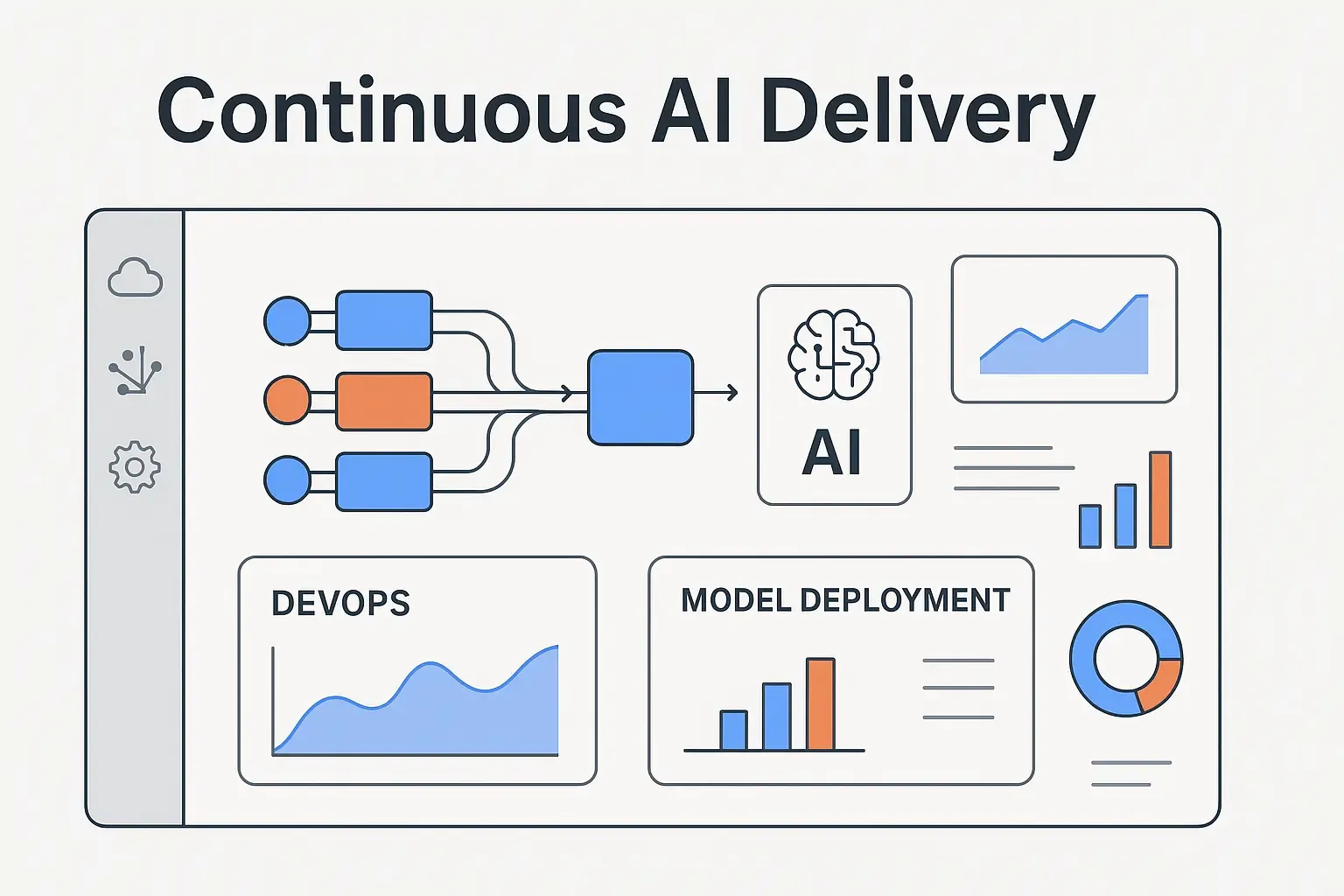
Artificial intelligence is becoming central to products and business operations, but deploying models is not as simple as shipping traditional software. Models change, data evolves, and real-world conditions shift faster than development teams can manually keep up. This is where Continuous AI Delivery enters the picture. It blends the strengths of ML Ops and DevOps to create a unified pipeline that supports the rapid, reliable, and scalable delivery of machine learning systems.
In this guide, you will explore how Continuous AI Delivery works, why it matters, and what businesses need to build a dependable workflow for AI-driven products.
The Rise of Continuous AI Delivery
Traditional DevOps helped teams release code faster and more consistently. But machine learning involves more than code. It involves data pipelines, training processes, model evaluation, monitoring, and retraining cycles. Models that perform well today may degrade next month because user behavior shifts or new patterns appear in the data.
Continuous AI Delivery solves this by introducing automatic retraining, validation, deployment, and monitoring loops that operate throughout the entire AI lifecycle. The result is an end-to-end system that keeps models accurate and reliable over time.
What Makes AI Delivery Different from Software Delivery
Shipping AI is not the same as shipping an app update. Here is why the processes differ:
1. AI Is Shaped by Data
Software depends on code. Machine learning depends on data and code. If the data changes, the model changes.
2. Model Performance Can Drift
Models lose accuracy as real-world patterns evolve. This requires continuous checks and updates.
3. Models Require Retraining
To stay relevant, models must be retrained regularly or triggered by performance thresholds.
4. Experiments Are Constant
Data scientists run many experiments. DevOps alone does not provide enough structure for tracking and comparing them.
5. Evaluation Metrics Vary
Success in AI is measured by precision, recall, drift scores, or fairness. These metrics need specialized monitoring.
Continuous AI Delivery brings structure to these challenges so teams can manage AI systems just as smoothly as software applications.
What Continuous AI Delivery Includes
A complete Continuous AI Delivery pipeline has several layers. Each layer automates part of the AI lifecycle.
1. Data Ingestion and Validation
The pipeline collects fresh data, validates it for quality, and checks for missing values, distribution issues, or bias. Clean data leads to reliable models.
2. Automated Training and Experimentation
Models are retrained automatically when new data arrives or when performance drops. Hyperparameter tuning, model selection, and experiment tracking happen at scale.
3. Model Validation
Before a model is deployed, it must pass strict validation steps. These checks ensure it is more accurate, stable, and fair than the current version.
4. Continuous Deployment
Once validated, models are pushed into production environments such as APIs, web apps, mobile apps, or backend systems. Deployment methods often include canary releases or shadow deployments to minimize risk.
5. Real-Time Monitoring
The system tracks accuracy, drift, latency, resource consumption, and anomalies. If performance drops, an automated retraining cycle begins.
6. Feedback Loops
User interactions, new data, errors, and predictions feed back into the training pipeline. This creates ongoing improvement.
How ML Ops and DevOps Merge in Continuous AI Delivery
ML Ops focuses on data workflows, model experiments, training, monitoring, and governance. DevOps focuses on pipelines, releases, automation, and infrastructure. Continuous AI Delivery merges the two into a single ecosystem.
Here is how they connect:
ML Ops Responsibilities
- Data preprocessing
- Model training
- Experiment tracking
- Feature store management
- Drift detection
- Performance monitoring
DevOps Responsibilities
- Infrastructure automation
- CI and CD pipelines
- Environment management
- Version control
- Deployment strategies
- Monitoring infrastructure
The Unified Outcome
Teams gain a pipeline where:
- Data enters
- Models train
- Models validate
- Models deploy
- Systems monitor
- Pipelines trigger updates
This creates a seamless cycle of improvement with minimal human intervention.
Benefits of Continuous AI Delivery
1. Faster Releases
Teams can deploy new models at the same speed they ship software updates.
2. Improved Accuracy
Models stay fresh, aligned with new patterns, and updated based on the latest data.
3. Reduced Risk
Systems detect drift early and revert or replace models automatically.
4. Scalable Experimentation
Data scientists can run hundreds of experiments without slowing down the release cycle.
5. More Reliable AI Products
Users receive consistent results backed by automated validation and monitoring.
6. Consistent Governance
Audit trails, versioning, and compliance are built into the pipeline.
Practical Workflow Example
Below is what a real Continuous AI Delivery workflow may look like:
- New data arrives from users.
- The pipeline performs data validation.
- Training jobs start automatically.
- Several candidate models are created.
- The system selects the best-performing model.
- The model is validated against fairness, accuracy, drift, and stability benchmarks.
- The model is deployed through a CD pipeline.
- Monitoring tools track performance in production.
- If drift appears, the pipeline triggers retraining.
This loop stays active forever, keeping the AI healthy.
Challenges Teams Face
Continuous AI Delivery is powerful, but it is also complex. Here are common challenges:
Model Drift
Drift needs constant monitoring to ensure predictions remain accurate.
Data Quality Issues
If input data is inconsistent or noisy, the model will fail to generalize.
Infrastructure Costs
Continuous training and monitoring require robust compute resources.
Governance Requirements
Businesses must protect user data, maintain audit logs, and comply with regulations.
Cross-Team Collaboration
Data teams, engineering teams, and product teams must work in sync.
Solving these challenges requires the right tools, workflows, and culture.
Best Practices for Building Continuous AI Delivery
Use modular pipelines
Break stages into reusable blocks for data, training, validation, and deployment.
Track everything
Log experiments, datasets, features, and model versions.
Automate retraining
Trigger new models based on time, data changes, or drift scores.
Use safe deployment strategies
Shadow tests and canary releases help avoid sudden failures.
Keep humans in the loop
Critical decisions should include human approvals.
Build strong monitoring
Track both system health and model quality.
The Future of Continuous AI Delivery
The future of AI delivery will be shaped by automation, transparency, and collaboration. As more businesses rely on AI, pipelines will become smarter and more self-correcting. We will see systems that:
- Self-organize training workloads
- Detect drift without manual thresholds
- Tune themselves based on upcoming conditions
- Predict the best deployment strategy
- Explain decisions clearly for governance
Continuous AI Delivery will become the foundation for reliable, scalable, and trustworthy AI systems.
Final Thoughts
Continuous AI Delivery represents the next step in the evolution of ML Ops and DevOps. With unified processes, automated pipelines, and real-time monitoring, businesses can release AI models quickly while ensuring accuracy and reliability. As AI becomes essential across industries, the ability to deliver models continuously will become a critical competitive advantage.