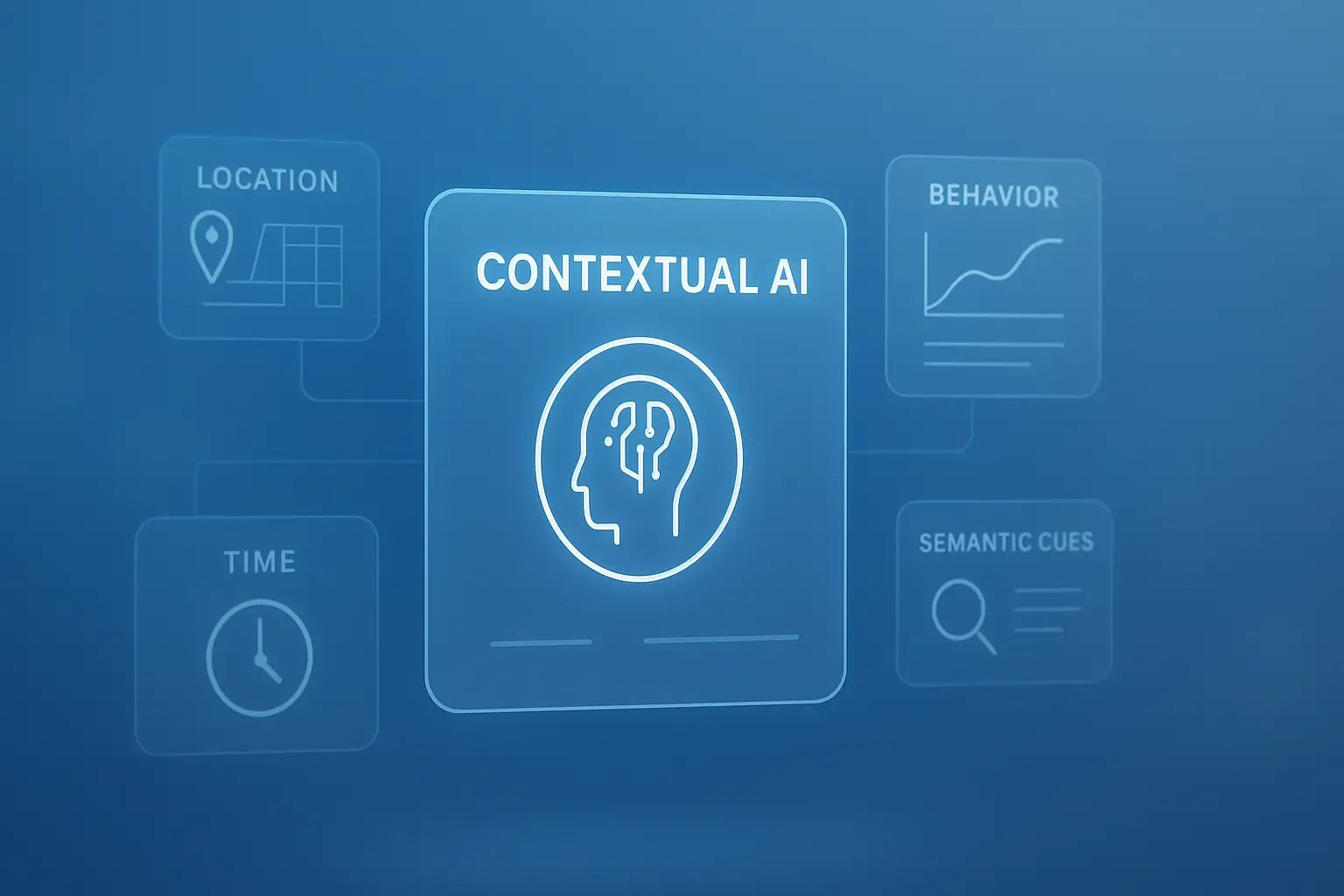
Artificial intelligence has advanced quickly over the last few years. Traditional systems were built to respond to direct inputs. You typed a query and the machine returned an answer. That model worked for predictable interactions, but it struggled with nuance, intent, and environment. Today, a new generation of models is emerging that can interpret context instead of reacting to isolated questions. This shift is known as contextual AI, and it is transforming how machines understand human behavior.
Contextual AI refers to systems that interpret meaning based on surrounding information. That includes the user’s intent, past behavior, location, current situation, device, emotional cues, and even the flow of a conversation. By doing so, these models create responses that feel more natural and relevant.
In this blog, we explore how contextual AI works, why it matters, where it is being used, and what the future looks like as machines evolve from answering queries to understanding situations.
What Makes Contextual AI Different
Older AI systems treated queries as standalone blocks of text. If the input was unclear or incomplete, the system struggled. Contextual AI takes a different approach by analyzing multiple layers around the input. This includes:
Intent. What the user truly wants to accomplish.
History. What the user asked previously and how they interacted.
Environment. Time, place, device, and background conditions.
Semantics. Deeper meaning behind words and phrases.
Tone. Emotional state detected through text, voice, or behavior.
By combining these factors, contextual AI offers responses that mirror human understanding. For example, if you ask a traditional system “Is it open today?” it would not know what “it” refers to. A contextual system tracks the ongoing conversation and understands that you are referring to the store mentioned earlier.
Why Contextual AI Matters
As digital interactions become more complex, context is no longer optional. It shapes the user experience in several important ways.
Better accuracy. With context, models reduce misunderstandings and deliver more precise answers.
Improved relevance. Context-aware models tailor responses and recommendations to the situation.
More natural interactions. Conversations feel fluid and human, especially in multi-turn dialogues.
Higher trust. When machines understand intent, they make fewer mistakes and confuse users less.
Smarter automation. Contextual AI can make decisions that align more closely with real-world workflows.
This is why contextual AI is becoming a core requirement for next-generation search engines, assistants, customer support systems, and enterprise automation tools.
How Contextual AI Actually Works
Contextual AI depends on several core building blocks.
1. Memory Systems
These systems store and recall previous interactions. Short-term memory tracks the current session, while long-term memory can store user preferences over time.
2. Multi-Modal Inputs
Context can come from text, voice, images, sensors, or system logs. Models combine these inputs to build a richer picture of the situation.
3. Semantic Understanding
Natural language processing models break down sentences and understand relationships between concepts. This allows them to interpret meaning beyond surface-level text.
4. Real-Time Personalization
Contextual AI adjusts to behavior in real time. If you switch from browsing travel destinations to hotels, the system immediately adapts.
5. Situational Awareness Models
These models include time, location, device, and environmental data. For example, a navigation app may change recommendations based on weather or traffic patterns.
All these elements work together to transform a simple input into a deeper understanding of what the user actually needs.
Where Contextual AI Is Being Used Today
Contextual AI is already shaping many industries.
Customer Support
Chatbots and support agents now understand customer history, previous complaints, sentiment, and the nature of the issue. This leads to faster resolutions.
Search Engines
Search is shifting from keyword matching to intent detection. Results are becoming more personalized and situational.
Healthcare
AI systems interpret symptoms along with context such as age, lifestyle, and recent activity to provide better assessments.
Smart Homes
Devices adjust lighting, temperature, or media based on context like occupancy, time of day, or user habits.
Productivity Tools
Writing assistants, scheduling systems, and collaboration apps use context to predict what users need next.
E-commerce
Retail platforms use browsing patterns, past purchases, and time-sensitive behavior to deliver tailored recommendations.
Benefits for Businesses and Developers
Organizations adopting contextual AI gain several advantages.
Higher engagement. Personalized interactions increase user satisfaction.
Better automation. Workflows operate with fewer mistakes.
Reduced support load. Systems resolve more issues independently.
Stronger user loyalty. People prefer experiences that understand their needs.
Competitive advantage. Businesses that use context deliver smarter and more intuitive services.
Contextual AI is becoming the standard for building intelligent digital products. Companies that adopt it early will lead the next wave of innovation.
Challenges That Still Need Solving
Despite its benefits, contextual AI faces a few challenges.
Privacy concerns. Using context means processing more user data, so strong safeguards are needed.
Model complexity. Context-aware systems require more advanced architecture and memory management.
Bias risks. Over-reliance on historical data can replicate existing biases.
Data requirements. High-quality, multi-modal data is necessary for accurate context interpretation.
Solving these challenges will be critical in making contextual AI safe, reliable, and trustworthy.
The Future of Contextual AI
The next era of AI will rely heavily on context. Instead of treating user inputs as isolated questions, machines will understand situations, goals, and emotional states.
Future systems are expected to:
• Predict needs before queries are made• Understand longer conversations with better memory• Personalize behavior based on evolving habits• Use multi-modal context from sensors, images, and environmental data• Improve accuracy across industries through richer situational awareness
Contextual AI will push us towards interactions that feel more natural and helpful. Machines will no longer just answer questions. They will understand the world around those questions.