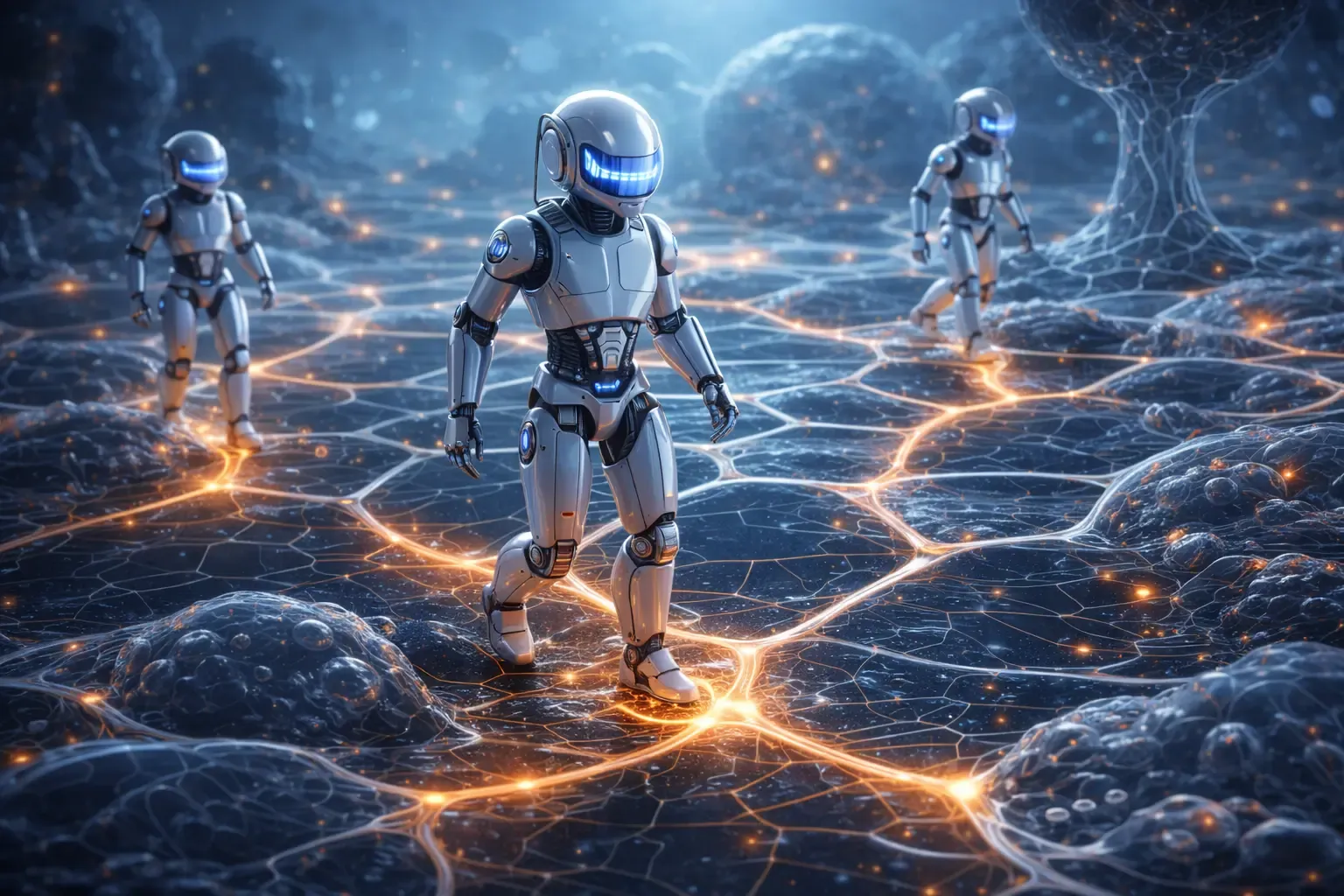
Artificial intelligence has long followed the logic of computers. It relies on centralized processing, heavy computation, and predefined rules. However, nature tells a different story. Single cells, without brains or processors, navigate complex environments every second. They find nutrients, avoid danger, and adapt instantly.
This shift in thinking leads us to Bio-Inspired AI Navigation, an emerging approach where machines learn from biology instead of code-heavy systems. Instead of asking how computers think, researchers now ask how cells move, sense, and decide with almost no resources.
This article explores how AI navigation can learn from cells, why this model outperforms traditional systems in many environments, and how it shapes the future of autonomous intelligence.
What Is Bio-Inspired AI Navigation?
Bio-Inspired AI Navigation refers to navigation systems designed by mimicking biological processes rather than conventional computational logic. These systems take inspiration from how living organisms move through their surroundings efficiently and adaptively.
Unlike traditional AI navigation systems that depend on maps, GPS, and heavy data processing, bio-inspired systems rely on local sensing, feedback loops, and decentralized decision-making.
Cells provide the perfect model. They operate without memory, maps, or central control, yet they navigate chemical gradients, heal damage, and respond to unpredictable environments.
This biological efficiency is exactly what modern AI systems need.
Why Learning Like Cells Matters More Than Learning Like Computers
Traditional AI navigation systems face several limitations. They require massive datasets, stable environments, and constant recalculation. In contrast, cells thrive in uncertainty.
Key differences between computer-based and cell-inspired navigation:
- Computers rely on centralized processing while cells use decentralized intelligence
- Traditional AI needs exact data, but cells adapt using incomplete information
- Machine navigation often fails in dynamic environments, whereas cells evolve instantly
Bio-Inspired AI Navigation removes complexity by embracing simplicity. Cells do not calculate paths. They respond to signals. This reactive intelligence allows faster and more resilient navigation.
How Cells Navigate Without a Brain
Understanding cellular navigation unlocks the foundation of bio-inspired AI systems.
Chemotaxis: The Core Principle
Chemotaxis is the process where cells move toward beneficial chemical signals and away from harmful ones. This simple rule drives powerful behavior.
Cells continuously sense their environment, compare signals, and adjust movement. No memory is required. No prediction model exists. Yet navigation remains effective.
Feedback-Driven Movement
Cells rely on feedback loops. When conditions improve, movement continues. When conditions worsen, direction changes. This constant adjustment creates adaptive navigation without computation.
Self-Organization
Cells coordinate movement collectively. This behavior leads to swarm intelligence, where group behavior emerges from simple individual actions.
These mechanisms form the blueprint for Bio-Inspired AI Navigation systems.
Core Principles of Bio-Inspired AI Navigation
To apply cellular intelligence to AI, researchers focus on a few essential principles.
Decentralized Decision-Making
There is no central controller. Each unit makes local decisions based on immediate input. This design improves resilience and scalability.
Continuous Environmental Sensing
Bio-inspired systems never stop sensing. Instead of processing large datasets, they rely on real-time feedback.
Adaptation Over Prediction
Rather than predicting the best path, bio-inspired navigation adapts step by step. This approach reduces failure in unknown or changing environments.
Energy Efficiency
Cells operate with minimal energy. Bio-inspired AI navigation mirrors this efficiency, making it ideal for low-power autonomous systems.
Applications of Bio-Inspired AI Navigation
This nature-driven approach is already transforming multiple industries.
Autonomous Robotics
Robots using bio-inspired navigation can move through debris, caves, or disaster zones without maps. They respond to environmental cues just like cells.
Swarm Drones
Drone swarms rely on decentralized intelligence. Bio-inspired AI navigation enables drones to avoid collisions, adapt to wind, and complete tasks collectively.
Medical Microrobots
Tiny robots navigating the human body cannot rely on GPS or heavy computation. Cellular navigation models allow them to move using chemical and physical signals.
Space Exploration
In unpredictable extraterrestrial environments, bio-inspired systems outperform traditional navigation models by adapting on the fly.
Bio-Inspired AI Navigation vs Traditional AI Navigation
Understanding the contrast highlights why this shift matters.
Traditional AI Navigation
- Depends on maps and predefined routes
- Requires extensive training data
- Struggles in unknown environments
- High computational cost
Bio-Inspired AI Navigation
- Operates without maps
- Learns through interaction
- Thrives in uncertainty
- Low computational overhead
This comparison shows why future autonomous systems increasingly adopt bio-inspired models.
The Role of Swarm Intelligence in Navigation
Swarm intelligence plays a major role in bio-inspired AI navigation. It emerges when multiple agents follow simple rules yet achieve complex group behavior.
Ant colonies, bird flocks, and bacterial colonies all demonstrate efficient navigation without leadership.
In AI systems, swarm intelligence allows:
- Faster exploration of environments
- Built-in redundancy and fault tolerance
- Adaptive routing without recalculation
Each agent behaves like a cell. Together, they create intelligent navigation systems.
How Bio-Inspired Navigation Improves AI Robustness
Robustness means continuing to function even when conditions change.
Cells survive damage, interference, and uncertainty. Bio-inspired AI navigation inherits these traits.
Fault Tolerance
If one unit fails, others continue. There is no single point of failure.
Environmental Resilience
Systems adapt to obstacles, signal loss, and noise without crashing.
Scalability
Adding more agents improves performance instead of increasing complexity.
This makes bio-inspired navigation ideal for real-world deployment.
Challenges in Implementing Bio-Inspired AI Navigation
Despite its advantages, challenges remain.
Translating Biology into Algorithms
Biological processes are complex and not always easy to model mathematically.
Hardware Constraints
Some bio-inspired systems require specialized sensors to mimic biological sensing accurately.
Integration with Existing AI Systems
Combining traditional AI and bio-inspired models requires careful system design.
However, ongoing research continues to overcome these challenges.
The Future of Bio-Inspired AI Navigation
The future of navigation lies in hybrid intelligence. Systems will combine classical AI with bio-inspired principles.
We can expect:
- Smarter autonomous vehicles that adapt like living organisms
- AI systems that require less data and energy
- Navigation models that evolve instead of update
As researchers move away from brain-centric intelligence, cellular models will define the next generation of AI navigation.
Why Bio-Inspired AI Navigation Matters for Artificial Intelligence
Bio-Inspired AI Navigation challenges the assumption that intelligence requires complexity. Cells prove that simple rules, applied continuously, can outperform advanced computation in uncertain environments.
This approach shifts AI development from control to cooperation, from prediction to adaptation, and from computation to interaction.
Nature has already solved many problems that AI still struggles with. Learning like cells may be the most intelligent move machines can make.
Final Thoughts
Bio-Inspired AI Navigation represents a fundamental change in how we design intelligent systems. By learning from cells instead of computers, AI becomes more adaptive, resilient, and efficient.
As technology continues to evolve, the most advanced systems may not think harder. They may simply respond better, just like living cells have done for billions of years.