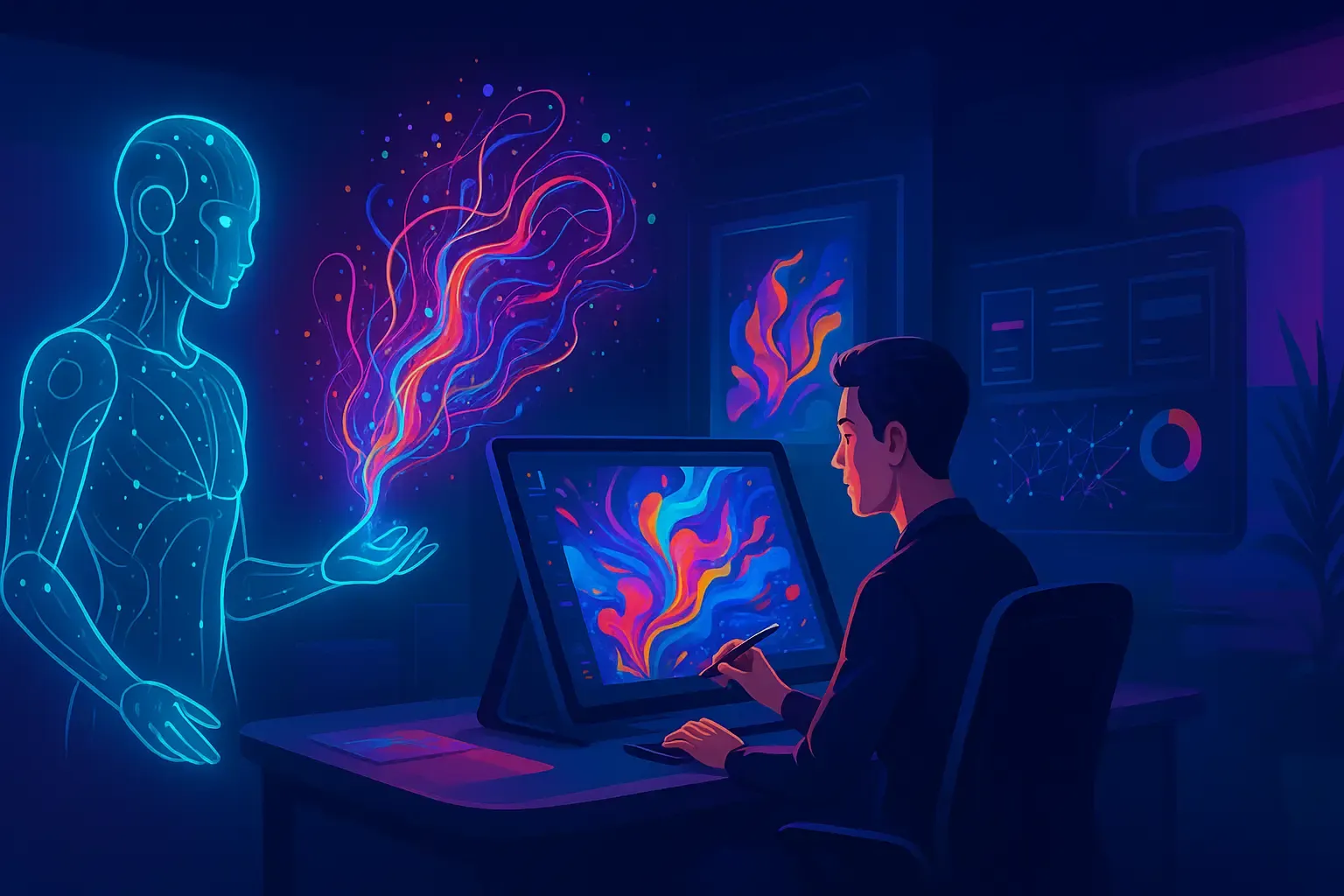
Artificial intelligence is no longer limited to data science labs or engineering teams. Today, AI is becoming one of the most powerful creative partners for artists, designers, filmmakers, musicians, and storytellers. From generating concept art in seconds to assisting with animation, music composition, and product prototyping, neural tools are unlocking new levels of imagination and productivity.
In this article, we’ll explore how AI is reshaping the creative world, what tools professionals are using, and how humans and machines collaborate to push creativity forward.
1. The Rise of AI-Assisted Creativity
Creativity has traditionally been a purely human domain. However, modern neural networks—especially generative AI—are now capable of producing text, illustrations, 3D models, voice, and music at astonishing quality.
This shift isn’t replacing creators. Instead, it’s augmenting them.
Why AI is entering the creative workflow:
- Speed – Create hundreds of concepts instantly instead of starting from scratch
- Exploration – Test wild ideas that would be too time-consuming to sketch or model manually
- Efficiency – Automate repetitive tasks like resizing, recoloring, and reformatting
- Accessibility – People without classical training can now produce high-quality creative work
- Inspiration – AI becomes a brainstorming partner that can spark new directions
The result is a new type of creativity: one where humans imagine, and AI helps execute.
2. How Designers Are Using AI Today
Designers across industries—from UI/UX to product design to architecture—are using AI to streamline workflows and generate bold new aesthetics.
Top design use cases:
• Concept Generation
Tools like Midjourney, Firefly, and DALL·E allow designers to create mood boards, style variations, and product concepts in seconds.
It drastically cuts time wasted on early exploration.
• UI/UX Automation
AI can automatically generate interface layouts, component variations, and user flows. Tools like Uizard and Galileo AI are becoming powerful prototyping companions.
• Branding & Identity
Logo generation, color palette exploration, font pairing, and visual identity testing are all being accelerated by AI.
• 3D & Industrial Design
Neural networks can now generate 3D models, textures, and materials—useful for gaming, film, architecture, and manufacturing.
Hunyuan3D, Spline AI, and Kaedim are leading this new wave.
3. AI in Art: New Mediums, New Expression
Artists aren’t just using AI as a tool—they're using it as a medium.
How artists embrace neural creativity:
• Generative Art
AI models produce surreal, abstract, or hyperrealistic imagery that can be used in digital galleries, NFTs, prints, and installations.
• Style Transfer
Artists can merge their personal style with historical art movements or blend multiple aesthetics effortlessly.
• Animation & Storyboarding
AI tools automate frame-to-frame generation, motion smoothening, and storyboarding—transforming both speed and creativity in video production.
• Music & Sound Design
AI engines like Suno, Udio, Stable Audio, and Google’s MusicLM generate musical ideas, soundscapes, and instrument patterns.
AI becomes a collaborator rather than a replacement.
4. AI + Creativity in the Business World
Creative teams in companies are using AI to work faster and smarter.
Practical business applications:
- Marketing teams – Generate graphics, social posts, voiceovers, and video scripts
- Product teams – Prototype UI ideas and test brand variations
- Film studios – Use AI for VFX, scene previsualization, and background generation
- Game developers – Build textures, maps, and character concepts in real time
- E-commerce brands – Create product imagery and lifestyle photos without photoshoots
AI unlocks creative automation that saves time, reduces cost, and boosts output quality.
5. The Ethical Side: Who Owns AI Art?
AI creativity comes with questions:
- Is AI-generated content truly original?
- Should AI be trained on copyrighted works?
- Who owns AI-generated creations: the user or the model?
Many countries are now exploring ownership laws and regulations. The future will likely include clearer frameworks around attribution, artist rights, and data transparency.
6. Human + AI: The Future of Creativity
The most successful creators are not those who compete with AI, but those who collaborate with it. AI removes limitations:
- You don’t need to be a master painter to visualize a concept
- You don’t need years of training to model a 3D object
- You don’t need a full studio to produce high-quality content
AI expands who can create and what can be created.
The future will include:
- Personalized AI creative assistants
- Hyper-realistic real-time 3D asset generation
- AI tools built directly into creative software
- Co-creative interfaces where humans guide and AI executes
- Entire films, games, and artworks built through human-machine collaboration
Creativity becomes more about ideas and less about technical constraints.
Conclusion
AI isn’t replacing artists or designers. It’s giving them superpowers.
Whether you’re an illustrator, a brand strategist, a musician, or a UX designer, AI can help you think bigger, work faster, and unlock creative possibilities that once felt impossible.
The future of creativity is not human vs. machine—it’s human amplified by machine.