The internet has always revolved around one thing: content. Whether it’s blog posts, videos, podcasts, or infographics, content fuels discovery, drives conversations, and builds authority. But in 2025, the conversation has shifted dramatically.
Artificial Intelligence (AI) is no longer just a helper—it has become a full-fledged content creator. From generative AI writing tools that churn out blog posts to voice models creating podcasts and video scripts, AI-generated content is everywhere.
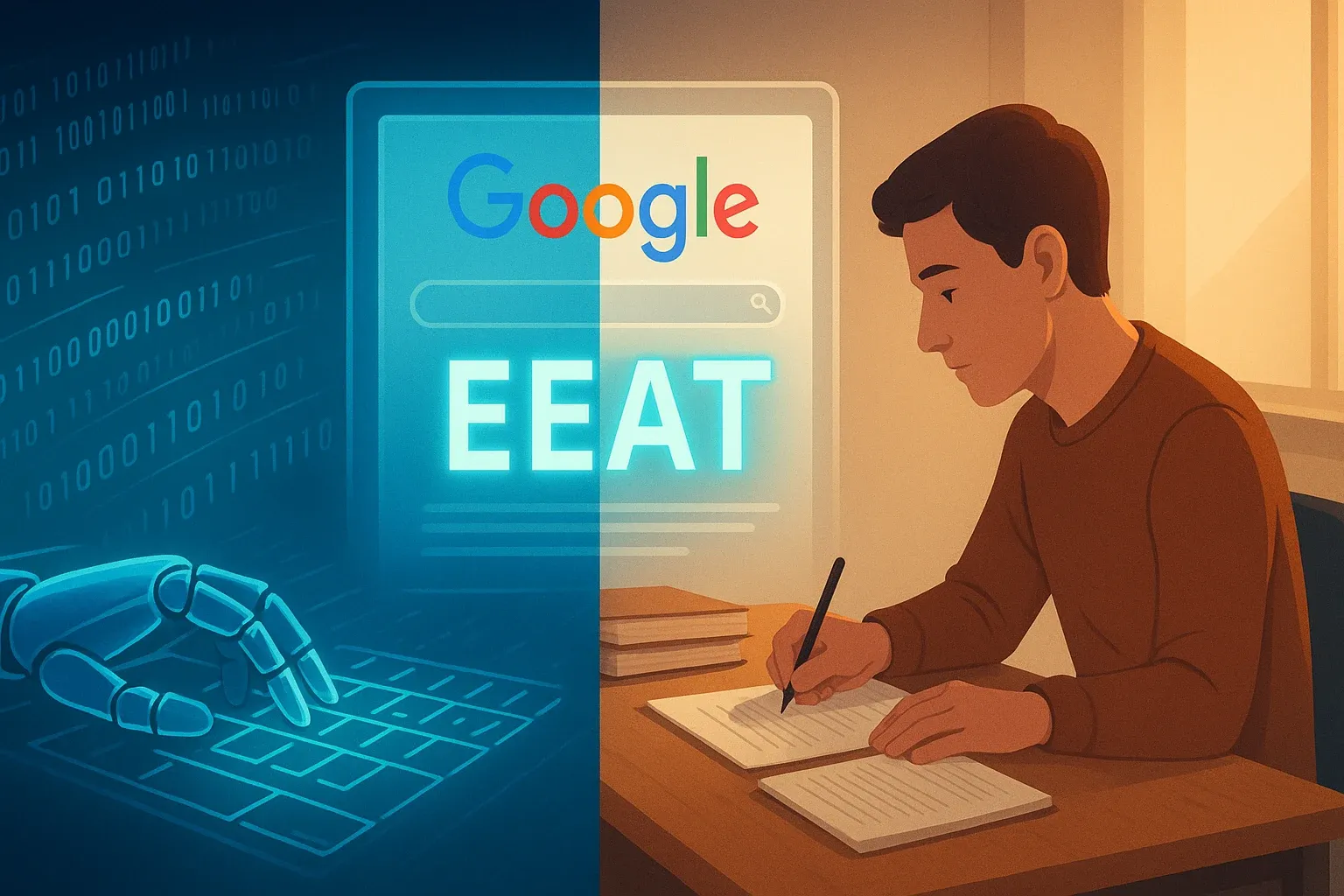
This raises the big question: how does Google evaluate AI content vs human content today? The answer lies in EEAT—Expertise, Experience, Authoritativeness, and Trustworthiness. Introduced as part of Google’s Search Quality Rater Guidelines, EEAT has become the benchmark for determining whether a piece of content deserves top ranking in search results.
In this blog, we’ll explore how Google applies EEAT to both AI and human content in 2025, the opportunities and risks of relying on AI-generated material, and strategies businesses can use to maintain visibility in an AI-saturated web.
Why EEAT Matters More Than Ever
Back in the early 2020s, SEO largely revolved around keywords, backlinks, and technical optimization. While these still matter, Google has made it clear that quality, authenticity, and expertise are the ultimate ranking signals.
The rise of AI content has forced Google to double down on EEAT:
- Expertise – Does the writer (human or AI) demonstrate deep knowledge of the subject?
- Experience – Is there evidence of first-hand or lived experience in the content?
- Authoritativeness – Is the content creator or website recognized as a trusted source?
- Trustworthiness – Is the information accurate, transparent, and safe for users?
For human writers, showcasing expertise and experience is relatively straightforward—bios, credentials, case studies, and original insights help establish credibility. For AI-generated content, the challenge is much steeper: AI doesn’t have lived experience, nor can it provide genuine authority.
That’s why Google is making sharp distinctions in 2025 between human and AI content, rewarding authenticity while penalizing generic mass production.
How Google Evaluates AI-Generated Content in 2025
Google doesn’t automatically penalize AI content. Instead, it evaluates the outcome—the quality and trustworthiness of the piece. Still, with billions of AI-generated articles flooding the web, Google has introduced stricter measures:
1. Detection of AI Writing Patterns
Even advanced AI leaves behind subtle fingerprints—predictable structures, lack of nuance, or repetitive phrasing. Google uses machine learning to identify these markers, particularly in high-volume, low-quality websites.
2. EEAT Weighting Against AI
AI content without human oversight struggles to meet EEAT standards. Since AI lacks true experience, articles that read as generic or templated are flagged as low quality.
3. Transparency Signals
Websites that disclose AI use and clearly distinguish AI-generated sections tend to perform better than those attempting to pass off AI work as fully human. Google values honesty as part of trust.
4. Cross-Referencing With Trusted Sources
AI articles that cite authoritative, verifiable sources rank higher. Unsupported claims, especially in YMYL (Your Money, Your Life) niches like health or finance, are heavily penalized.
How Google Evaluates Human Content in 2025
Human-written content continues to dominate in areas where EEAT requires depth, nuance, and real-world insight:
- Personal Experience Counts – Google explicitly rewards content where the author shares hands-on experience, case studies, or unique stories.
- Credibility Markers – Author bios with credentials, linked social proof, and recognized industry presence give human content a ranking advantage.
- Quality Over Quantity – Unlike AI, humans can naturally weave context, empathy, and original thought into articles—qualities Google considers high-value.
That said, humans are not immune to penalties. Low-quality, plagiarized, or misleading content written by humans is judged just as harshly. The difference lies in execution.
The Middle Ground: AI + Human Collaboration
By 2025, the most successful content strategies are hybrid. Companies that thrive in SEO are blending AI efficiency with human oversight.
Benefits of AI in Content Creation
- Scale – AI handles repetitive drafting, ideation, and formatting.
- Speed – Businesses can publish quickly without sacrificing consistency.
- Optimization – AI helps with keyword placement, readability, and metadata.
Benefits of Human Oversight
- Validation – Humans fact-check and refine AI’s output.
- Experience – Authors add lived experiences and personal perspectives AI cannot.
- Creativity – Storytelling, humor, and emotional depth remain uniquely human.
In short: AI writes the draft, humans ensure EEAT compliance.
Key EEAT Challenges With AI Content
While AI content has improved dramatically, three big challenges remain:
- Lack of First-Hand ExperienceAI can simulate reviews, but it cannot physically test products or live through an experience. Google now flags “synthetic experiences” in reviews as misleading.
- Risk of InaccuraciesEven advanced AI models occasionally “hallucinate” facts. Without human intervention, this undermines trustworthiness.
- Ethical & Transparency IssuesAudiences are increasingly skeptical of content with no disclosure of AI usage. Sites that pretend all content is human risk damaging their credibility.
Strategies for Ranking in 2025
Whether using AI, human, or hybrid content, the following strategies ensure strong EEAT performance:
1. Showcase Real Authors
Even if AI assists, list verified human authors with bios, credentials, and links to professional profiles.
2. Incorporate First-Hand Insights
Include case studies, data, original images, or personal stories—signals Google values highly.
3. Transparency About AI Use
Disclose when AI is used in drafting or research. Transparency boosts trustworthiness.
4. Leverage Authoritative Sources
Back claims with citations from reputable journals, organizations, or experts.
5. Focus on Depth and Uniqueness
Thin, generic AI articles won’t rank. Deep analysis, expert commentary, and human-added value are essential.
6. Avoid Overproduction
Mass-publishing hundreds of AI articles without oversight triggers quality downgrades. Quality beats volume in 2025.
The Future of Content: AI vs Human, or AI + Human?
It’s tempting to frame the debate as “AI vs humans,” but the reality is more nuanced. AI isn’t replacing human content—it’s reshaping the workflow.
- Pure AI Content – Fast, scalable, but vulnerable to EEAT shortcomings.
- Pure Human Content – Authentic, but slower and harder to scale.
- Hybrid Approach – Efficient, authoritative, and future-proof for SEO.
Google’s own guidelines suggest that the best content of 2025 will come from humans who use AI responsibly, not replace themselves with it.
Final Thoughts
The debate over AI content vs human content isn’t about who wins—it’s about how they work together. Google’s EEAT framework ensures that real expertise, lived experience, and trust remain central to ranking, regardless of how content is produced.
In 2025, businesses that rely solely on AI will risk falling into the trap of generic, low-value publishing. Those that combine AI’s efficiency with human oversight, authenticity, and authority will dominate search rankings.
The future of content creation isn’t about AI or humans—it’s about AI and humans together, creating content that is fast, trustworthy, and valuable.