Artificial Intelligence (AI) has become the driving force behind today’s technological revolution. From chatbots and generative AI tools to robotics and predictive analytics, AI seems to be everywhere. Startups are racing to release AI-powered products, while major tech companies like Google, Microsoft, and OpenAI are pushing the boundaries with cutting-edge models.
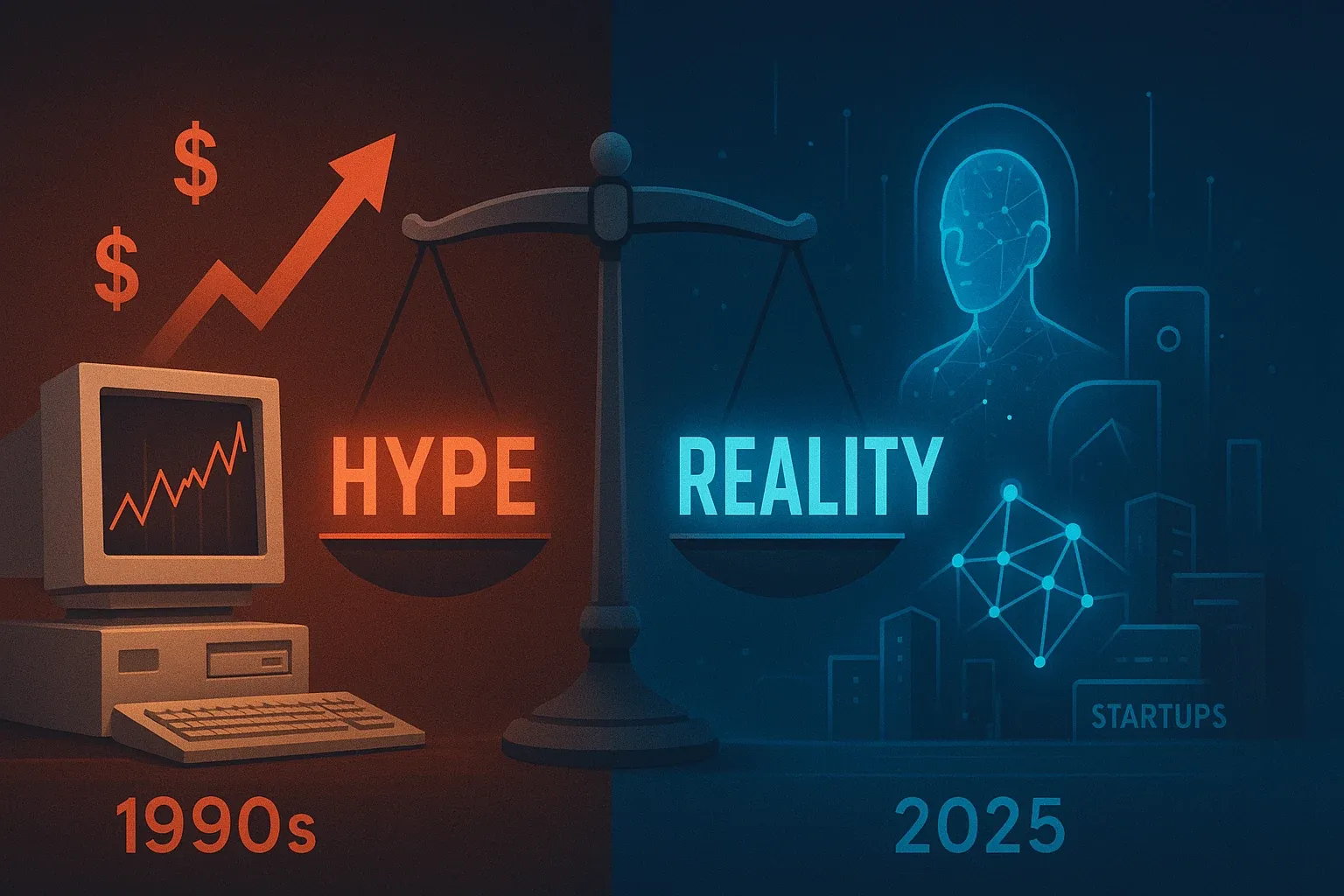
But as the excitement grows, a critical question arises: is AI’s boom peaking? To answer this, it helps to revisit the dotcom bubble of the late 1990s and early 2000s. That era was marked by rapid innovation, skyrocketing valuations, and an inevitable correction. Could AI be on the same trajectory, or is it different this time?
In this article, we’ll explore the parallels between the AI boom and the dotcom era, uncover the lessons history can teach us, and analyze what might come next for artificial intelligence in 2025 and beyond.
The Parallels Between the Dotcom Bubble and the AI Boom
The dotcom bubble began in the mid-1990s as the internet gained mainstream attention. Investors poured money into internet startups with little more than an idea and a ".com" in their name. Valuations soared, media hype exploded, and everyone wanted a piece of the future of the internet.
Fast forward to 2023–2025, and we see strikingly similar patterns in AI:
- Explosive investment growth – Billions of dollars are being funneled into AI startups, often before sustainable business models are proven.
- Unrealistic promises – Many companies claim AI will revolutionize industries overnight, from healthcare to education, but often underdeliver.
- FOMO (Fear of Missing Out) – Businesses feel compelled to adopt AI tools—even if they don’t fully understand or need them—just to keep up.
- Speculation-driven valuations – Some AI startups reach billion-dollar valuations without clear paths to profitability, reminiscent of dotcom “paper tigers.”
The internet was undoubtedly transformative, but the bubble burst eliminated many overhyped players before the survivors—Google, Amazon, eBay—went on to define the digital economy. AI may follow a similar path.
Lessons Learned from the Dotcom Era
The dotcom bust wasn’t the end of the internet. It was a necessary correction that separated hype from reality. This provides three critical lessons for AI today:
1. Hype Creates Vulnerability
Just like in the dotcom bubble, excessive hype around AI makes the sector vulnerable to sudden downturns. If companies overpromise and underdeliver, investor confidence can collapse quickly.
2. Utility Outlasts Hype
The companies that survived the dotcom crash were those offering real utility—Amazon with online shopping, Google with search, and PayPal with secure transactions. For AI, the key will be building tools that solve real problems, not just look impressive in demos.
3. Sustainable Business Models Matter
Dotcom startups often failed because they couldn’t monetize their platforms. Today, AI companies must balance innovation with sustainable revenue models, especially as operational costs for training large models remain enormous.
Is AI at Risk of Its Own Bubble?
The question isn’t whether AI will endure—it will—but whether today’s explosive growth is sustainable.
Several indicators suggest we may be entering “bubble territory”:
- Massive Venture Capital Funding: AI startups raised over $50 billion in 2024, sometimes with little more than a prototype.
- Copycat Products: Dozens of generative AI tools offer similar features (text generation, image creation) with minor differences, competing for limited markets.
- Overinflated Expectations: Consumers and enterprises expect AI to perform flawlessly, but issues like hallucinations, bias, and ethical concerns remain unresolved.
That said, unlike many dotcom startups, AI already has demonstrated, large-scale utility in industries ranging from finance and logistics to healthcare and education.
The Strengths Keeping AI From a Total Collapse
Despite risks of overhype, AI also has key strengths that make it more resilient than dotcom startups:
- Enterprise Integration: Major corporations are already embedding AI into workflows, from customer service automation to fraud detection.
- Government & Institutional Backing: Governments worldwide are funding AI research, ensuring its longevity as a strategic technology.
- Tangible Efficiency Gains: Unlike many speculative dotcoms, AI adoption can directly reduce costs, increase productivity, and drive innovation.
These factors suggest that while a correction may come, AI is more likely to stabilize rather than collapse completely.
What Comes Next for AI in 2025 and Beyond
So, if AI is at or near its peak hype cycle, what lies ahead?
1. The “Correction” Phase
Just as with the dotcom bubble, weaker players will likely fade out. AI startups without sustainable business models will fold, while the strongest ones consolidate their dominance.
2. Shift to Industry-Specific AI
Rather than broad, one-size-fits-all platforms, the next wave of AI will be specialized—healthcare AI, legal AI, education AI—each tailored to unique needs and regulations.
3. Regulation and Ethics Will Shape Growth
Governments are already drafting AI regulations. Transparency, data privacy, and responsible AI use will define the next phase, determining who thrives and who fails.
4. Convergence with Other Technologies
AI won’t grow in isolation. It will merge with other innovations:
- IoT (Internet of Things) for smarter cities and homes.
- Biotech for personalized medicine.
- Robotics for automated manufacturing and logistics.
- Quantum Computing for solving complex AI training challenges.
5. Sustainable AI Models
Energy usage is one of AI’s biggest challenges. Expect a push toward leaner models, micro-LLMs, and eco-friendly computing to balance innovation with sustainability.
The Human Factor: Will Jobs Survive the AI Wave?
One of the biggest fears tied to AI’s boom is job displacement. Just as the internet redefined careers, AI is reshaping the workforce:
- Roles at risk: Data entry, customer support, content generation.
- New opportunities: AI ethics, prompt engineering, human-AI collaboration specialists.
- Hybrid workplaces: Rather than total replacement, AI will likely augment human skills, creating faster, smarter workflows.
The winners will be those who adapt—leveraging AI while honing uniquely human skills like creativity, empathy, and critical thinking.
A Balanced Perspective: Hype, Reality, and Opportunity
AI’s boom might be peaking in terms of media hype, but the underlying technology is only beginning to mature. Like the internet, it will undergo cycles of excitement, correction, and long-term integration into everyday life.
The key takeaway: this isn’t the end of AI, it’s the start of its real-world journey.
Final Thoughts
History doesn’t repeat itself, but it often rhymes. The dotcom bubble taught us that hype-driven markets eventually correct, but real innovation survives and thrives. AI is no different.
Yes, we may see failures, consolidation, and slower growth in the short term. But the long-term future of AI is vast, from healthcare breakthroughs to smarter cities and personalized education. The next decade will be defined not by whether AI survives, but by how we shape it responsibly.