Publishing high-quality content filled with targeted keywords is no longer enough to secure top rankings on Google.
With millions of web pages generated daily and Google's AI Overviews synthesizing search queries across India, search engine algorithms evaluate who stands behind the content before deciding where to rank it.
This quality assessment system centers on E-E-A-T.
Understanding what is E-E-A-T and how to build it for your website in India enables you to protect your organic rankings, earn citations in AI search interfaces, and turn casual search traffic into loyal customers.
What Is E-E-A-T? Breaking Down the 4 Pillars
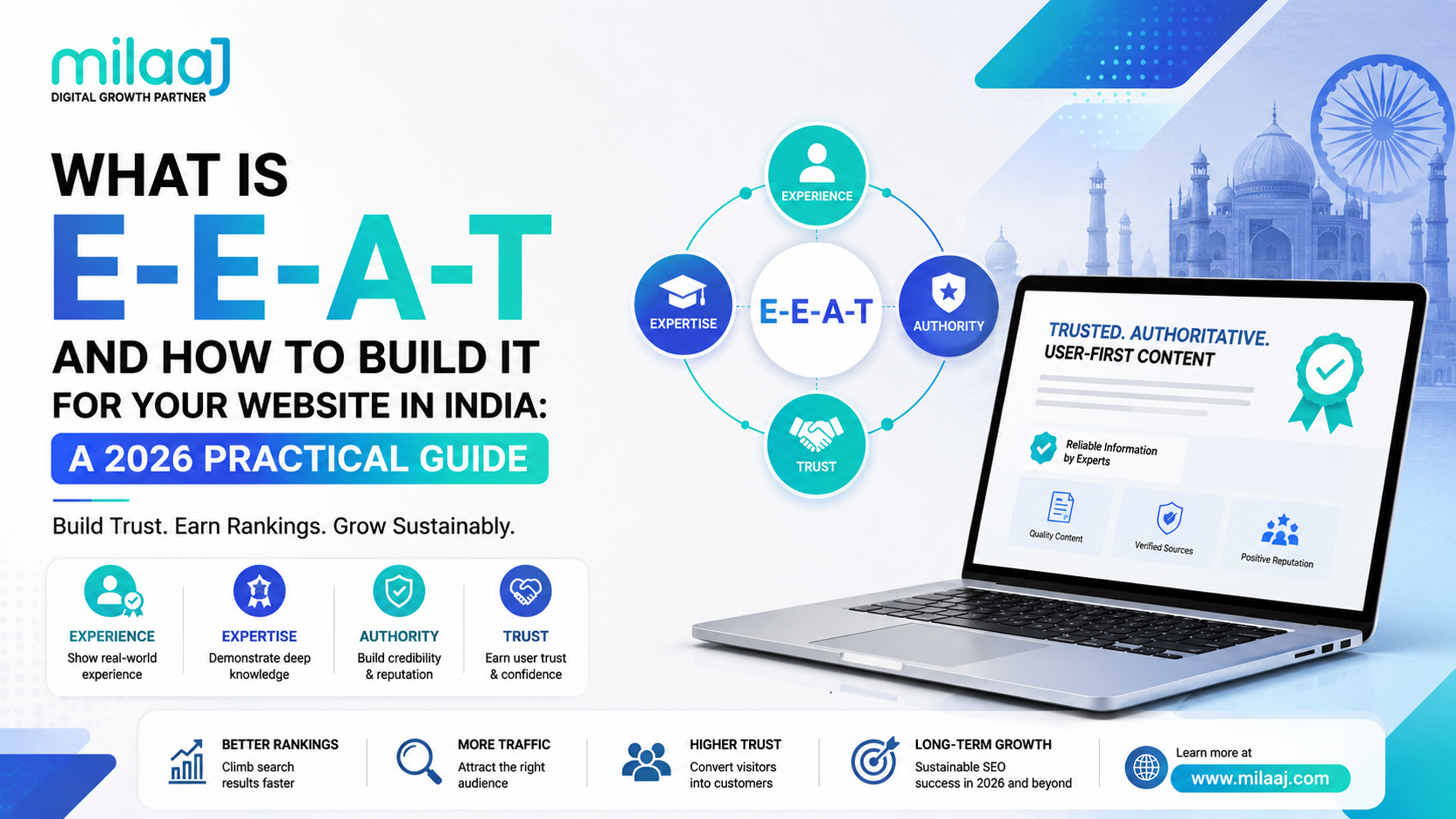
Codified in Google's Search Quality Evaluator Guidelines, E-E-A-T stands for Experience, Expertise, Authoritativeness, and Trustworthiness. While not a direct algorithmic metric like page speed, E-E-A-T represents a foundational quality framework that trains automated ranking systems.
[ THE E-E-A-T PYRAMID OF QUALITY ] ┌─────────────────┐ │ TRUSTWORTHINESS│ <-- The Core Foundation └────────┬────────┘ │ ┌─────────────────────┼─────────────────────┐ ▼ ▼ ▼ [ EXPERIENCE ] [ EXPERTISE ] [ AUTHORITIVENESS ] First-hand usage Subject mastery External recognition
1. Experience (First-Hand Involvement)
Google evaluates whether the author possesses practical, real-world experience with the subject.
- Example: A review written by someone who personally tested a mobile device in an Indian retail store carries significantly more weight than an article rehashing online specifications.
2. Expertise (Subject Mastery)
Expertise measures formal skill and knowledge depth. For Your Money or Your Life (YMYL) topics—such as health, personal finance, or legal advice—Google demands verified professional qualifications.
3. Authoritativeness (Industry Recognition)
Authoritativeness reflects how widely other industry experts and media platforms recognize your website or authors as trusted information sources.
4. Trustworthiness (The Core Pillar)
Trustworthiness sits at the center of the framework. An inaccurate or dishonest page fails on trust, rendering the other three elements ineffective.
Why E-E-A-T Matters More for Indian Websites in 2026
The Indian digital market has expanded rapidly, with hundreds of millions of searchers looking for reliable answers across local, regional, and national domains.
5 Practical Steps to Build E-E-A-T for Your Website in India
Building E-E-A-T requires systematic proof of human accountability and verifiable expertise.
Step 1: Replace Anonymous Bylines with Verifiable Authors
Eliminate generic author names like "Admin" or "Staff Writer". Attribute every article to a real person.
- Create dedicated Author Bio pages detailing education, years of experience, professional certifications, and links to personal social profiles.
- Mention regulatory body memberships relevant to India (such as SEBI for finance or Bar Council for legal topics).
Step 2: Implement Advanced Person and Organization Schema Markup
Structured data helps search engine crawlers map real-world relationships between people, brands, and web content. Add Person schema to author pages and link external profiles using the sameAs array:
JSON
{ "@context": "https://schema.org", "@type": "Person", "name": "Arjun Nair", "jobTitle": "Lead SEO Strategist", "worksFor": { "@type": "Organization", "name": "Milaaj Digital Academy" }, "sameAs": [ "https://www.linkedin.com/in/example-profile", "https://twitter.com/example-profile" ]}
Step 3: Add First-Hand Proof and Proprietary Insights
Include real process screenshots, original photos, custom research, and local Indian case studies to demonstrate lived experience.
Mastering technical structured data, author entity mapping, and search compliance requires practical training. Enrolling in a hands-on digital marketing course helps you build real-world experience across performance analytics, brand identity building, and multi-channel marketing campaigns.
Step 4: Earn Editorial Mentions via Local Digital PR
Build external authoritativeness by securing mentions on reputable Indian news portals, regional industry blogs, and industry podcasts. Unlinked brand mentions on trusted sites still contribute positive entity signals to Google's knowledge graph.
Step 5: Maintain Full Business Transparency
Ensure your website displays complete operational details to prove legitimacy:
- Add an explicit About Us page introducing your core team, physical office address in India, and registered GSTIN details.
- Make contact numbers, official emails, refund policies, and privacy terms easily accessible on all pages.
- Display verified customer feedback and manage ratings actively on Google Business Profile.
To gain advanced skills in algorithm compliance, technical schema validation, and topical authority mapping, taking a specialized advanced SEO course provides step-by-step guidance to audit and optimize sites for modern search engines.
E-E-A-T Optimization Checklist for Indian Brands
Use this matrix to review your domain's trust signals:
Category | Optimization Action | Status |
Author Layer | Every article attributed to a credentialed author | ▢ Pending |
Author Layer | Person schema implemented with sameAs social links | ▢ Pending |
Content Layer | Original media, data tables, and direct proof added | ▢ Pending |
Site Layer | Detailed About page with physical address & GSTIN listed | ▢ Pending |
Site Layer | Transparent terms, privacy policy, and contact info visible | ▢ Pending |
Web Layer | Brand mentions on external industry publications | ▢ Pending |
Frequently Asked Questions (FAQs)
Is E-E-A-T a direct Google ranking factor?
E-E-A-T is not a single, direct algorithmic ranking metric like page speed or HTTPS. Instead, it is a quality framework that Google uses to evaluate search results. Machine learning models utilize signals matching E-E-A-T principles to determine content quality.
Can AI-generated content achieve high E-E-A-T scores?
Yes, provided the content is thoroughly reviewed, fact-checked, and edited by a qualified human subject matter expert who takes accountability for its accuracy. Purely automated AI content published without human validation fails on trust and experience.
How long does it take to establish strong E-E-A-T in India?
Building E-E-A-T takes continuous effort over 3 to 6 months. Establishing verified author entities, building local digital PR citations, and collecting authentic customer reviews require sustained execution across your entire digital presence.
Conclusion: Build Lasting Search Authority
Understanding what is E-E-A-T and how to build it for your website in India is essential for maintaining organic search visibility. By attributing content to real experts, adding Person schema markup, displaying first-hand proof, and maintaining complete business transparency, you turn your website into a trusted industry authority.
Audit your author bios today, update key business pages, and secure your search presence.