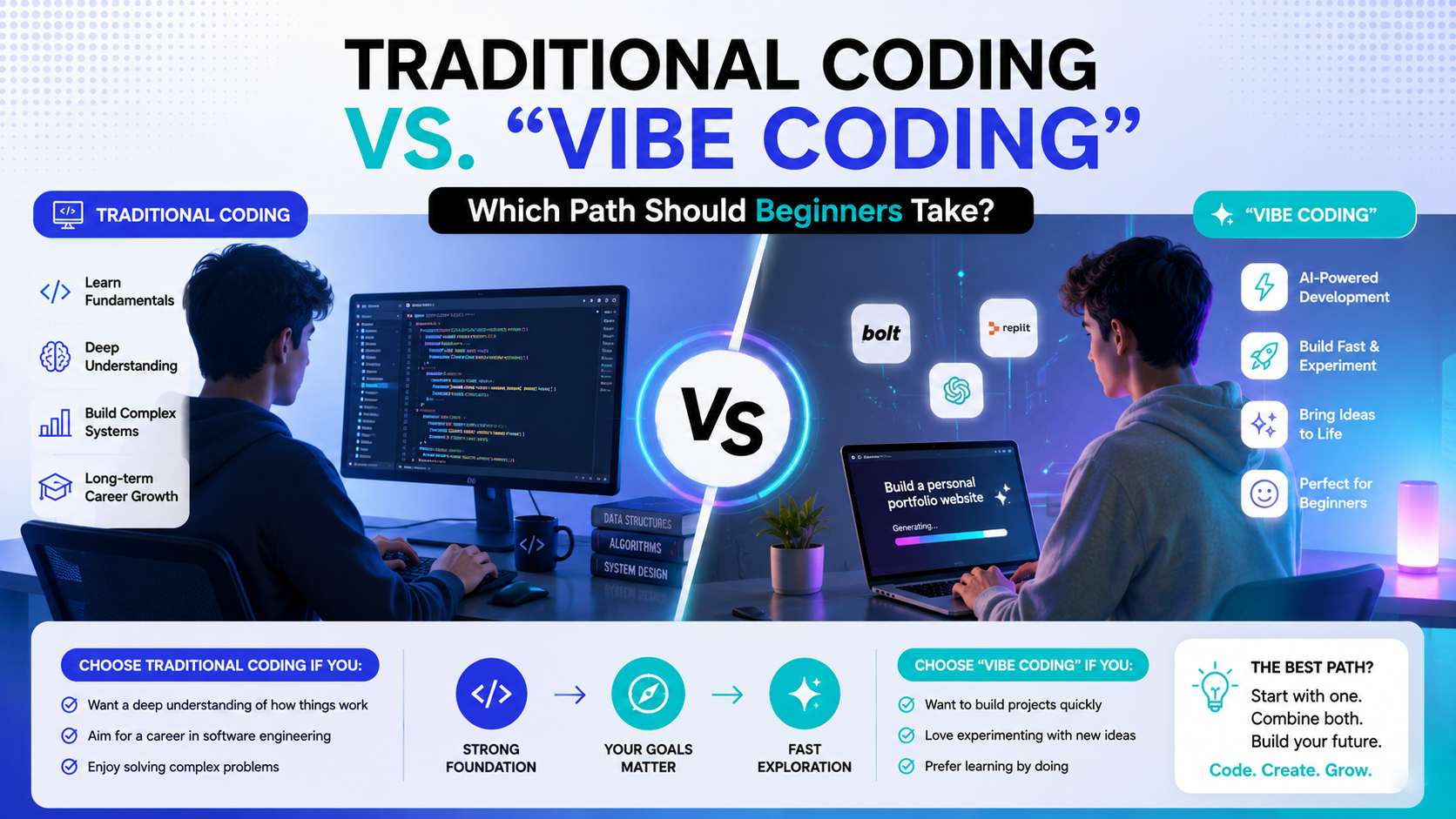
Imagine building a fully functional web application without writing a single line of syntax. You simply explain what you want in plain English, hit enter, and watch an artificial intelligence agent spin up the database, design the user interface, and deploy the application to the cloud. You are not manually managing memory arrays, resolving merge conflicts, or hunting down missing semicolons. Instead, you are guiding a highly sophisticated machine.
This is the reality of "Vibe Coding" a term coined within the tech community to describe the shift from manual programming to high-level system orchestration using generative AI tools.
But this new shift introduces a massive dilemma for individuals who are just entering the tech sector. If an AI can generate functional software architectures from a simple text prompt, is it still worth spending months learning variable scopes, loops, and data structures? When comparing traditional coding vs vibe coding, which methodology should someone who is learning to code prioritize?
This detailed guide breaks down both paradigms, maps out their core differences, and provides a clear roadmap for anyone navigating software development for beginners in this new era.
Defining the Contenders: What is Traditional Coding?
To appreciate the rise of AI-driven workflows, we must first look at how software has traditionally been built. Traditional programming requires a human engineer to explicitly translate logical solutions into language that computers can parse.
The Anatomy of the Traditional Developer
When you follow standard software engineering principles, you interact directly with computer logic. You must master the explicit rules of syntax, learn how different systems communicate, and debug execution runtime errors step-by-step.
- Granular Control: You control exactly how memory is handled, how data streams are processed, and how data structures scale.
- The Learning Curve: This path demands high cognitive investment. Beginners often spend weeks understanding fundamental concepts like arrays, object-oriented programming (OOP), asynchronous execution, and application programming interfaces (APIs).
- The Execution Style: Writing line-by-line code in an Integrated Development Environment (IDE), compiling code, reviewing console logs, and manually fixing execution exceptions.
Traditional coding builds structural thinking. It teaches you how computers process information, making it the bedrock of computer science academia for decades.
The New Frontier: What is "Vibe Coding"?
Vibe coding strips away the syntax layer. Instead of writing code directly, developers use advanced large language models (LLMs) and AI coding assistants as their primary engine. You don't write the script; you write the system requirements.
The Mechanics of "Vibing" with Machines
In a vibe coding environment, your primary language is natural speech, and your core technical skill shifts toward prompt engineering.
- Declaration Over Execution: Instead of figuring out how to build a user authentication loop, you declare: "Build a secure user registration form with JWT authentication and validate email inputs."
- Rapid Automated Prototyping: The AI engine instantly generates the backend controllers, styles the frontend, and runs automated testing suites.
- The Iterative Feedback Loop: If an error occurs, you copy the error message back into the AI or let the agent read its own terminal logs, prompting it to fix the issue on its own.
The term "vibe coding" implies that the developer is no longer deep in the weeds of syntax error tracking. You monitor the overarching architectural health, user experience, and product mechanics while letting the underlying machine handle the heavy lifting.
Traditional Coding vs Vibe Coding: A Head-to-Head Breakdown
For someone entering the world of tech, picking an approach dictates how you spend your learning hours. Let's compare these two structural styles across several performance metrics.
Feature / Metric | Traditional Coding | Vibe Coding |
Learning Curve | High; requires months of continuous daily syntax practice. | Low; relies on clear communication and logic. |
Development Speed | Moderate; restricted by manual typing and debugging times. | Hyper-fast; builds basic prototypes in minutes. |
System Visibility | Total; you know exactly why every single function exists. | Obscured; relies on code blocks generated by third-party AI frameworks. |
Debugging Complexity | Straightforward if you understand core runtime logic. | Difficult if the AI introduces subtle logical hallucinations. |
Required Skillsets | Computer science, data structures, specific language syntax. | System architecture, prompt engineering, product design. |
The Hidden Risks of Relying Exclusively on Vibe Coding
For a beginner, the allure of vibe coding is incredibly strong. Why spend three hours trying to understand a JavaScript asynchronous function when a copilot programming application can write it for you in three seconds? However, skipping the foundational steps creates structural vulnerabilities in your skillset.
1. The Danger of Silent Hallucinations
Generative AI models are predictive text systems, not deductive mathematical systems. This means they can generate code that looks clean and visually perfect but contains massive logical flaws, out-of-date library calls, or severe security holes. If you do not possess foundational skills, you will never be able to audit the security of the script the AI generates.
2. The "Debugging Wall"
What happens when your AI assistant gets stuck in a recursive loop, repeatedly generating code that fails to fix a critical system error? Without basic knowledge of software development for beginners, you will hit a metaphorical wall. You will be completely unable to read the terminal log, inspect the network requests, or step through the database queries to fix the underlying issue manually.
3. Lack of Problem-Solving Frameworks
Learning to program manually rewires how your brain processes complex problems. It forces you to break large, ambiguous concepts into tiny, executable instructions. Relying entirely on an AI assistant from day one prevents your brain from developing this essential analytical logic.
Why a Hybrid "Centaur" Model is the Best Move for Beginners
The debate between traditional coding vs vibe coding shouldn't be framed as a zero-sum game. The most successful modern developers do not pick one over the other; they integrate both methods into a unified workflow. This approach is known in the tech community as becoming a "Centaur" developer—half human intuition, half computer processing power.
Phase 1: Build the Core Foundation Manually
Before you rely on automated software builders, you must spend time learning the basics manually. Write basic functions, build static websites using pure HTML and CSS, and run simple scripts through your terminal. You need to understand how data moves across a network, how APIs fetch payloads, and how relational databases organize information.
Phase 2: Use AI Assistants as a Pair Programmer
Once you comprehend basic loops, objects, and HTTP methods, introduce AI coding assistants into your setup. Instead of allowing the AI to write your apps from scratch, use it to explain complex errors, optimize poorly written code blocks, or automate repetitive boilerplate architecture.
[The Ideal Hybrid Learning Path] │ ├── Step 1: Learn Core Computer Logic (No AI Assistance) │ ├── Step 2: Build Small Projects Manually to Solidify Syntax │ ├── Step 3: Introduce AI Tools to Automate Boilerplate Coding │ └── Step 4: Focus on System Architecture & Product Design
Phase 3: Transition to High-Level Orchestration
Once your technical baseline is secure, you can transition fully into rapid development modes. You can utilize prompt engineering to deploy entire features in minutes, using your core engineering principles to verify, secure, and refine the AI's output.
Preparing for the Future of Programming
The tech industry is evolving at breakneck speed. Junior developers who only know how to type basic syntax are being outpaced by those who know how to use AI to build complex applications in record time. Conversely, individuals who only know how to use AI prompts without understanding the underlying code find themselves unable to fix advanced technical errors or build scalable enterprise platforms.
To thrive in this environment, you must build an educational foundation that values both sides of the coin. Mastering system structures, digital logic, and analytical problem-solving prepares you to leverage any automation tool that emerges down the road.
If you want to stay competitive in this modern tech ecosystem, check out the immersive courses available at the Milaaj Digital Academy. By combining fundamental technical skills with modern, practical application strategies, you learn how to balance structural engineering concepts with cutting-edge tools.
Explore our comprehensive tech tracks and foundational toolsets on the main Milaaj Digital Academy Education Platform to build the technical resilience required to navigate the future of programming with absolute confidence.
Frequently Asked Questions (FAQs)
What exactly is "Vibe Coding"?
Vibe coding refers to a modern software development approach where a person relies primarily on generative AI models and automated tools to write, compile, and deploy software applications instead of writing syntax line-by-line manually.
Should beginners skip learning syntax and jump straight to vibe coding?
No. Skipping foundational coding principles leaves beginners vulnerable to AI errors and structural hallucinations. Without a solid understanding of basic programming principles, you will be unable to debug complex code errors when an AI tool fails.
Is traditional coding becoming obsolete?
Traditional coding is not becoming obsolete; rather, it is evolving. While human developers write less raw, repetitive code manually, deep knowledge of software architecture, security, database design, and algorithmic thinking remains critical to auditing and guiding AI engines.
How can I combine traditional coding vs vibe coding as a beginner?
The best approach is to learn foundational syntax and programming logic manually first. Once you understand how basic applications function under the hood, introduce AI assistants to help you write boilerplate structures, explain complex errors, and speed up your overall development timeline.