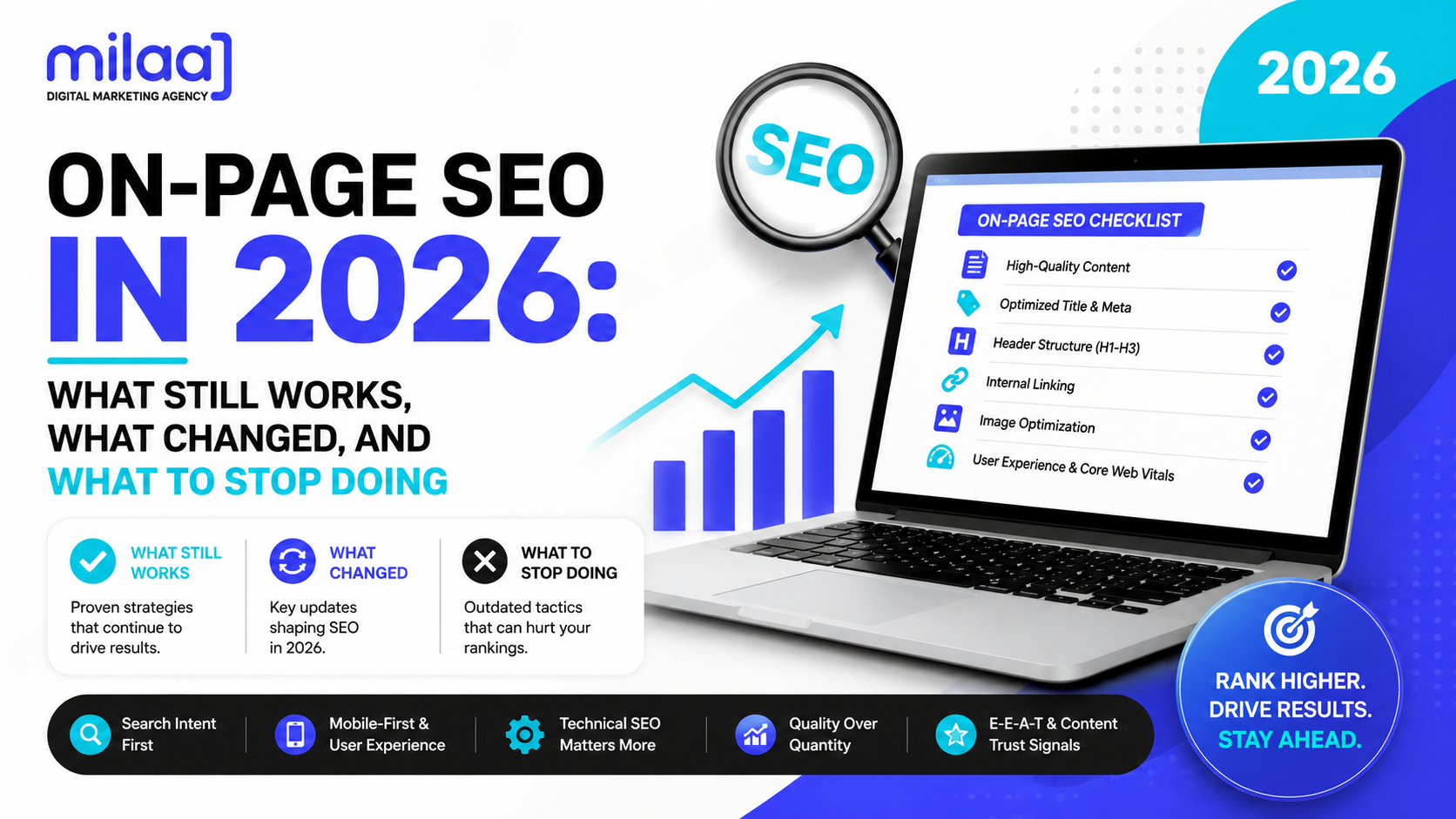
Search engine optimization evolved more over the past two years than in the previous decade.
With Google’s AI Overviews synthesizing search results, AI engines like Perplexity citing directly from web pages, and conversational search dictating user habits, on-page optimization looks fundamentally different today.
Static keyword placement no longer guarantees rankings. Instead, success depends on how effectively search engines and Large Language Models (LLMs) can extract, trust, and quote your content.
Here is your practical breakdown of on-page SEO in 2026: what still drives rankings, what changed in the era of AI, and what outdated tactics you must abandon immediately.
What Still Works: Core Fundamentals That Remain Critical
While search algorithms become more sophisticated, foundational user experience and structural signals remain essential for organic visibility.
1. Tight Alignment with Search Intent
Google prioritizes pages that fulfill user expectations immediately.
- Informational Queries: Deliver clear, accurate answers near the top of the page.
- Commercial Queries: Provide comparison tables, key metrics, and specs upfront.
- Transactional Queries: Keep layout conversion paths clear with minimal friction.
2. Strategic Heading Structure (H1, H2, H3)
A clean heading hierarchy organizes content for human readers and aids machine indexing. Use a single, descriptive H1 tag containing your target keyword. Break sub-topics into descriptive H2 and H3 subheadings that outline clear semantic relationships.
3. Contextual Internal Linking
Internal links distribute page equity across your site while helping search crawlers map your site's topical authority. Link related blog posts and service pages using descriptive, keyword-rich anchor text instead of generic phrases like "click here."
Building a career around modern search engines requires combining technical foundation, analytics, and performance optimization. Enrolling in a comprehensive digital marketing course provides practical experience running live campaigns, executing site audits, and analyzing user conversion paths.
What Changed: The 2026 AI and Semantic SEO Shift
Generative search engines transformed how content gets evaluated, indexed, and cited.
1. The "Answer-First" Content Block Architecture
AI Overviews and answer engines scan web pages for concise, extractable blocks of text.
- Position a direct, 40-to-60-word answer immediately below primary subheadings (H2 or H3).
- Expand on the topic afterward with detailed context, expert insights, and visual evidence.
❌ OUTDATED FORMAT: H2: What is On-Page SEO? [Paragraph 1]: In today's digital landscape, business growth depends on digital visibility... [Paragraph 2]: Search engine optimization has evolved over many decades... [Paragraph 3]: On-page SEO means...✅ 2026 "ANSWER-FIRST" FORMAT: H2: What is On-Page SEO? [Direct 45-Word Answer]: On-page SEO is the practice of optimizing individual web page elements—including HTML headers, content structure, schema markup, and internal links—to improve search engine visibility, user experience, and AI search citations. [Deep Explanatory Copy & Bulleted Lists Follow...]
2. Semantic Entity Coverage Over Keyword Frequency
Modern search engines process topics as web entities—interconnected concepts, places, people, and things. Instead of repeating your main phrase multiple times, cover semantically related LSI keywords and sub-topics naturally within the copy.
3. Structural Scannability (Tables and Lists)
AI models process structured data faster than dense prose. Present complex technical comparisons, step-by-step workflows, or product specifications using clean Markdown tables or bulleted lists.
[ Dense 4-Paragraph Copy ] ➔ Slow for AI processing ➔ Often Skipped [ Markdown Tables & Lists ] ➔ Fast Machine Extraction ➔ Cited in AI Overviews
To master advanced technical SEO, JSON-LD schema implementation, and AI Search optimization (GEO), taking a dedicated advanced SEO course builds the skills needed to rank websites in modern search environments.
What to Stop Doing: 5 Obsolete Tactics Hurting Your Rankings
Continuing to use outdated SEO practices can suppress your organic performance and reduce domain trust.
1. Stop Keyword Stuffing
Forcing keywords into sentences at artificial densities (3% to 5%) hurts readability and triggers webspam filters. Aim for a ~1% natural keyword density. Write primarily for human clarity, integrating primary terms and variations where they make sense contextually.
2. Stop Writing Fluff Introductions
Avoid starting articles with generic statements like "In today's fast-paced digital world..." Users and AI crawlers want direct answers immediately. State the purpose of your article in the first two sentences and move straight into actionable information.
3. Stop Publishing Unedited, Low-Quality AI Content
Publishing hundreds of unedited AI-generated posts without human editorial oversight damages site authority. Google’s quality algorithms identify and demote thin, repetitive content that lacks original insights or expert validation.
4. Stop Using Anonymous Author Bylines
Articles written on competitive topics require clear E-E-A-T signals. Attributing posts to generic tags like "Admin" or "Staff" harms credibility. Use real author profiles linked to verified credentials and Person schema markup.
5. Stop Creating Separate Pages for Micro-Variations
Avoid creating individual web pages for tiny keyword variations (e.g., creating separate posts for "on page seo tips" and "best on page seo tips"). Consolidate related sub-topics into comprehensive, single-page resources that cover a broader topic completely.
2026 On-Page Optimization Execution Matrix
Use this matrix during pre-publish audits:
Element | Modern Standard | Action Required |
Target Keyword Density | ~1% (Natural Placement) | Integrate naturally in title, H1, intro, and body |
Introductory Copy | Maximum 2-3 Sentences | Deliver direct value; avoid fluff openings |
Subheading Answers | 40-60 Word Direct Block | Position a concise summary directly under H2 headers |
Data Formatting | Tables & Bullet Points | Format comparative specs into structured Markdown tables |
Author Attribution | Real Person + Schema | Attach verified author bios with JSON-LD markup |
Internal Linking | 2-4 Contextual Links | Link relevant topic cluster pages using descriptive anchors |
Frequently Asked Questions (FAQs)
What is the ideal keyword density for on-page SEO in 2026?
A natural keyword density of approximately 1% is ideal. Focus on search intent, natural phrasing, and topical completeness rather than forcing specific keyword counts.
How long should blog posts be to rank in 2026?
There is no universal word count requirement. Pages should be as long as necessary to answer the user's intent completely. Short, direct answers work best for simple queries, while comprehensive guides (1,200 to 2,000+ words) suit broader topics.
Do meta tags still matter for on-page SEO?
Meta titles and meta descriptions remain critical. Meta titles act as direct ranking signals, while persuasive meta descriptions drive click-through rates (CTR) on traditional search engine result pages.
Conclusion: Adapt Your On-Page Strategy for Modern Search
On-page SEO in 2026 requires balancing human readability with structured data processing for search engine crawlers and AI models.
Align your content with search intent, format key answers for immediate extraction, consolidate thin pages into comprehensive guides, and eliminate outdated keyword-stuffing practices. Audit your top-performing web pages today, upgrade your heading structures, and secure your search presence.