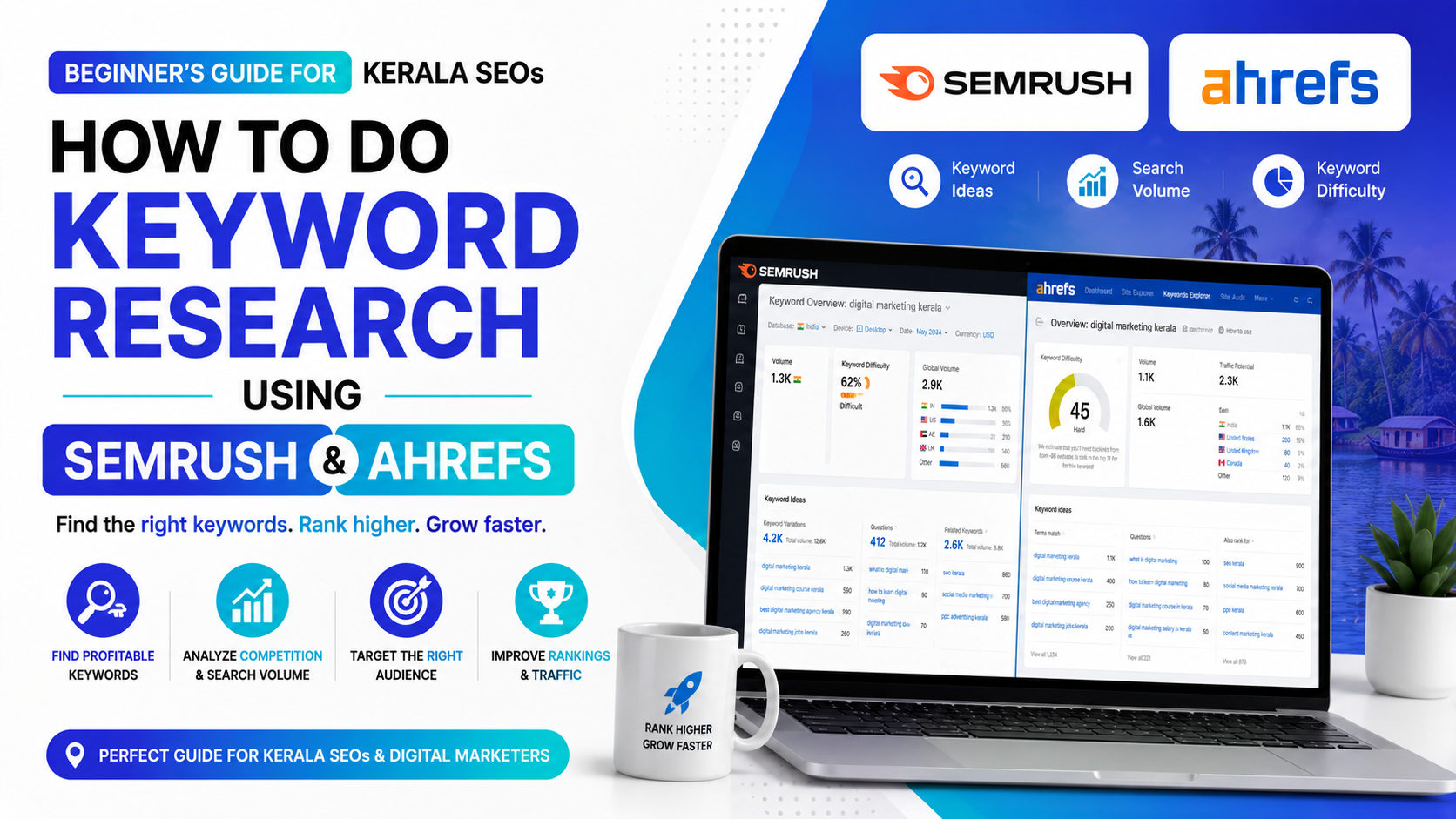
Keyword research remains the backbone of search engine optimization. Whether you are scaling an e-commerce platform in Kochi, offering digital services in Calicut, or managing international clients from Trivandrum, picking the right keywords determines whether your website generates revenue or sits invisible on page five.
However, performing keyword research in 2026 requires more than pulling basic search volumes. With Google AI Overviews and conversational search altering user behavior, SEO specialists in Kerala must combine data from industry-standard tools like SEMrush and Ahrefs with local search nuances.
This beginner-friendly guide breaks down exactly how to do keyword research using SEMrush and Ahrefs, tailored specifically for Kerala SEOs and digital marketers.
Understanding Search Intent Before Launching Tools
Before opening SEMrush or Ahrefs, categorize your target keywords by search intent. Search engines rank pages based on how accurately they satisfy the user's underlying goal.
Focusing purely on high-volume informational terms without mapping commercial intent leads to high web traffic with zero conversions.
How to Do Keyword Research Using SEMrush
SEMrush excels at granular location tracking, instant intent classification, and discovering dynamic search features.
Step 1: Discover Seed Keywords via Keyword Overview
- Open SEMrush and navigate to Keyword Overview.
- Enter your core topic (e.g., digital marketing course or ayurvedic resort).
- Set your target database to India (or switch to regional filters for localized campaigns).
- Review Search Volume, Keyword Difficulty (KD%), and Intent badges.
Step 2: Expand Your List with the Keyword Magic Tool
- Paste your seed keyword into the Keyword Magic Tool.
- Apply the Phrase Match or Related filters to generate hundreds of variations.
- Filter by KD % (0-29% for low competition) to find quick wins for new websites.
- Filter by Questions to identify long-tail informational queries ideal for blog content.
[ Seed: "SEO Course" ] ➔ [ Filter: KD < 30% ] ➔ [ Result: "SEO course in Kozhikode fee" ]
Step 3: Steal Competitor Terms via Keyword Gap
- Go to the Keyword Gap tool.
- Enter your website URL along with three top competitors in Kerala.
- Select Untapped or Missing keywords to reveal search terms your competitors rank for, but you miss entirely.
If you are starting out in digital marketing and want to master client-ready workflows using tools like SEMrush and GA4, enrolling in a practical digital marketing course gives you hands-on experience running live campaigns.
How to Do Keyword Research Using Ahrefs
Ahrefs provides unmatched backlink-driven keyword difficulty accuracy, click metrics, and parent topic grouping.
Step 1: Uncover High-Value Terms with Keywords Explorer
- Open Ahrefs and launch Keywords Explorer.
- Type your main phrases and select India as the target country.
- Check the Clicks and CPS (Clicks Per Search) metrics.
Step 2: Use the Parent Topic Feature to Avoid Keyword Cannibalization
Ahrefs automatically groups individual search queries under a Parent Topic. If three different long-tail variations share the same Parent Topic, target them all on a single comprehensive page rather than creating three thin, competing blog posts.
Step 3: Reverse-Engineer Competitor Success with Content Gap
- Paste a top competitor's domain into Site Explorer.
- Click on Organic Keywords to analyze their highest-traffic pages.
- Open the Content Gap tool, enter your direct rivals, and discover high-intent keywords missing from your site architecture.
To build deep skills across keyword grouping, technical site structure, schema markup, and Generative Engine Optimisation (GEO), taking a specialized advanced SEO course helps you transition from basic keyword research to advanced search strategy.
Localizing Keyword Research for the Kerala Market
Executing keyword research for Kerala brands requires handling localized language patterns, mixed English-Malayalam search terms (Manglish), and city-specific qualifiers.
- Include Regional Geotags: Combine core services with city names (Kochi, Kozhikode, Trivandrum, Malappuram). Search volumes may appear lower in tools, but conversion rates are significantly higher.
- Account for Manglish & Phrasing Differences: Indian users often search using distinct queries like "best resort near me low budget" or "laptop repair home service Al Barsha".
- Verify Search Intent on Local SERPs: Always manually search your target keyword in an incognito window set to India. Confirm whether Google displays local map packs, directory listings, or long-form blog posts before creating content.
Frequently Asked Questions (FAQs)
Which tool is better for beginners in Kerala: SEMrush or Ahrefs?
Both tools are industry leaders. SEMrush offers a broader suite for beginner marketers (including built-in social media and PPC tools), while Ahrefs provides superior backlink analysis and clean keyword grouping metrics.
How do I estimate keyword difficulty accurately?
Do not rely solely on tool metrics (KD). Always inspect the top 5 ranking pages on Google manually. If the top results feature high domain authority sites with exact-match titles and rich backlinks, ranking will prove difficult regardless of a low tool score.
What is the recommended keyword density in modern SEO?
Maintain a natural keyword density around 1%. Avoid stuffing search terms. Instead, focus on topical depth, semantic entities, and LSI keywords that satisfy user intent naturally.
Conclusion: Turn Keyword Research into Organic Growth
Learning how to do keyword research using SEMrush and Ahrefs gives Kerala SEOs and agency owners a decisive advantage. By combining SEMrush's keyword gap insights with Ahrefs' parent topic grouping, you can build data-driven content strategies that win top search rankings.
Start by identifying 5 low-competition, high-intent keywords in your niche today, optimize your site pages, and build your search visibility step-by-step.