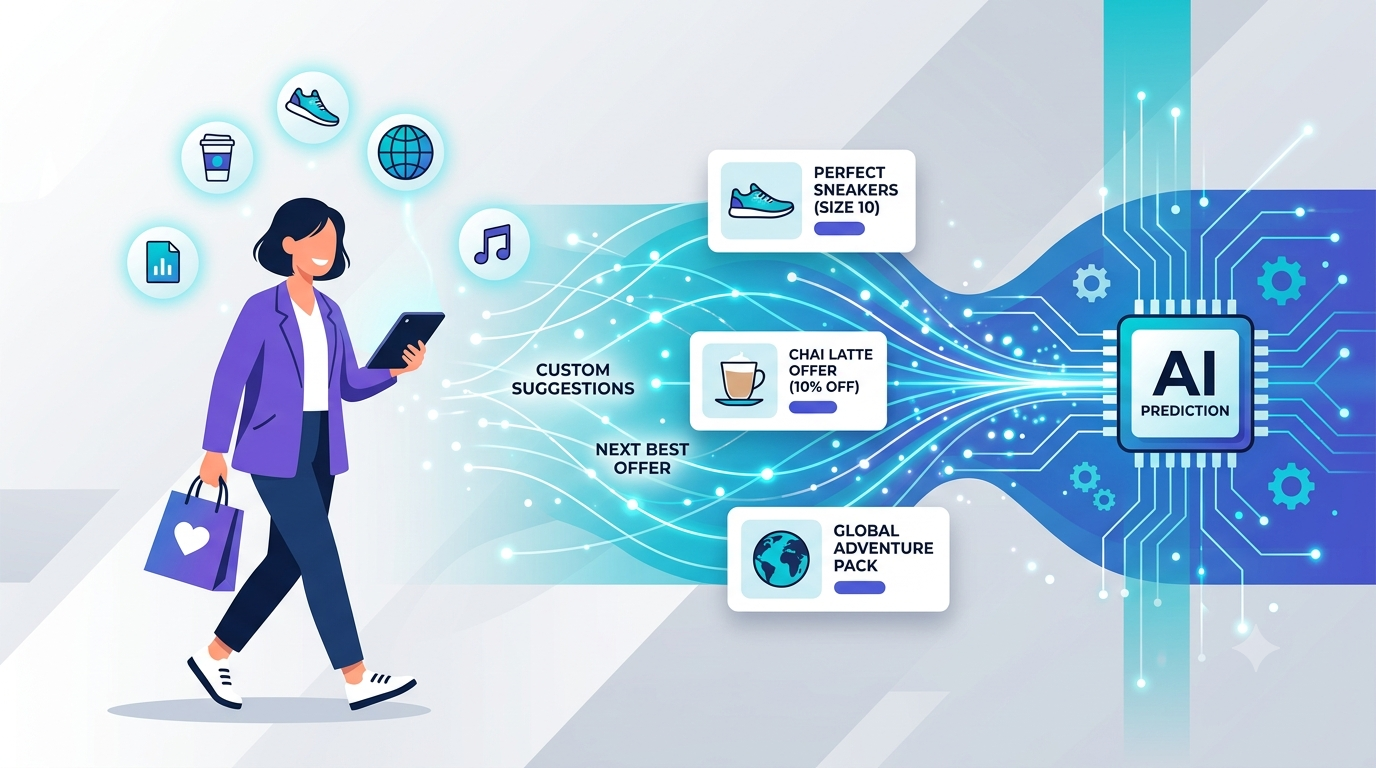
Have you ever opened an app and felt like it was reading your mind? You browse a streaming service, and the exact documentary you wanted to watch appears at the top of your screen. You check an online store, and it recommends a perfect pair of shoes matching a jacket you bought three weeks ago in a physical boutique.
This seamless experience is not magic. It is the result of advanced data infrastructure.
Modern brands no longer rely on broad consumer categories or static demographic lists. Instead, forward-thinking growth teams deploy cutting-edge data ecosystems powered by AI to predict what your customer wants with incredible accuracy. This paradigm shift, known as hyper-personalization, allows businesses to transform passive historical information into active, conversational, and individualized consumer journeys.
If your company still sends identical mass emails or generic product updates, you are falling behind. This comprehensive guide details the mechanics of hyper-personalization strategies and explains how to build predictive workflows that drive sustainable business growth.
Moving Past Basic Segmentation: What is Hyper-Personalization?
To understand how companies use artificial intelligence to anticipate consumer needs, we must define how this approach differs from traditional marketing tactics.
The Limits of Traditional Marketing Segmentation
Traditional segmentation groups consumers based on static traits. For example, a company might target "women aged 25 to 34 living in urban environments who enjoy fitness."
While this categorization provides a general starting point, it treats thousands of unique individuals as a single monolithic block. It assumes every consumer in that bracket behaves identically, ignoring real-time personal context, immediate problems, and shifting financial behaviors.
The Hyper-Personalization Evolution
Hyper-personalization ignores broad categories entirely. Instead, it looks at the individual consumer as their own separate segment. By leveraging a centralized database, advanced algorithms analyze a continuous stream of real-time behavioral data points to customize every touchpoint instantly.
How AI Predicts Complex Consumer Needs
Anticipating a consumer’s next choice requires a robust integration of data science and processing speed. The entire workflow relies on three core technical pillars.
1. Unified Customer Data Platforms (CDPs)
AI cannot operate effectively in isolation; it requires structured, cross-channel information to draw accurate conclusions. A Customer Data Platform pulls fragmented data points from every corner of your business—including website visits, mobile app interactions, physical point-of-sale transactions, and support ticket logs—into a single profile. This complete view ensures the predictive engine understands the entire history of the individual's interactions with your brand.
2. Predictive Analytics and Machine Learning
Once a CDP centralizes this data, machine learning customer behavior models analyze historical patterns to find hidden correlations. For instance, an algorithm might discover that customers who buy a specific software subscription usually seek an advanced analytics add-on exactly 45 days later.
By identifying these subtle behavioral patterns across millions of past customer interactions, the predictive framework can forecast the exact day a new user will need assistance or a product upgrade.
3. Real-Time Marketing Personalization Engines
Data analysis loses its value if your team can't act on it immediately. Real-time decision engines process incoming customer behavior instantly. If a user drops off a checkout page, the system evaluates their profile and immediately updates the website homepage banner or triggers a personalized mobile notification with an offer tailored precisely to their specific hesitation point.
Key Benefits of Predictive Personalization Frameworks
Shifting your digital ecosystem toward predictive modeling demands an investment in modern software architectures. However, the long-term returns consistently outperform traditional outreach efforts.
[Predictive Personalization Benefits] │ ├── Maximized Conversion Metrics (Relevant offers reduce checkout abandonment) │ ├── Extended Customer Lifetime Value (Anticipating needs builds deep brand loyalty) │ └── Optimized Advertising Spend (Budgets target highly qualified buyers)
- Maximized Conversion Metrics: Presenting a user with the exact solution they need reduces search friction, eliminates decision fatigue, and significantly lowers checkout abandonment rates.
- Extended Customer Lifetime Value (LTV): When a brand consistently anticipates a consumer's challenges and provides timely solutions, it builds deep brand loyalty. Customers stop shopping around because your digital platform handles their needs effortlessly.
- Optimized Advertising Spend: Instead of wasting capital running broad retargeting ads to unengaged audiences, predictive modeling tells you exactly which users are closest to making a purchase, allowing you to allocate your ad budgets precisely.
Step-by-Step Guide to Launching Hyper-Personalized Systems
Transitioning your marketing operation from static campaigns to an active, predictive system requires a structured implementation plan.
Step 1: Fix Data Fragmentations
You cannot build reliable predictive models if your website analytics, email marketing platforms, and sales CRMs run in isolated silos. Prioritize connecting your data streams using clean APIs or a dedicated CDP so your algorithms have a complete view of the user journey.
Step 2: Start with Targeted Behavioral Triggers
Do not attempt to automate your entire product line overnight. Start by applying predictive triggers to high-value points in your sales pipeline. For example, build an automated workflow that offers customized training resources to users whose platform activity drops below a specific baseline during their first week of onboarding.
Step 3: Continuously Audit Automated Systems
AI models require regular oversight to prevent algorithmic drift a situation where predictive models lose accuracy over time due to shifting market trends. Schedule routine audits to ensure your machine learning recommendations match current consumer preferences.
Balancing Predictive Analytics with Consumer Data Privacy
As hyper-personalization strategies become more powerful, managing data ethics and privacy compliance becomes paramount. Consumers want tailored digital interactions, but they also demand total control over their personal information.
Aligning your automated campaigns with modern global privacy standards avoids costly compliance fines and positions your organization as a trustworthy market leader. Embracing zero-party data—where users intentionally share their preferences through interactive quizzes or configuration forms—allows you to fuel your predictive algorithms safely without relying on intrusive tracking methods.
To master the technical balance between data architectures, predictive systems, and ethical deployment, consider exploring specialized professional training. You can build these high-demand skills through the comprehensive Milaaj Digital Academy AI-Based Digital Marketing Course, which bridges the gap between modern data strategy and practical campaign execution.
Learning how to navigate complex data frameworks ensures your business remains resilient as consumer expectations evolve. Discover our foundational courses and advanced tracks directly on the main Milaaj Digital Academy platform to learn how to turn data insights into long-term customer relationships.
Frequently Asked Questions (FAQs)
What is the difference between personalization and hyper-personalization?
Standard personalization uses basic information like adding a customer's first name to an email subject line. Hyper-personalization leverages real-time data streams, machine learning, and unified databases to alter the actual products, layouts, and messages a customer sees based on their unique behavior.
How can small businesses use AI to predict what customers want?
Small businesses do not need custom-built machine learning infrastructures. They can achieve predictive personalization by using modern SaaS marketing tools, accessible CRMs, and email software that feature built-in predictive analytics and behavioral automation engines.
What data does hyper-personalization rely on?
It relies on a combination of historical data (past invoices, support logs) and real-time behavioral data (current mouse movements, page scroll depth, active app sessions, and contextual features like local weather or device type).
How do privacy laws affect predictive marketing?
Regulations like GDPR and CCPA require brands to obtain clear, explicit consent before gathering or analyzing consumer data. Successful marketers adapt by using transparent collection methods and zero-party data to power their AI models safely.